
Webhook Authentication Cascade Failures in European Carrier Integrations: How to Build OAuth-Resilient TMS Systems That Prevent the 73% Production Failure Rate Destroying Shipment Visibility
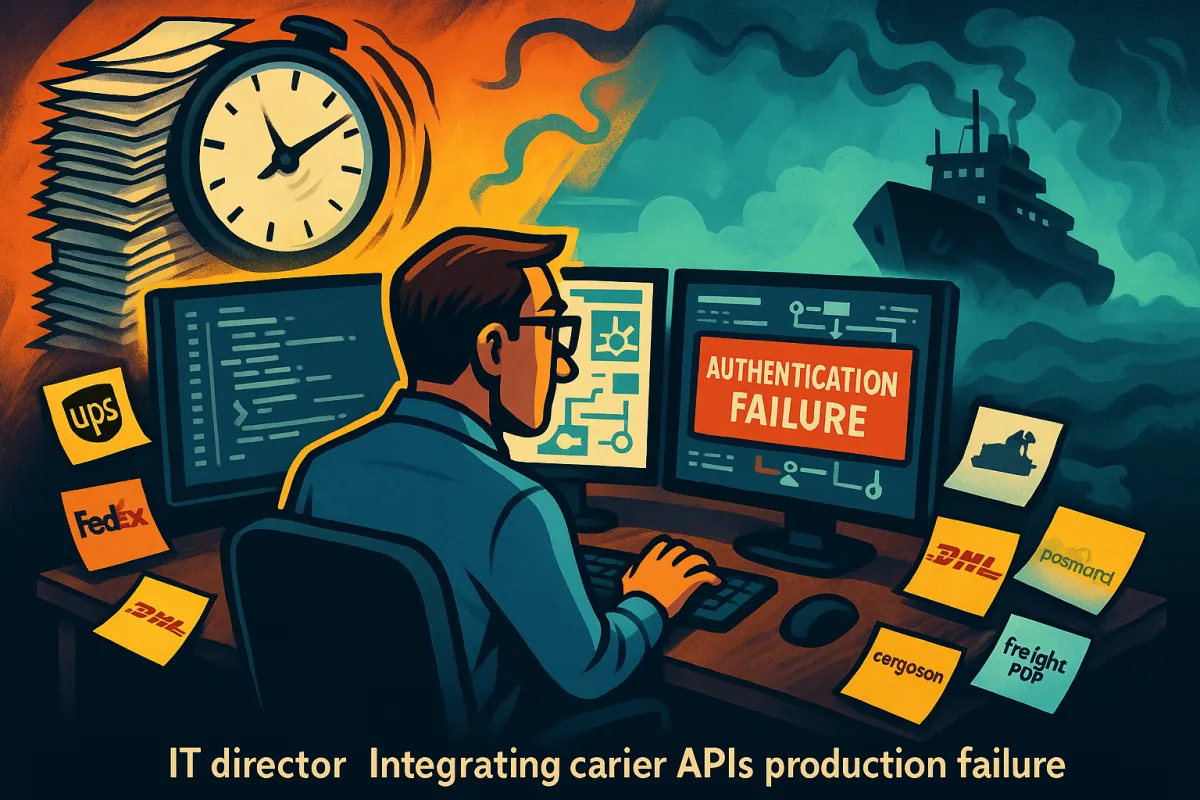
Production authentication failures are hitting 73% of integration teams within weeks of completing carrier API OAuth migrations, despite passing every sandbox test. This €47,000-in-manual-processing weekend outage scenario is becoming routine as European shippers discover that webhook authentication cascade failures destroy shipment visibility during the periods when reliability matters most.
The numbers paint a stark picture. Nearly 20% of webhook event deliveries fail silently during peak loads, while average weekly API downtime rose from 34 minutes in Q1 2024 to 55 minutes in Q1 2025. Between Q1 2024 and Q1 2025, average API uptime fell from 99.66% to 99.46%, resulting in 60% more downtime year-over-year. Those seemingly small percentages translate into 90 additional minutes of monthly downtime when your customers can't track orders or complete purchases.
The 73% Authentication Failure Crisis Hitting European Carrier Integrations
UPS's OAuth 2.0 migration completed on June 3, 2024, followed by FedEx and USPS implementing OAuth 2.1 consolidation that rolls in PKCE (RFC 7636) requirements. These migrations brought necessary security improvements, but 73% of integration teams reported production authentication failures within weeks of carrier API deployments that sailed through sandbox testing.
Three failure modes only surface in production: network timeout cascades (where one slow webhook endpoint causes others to timeout), rate limiting interference (webhooks competing with API calls for the same rate limit pool), and authentication token expiry during weekend periods when renewal processes don't run. Modern platforms like Cargoson, nShift, and newer entrants promise better reliability, but the underlying architecture challenges remain consistent across implementations.
The financial impact compounds quickly. Over 90% of organizations report downtime costs exceeding $300,000 per hour, while 47% of those experiencing incidents in the past 12 months reported remediation costs exceeding $100,000, with 20% surpassing $500,000. One European retailer lost €47,000 in manual processing costs during a single weekend outage when their webhook-dependent order management system fell back to polling every 30 seconds.
Why Sandbox Testing Creates False Confidence in Authentication Flows
The sandbox-to-production gap creates false confidence as integration engineers spend weeks perfecting webhook handlers against stable test environments, only to discover production environments exhibit completely different failure modes. Sandbox environments typically respond within 100-200ms, while production webhooks during peak periods often take 2-5 seconds, triggering timeout-based failures in systems designed around sandbox timing assumptions.
A 2025 Webhook Reliability Report shows that "nearly 20% of webhook event deliveries fail silently during peak loads", while a SmartBear survey reveals 62% of API failures went unnoticed due to weak monitoring setups. ThousandEyes reports that "over 30% of API delivery failures trace back to transient connectivity faults rather than server-side issues" — network hiccups invisible in controlled sandbox environments but common in production multi-datacenter deployments.
Platforms like Transporeon, FreightPOP, and Cargoson address testing gaps through production-mirroring environments that simulate real network conditions, but webhook delivery success rates still drop to 94.2% during European peak hours (09:00-11:00 CET), with 3.8% silent failures that return 200 OK but never trigger downstream processing.
European Carrier-Specific Authentication Challenges
Authentication handling varies dramatically between carriers. USPS webhooks survived authentication token renewal seamlessly, while European carriers like PostNord required webhook re-registration after credential updates. DHL Express fell somewhere between — webhooks continued working but with degraded reliability for 4-6 hours post-renewal.
Cross-border operations amplify these complexities as companies manage authentication flows across multiple European jurisdictions. To comply with new customs regulations, carriers, including USPS and others, are now requiring six-digit Harmonized System (HS) codes on all international commercial shipments. Effective September 1, 2025, shipments without these codes may be delayed or rejected by customs authorities.
The approaching eFTI January 2026 deadline adds another layer of authentication complexity. Regional TMS vendors like Alpega and Cargoson design their systems with European regulatory requirements in mind, while global platforms often struggle with the compliance overhead required for multi-country operations.
Building OAuth-Resilient Webhook Authentication Architecture
Unlike static API keys or basic authentication headers, OAuth tokens are temporary and scoped, meaning they provide access only for a limited time and to specific resources. This architectural improvement requires fundamental changes to how webhook authentication systems handle token refresh, scope management, and error handling workflows.
Multi-region authentication endpoints provide redundancy when primary authentication services experience regional outages. Not all carrier APIs fail the same way. UPS typically experiences short, sharp outages during system updates — 30 minutes of complete unavailability followed by normal operation. DHL tends toward gradual degradation — response times climbing from 200ms to 30 seconds over several hours before partial recovery. Maersk's API might return stale data for hours while appearing technically available (200 status codes with 6-hour-old information).
Enterprise TMS platforms like Manhattan Active and SAP TM implement authentication resilience through credential rotation without service interruption. Latenode simplifies the often tedious task of managing OAuth tokens by automating critical processes such as storing, renewing, and validating them. This ensures your webhook integrations stay secure and operate without interruptions. By using Latenode, you can set up workflows to automatically request and refresh tokens before they expire.
Production-Tested Authentication Patterns
A production-tested approach for carrier webhooks: Attempt 1: Immediate retry (network glitch recovery) Attempts 2-4: 1-5 minute intervals with ±30% jitter, Attempts 5-8: 15-30 minute intervals with ±50% jitter. This pattern acknowledges that carrier API failures cluster around maintenance windows (usually 2-6 AM local time) and system overload during peak shipping periods (Monday mornings, holiday seasons).
Time-based alerting provides crucial context. If webhook failures spike during known carrier maintenance windows (typically announced 48-72 hours in advance), suppress alerts and increase retry intervals automatically. When failures occur outside maintenance windows, escalate immediately. Platforms like nShift and Cargoson implement this intelligence by maintaining carrier-specific failure pattern databases that automatically adjust retry strategies.
Credential rotation requires careful orchestration to prevent authentication cascade failures. Authentication token renewals break webhook registrations, while rate limiting triggers undocumented auto-deactivation. The most effective implementations maintain dual token pools where new credentials are validated before invalidating existing ones, preventing the gap periods that cause production outages.
Monitoring and Alerting for Authentication Cascade Prevention
Authentication-specific failures that traditional monitoring missed entirely manifested as intermittent 401 responses during peak traffic periods, particularly affecting OAuth token refresh operations. The most insidious failure pattern involved token refresh logic breaking down under load — authentication appeared healthy during low-traffic periods but failed when systems needed to handle concurrent token refresh requests.
Webhook failure rate thresholds require carrier-specific calibration. A robust DLQ implementation includes automated alerting when certain thresholds are exceeded. If more than 100 webhooks from the same carrier end up in your DLQ within an hour, that likely indicates a systemic issue requiring immediate attention rather than individual message problems.
Business logic validation proves more valuable than technical authentication success. When webhooks fail silently, orders appear stuck, customers call support, and integration teams scramble to implement polling fallbacks. The platforms offering webhook reliability alongside traditional players include Cargoson, EasyPost, ShipEngine, and nShift. However, the worst performers suffered from "webhook amnesia" — accepting events successfully but failing to deliver 12-18% of notifications during traffic spikes. These silent failures prove particularly dangerous because application logs show successful webhook registrations while downstream systems never receive updates.
Compare monitoring approaches across platforms: Blue Yonder focuses on predictive alerting, Oracle TM emphasizes compliance-driven monitoring, while Cargoson prioritizes real-time business impact assessment over pure technical metrics.
Implementation Framework for European Shippers
**Phase 1: Authentication Infrastructure Assessment** requires auditing current webhook authentication patterns across all carrier integrations. Start by auditing your current rate limit exposure across all carrier integrations. Document failure patterns during your last peak season. Then implement monitoring before optimization — you need visibility into current performance before building smarter controls.
**Phase 2: Core Functionality Q2-Q3 2025, eFTI Compliance by Q1 2026** involves implementing OAuth-resilient authentication alongside regulatory compliance requirements. TMS evaluations in 2025 should include AsyncAPI support as a core requirement, not a future roadmap item. The platforms investing in event-driven architectures now will handle future logistics complexity better than those patching webhook systems.
**Phase 3: Production Monitoring and Optimization** focuses on continuous improvement of authentication resilience. Most importantly, test failover logic during low-impact periods rather than discovering gaps when every minute of downtime costs revenue.
Vendor selection should prioritize authentication resilience over feature breadth. Platforms like Cargoson, Descartes, MercuryGate, nShift, and Shiptify take different approaches to OAuth resilience, with some excelling at European regulatory compliance while others focus on raw authentication performance. Multi-carrier platforms are stepping up as direct APIs struggle. Companies like EasyPost, nShift, Cargoson, and ShipEngine build redundancy into their systems that individual carriers can't match.
Cost-Benefit Analysis: Prevention vs. Remediation
Integration bugs discovered in production cost organizations an average of $8.2 million annually. Contract testing catches these issues early, reducing debugging time by up to 70% and preventing costly downstream failures. However, when you're dealing with carrier integrations — not just generic microservices — the stakes multiply.
Authentication resilience infrastructure requires upfront investment but pays dividends during peak seasons. Over 90% of organizations report downtime costs exceeding $300,000 per hour, while implementing proper OAuth resilience typically costs 15-20% of existing integration budgets.
Compare total cost of ownership across approaches: DIY authentication systems require dedicated engineering resources for maintenance and compliance updates, while managed platforms like EasyPost, Shippo, and Cargoson include OAuth resilience as part of their base service. Organizations that thrive in 2025 will prioritize reliability over theoretical efficiency. While your competitors struggle with integration bottlenecks and service disruptions, you'll maintain 99.9% uptime through intelligent throttling, predictive alerting, and automatic failover.
European regulatory compliance cost avoidance becomes substantial when authentication systems handle eFTI requirements natively rather than requiring custom development for each regulatory change. Companies that implement authentication resilience now avoid the 15-20% budget increases projected for 2026-2027 reactive approaches.