
Unified Carrier Integration APIs: How European Shippers Can Cut Multi-Carrier Connectivity Costs 60% During the 2026 API Migration Crisis
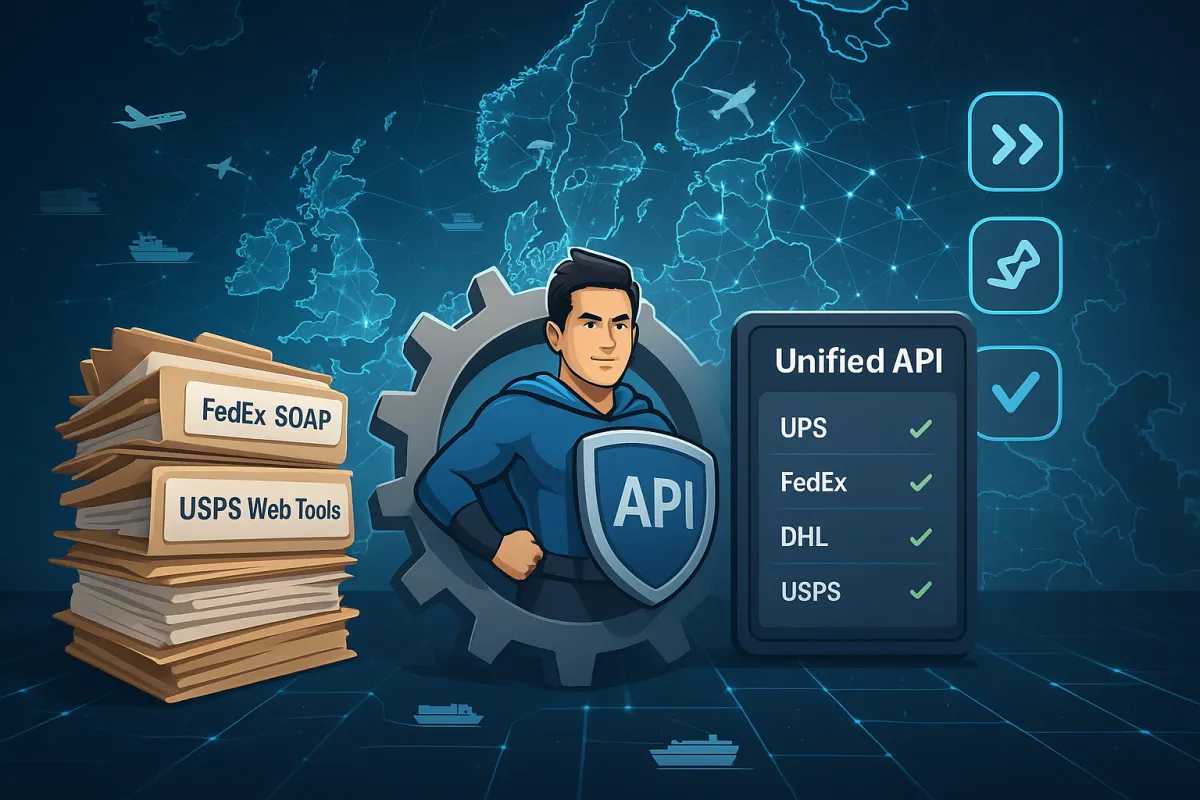
European shippers working with 20-30 regular carriers face a reality that procurement teams consistently underestimate: basic API integrations cost €5,000-€15,000, while complex ERP connections exceed €50,000. Add the pressure from USPS switching off Web Tools APIs in January 2026 and FedEx retiring SOAP-based endpoints in June 2026, and you have a perfect storm that's forcing European manufacturers to reconsider their entire approach to carrier connectivity.
While most companies struggle with one-by-one integrations that spiral into budget disasters, unified carrier integration APIs present a path to reduce tender cycle time from 72 hours to 8 hours and save 15 hours per week across transport teams. But understanding this opportunity requires looking beyond traditional procurement thinking toward infrastructure that can handle the complexity of European cross-border operations.
The €50,000 Per-Carrier Integration Crisis Hitting European Shippers
A German automotive parts manufacturer discovered their integration nightmare six months into an €800,000 TMS deployment. They found their European carriers couldn't integrate without costly custom development work - turning their "smart procurement decision" into a complete platform re-implementation. Sound familiar?
The numbers reveal why budget overruns hit 75% of European TMS implementations. Your carrier network complexity determines integration costs more than vendor pricing models, feature lists, or implementation timelines. Most European manufacturers work with 20-30 regular carriers but could benefit from access to 200-300 qualified providers, with each connection requiring testing, documentation, and ongoing maintenance that vendors don't include in their initial quotes.
Here's what catches most procurement teams off-guard: many carriers aren't willing or able to create API connections, and even when they are, they'll charge integration costs to you. When you multiply those costs across 10-15 integrations minimum for basic domestic shippers, potentially totaling 1,000-1,500 hours of labor, the financial reality becomes clear.
Carrier connectivity protocols vary dramatically by country. French carriers might use different API standards than German logistics providers, while Scandinavian forwarders often require specialized integration approaches. This fragmentation forces European shippers into expensive custom development cycles that traditional budgeting simply doesn't account for.
2026 Carrier API Retirement Deadlines: The Perfect Storm
The timeline for major carrier API migrations has accelerated beyond what most integration teams anticipated. FedEx Web Services (SOAP) will be retired on June 1, 2026, while remaining SOAP-based endpoints will be fully retired, requiring integrations to use FedEx's REST APIs for rates, labels, tracking, and future service updates. USPS is switching off the last of its Web Tools APIs (Version 3) in January 2026, with all merchants and solution providers needing to migrate integrations to the new USPS APIs by this date.
UPS completed their OAuth 2.1 migration on January 15, 2025, yet by February 3rd, 73% of integration teams reported production authentication failures. This pattern reveals the complexity European operations face when managing authentication across multiple carriers simultaneously.
The consolidation happening alongside these migrations creates additional pressure. Enterprise TMS platforms like Cargoson, Manhattan Associates, and SAP TM have already implemented FedEx REST endpoints and are managing dual-API operations for clients during the transition period. Meanwhile, companies using traditional one-by-one integration approaches face mounting technical debt from supporting both legacy and modern endpoints.
Why Traditional One-by-One Integration Approaches Are Failing
The "long pole of the tent" of implementation time, and therefore cost, resides in the design, build, and testing of integrations. Each carrier connection demands specialized knowledge of their data formats, authentication requirements, and business logic - expertise that becomes obsolete the moment they update their APIs.
The UPS, USPS, and FedEx transitions highlight the new reality: carrier APIs don't stand still. Even after these migrations are complete, carriers will continue updating pricing logic, delivery data, security requirements, and services. Your integration team either dedicates ongoing resources to maintenance, or your connections gradually break down as carriers evolve their platforms.
The Unified API Solution: Learning from DCSA Container Shipping Standards
The container shipping industry provides a compelling model for how standardized APIs can solve multi-carrier integration complexity. DCSA develops standards to establish a common framework within the container shipping industry. These standards promote interoperability and efficiency, facilitating seamless communication and collaboration among various stakeholders.
The DCSA VGM Standard introduces a unified API for real-time submission, validation, and exchange of verified container weight information across shippers, carriers, terminals and other parties involved. Built on DCSA's data model, it enables carriers and their customers to make a transition to the APIs-based VGM submission for better data quality, automation, and integration.
What makes this relevant for European shippers? DCSA and its member carriers have published track and trace standards comprising a common set of processes as well as data and interface standards that can be implemented by carriers, shippers and third parties to enable cross-carrier shipment tracking. Once implemented, the standards will enable customers and supply chain participants to digitally communicate with all carriers in a unified way.
This standardization approach directly addresses the fragmentation European manufacturers face when working with multiple transport providers. Standards enable digital interoperability between carriers, ports, container terminals, shippers, freight forwarders, feeders and technology providers while increasing efficiency and reliability through data harmonisation.
Unified Carrier Integration Platforms: Architecture and Cost Benefits
Unified APIs solve the carrier complexity problem by abstracting different carrier requirements into a single interface. These are direct integrations with carriers: FedEx, UPS, USPS, DHL, Canada Post. They are low-level, inconsistent, and rarely used directly by SaaS teams. Examples: EasyPost, Shippo, ShipEngine, Sendcloud. These platforms: connect to multiple carriers, generate labels, provide rate shopping, expose tracking.
APIs like FedEx, UPS, USPS, DHL, and aggregator platforms like Shippo and ShipStation all behave differently. FedEx, UPS, USPS, DHL, Shippo, ShipStation—each exposes different APIs, different assumptions, and different levels of event support. Tracking updates arrive inconsistently. Labels trigger irreversible actions. Some systems don't even support list endpoints.
The architecture difference matters for European operations. ShipEngine is designed for businesses of all sizes, especially those with high-volume shipping needs. One of ShipEngine's unique selling points is its direct integration with major carriers such as FedEx, UPS, and USPS, allowing businesses to access discounted shipping rates. EasyPost is a developer-first shipping API offering connectivity to 100+ carriers, address verification, customs management, and returns all via a lightweight REST interface.
Modern European TMS platforms recognize this need. While many TMS solutions offer published APIs, carriers are often unwilling or unable to create connections themselves, and even when they can, they typically charge integration costs back to the shipper. Transporeon and nShift require carriers to implement standard EDI interfaces themselves, while Cargoson builds true API/EDI connections with carriers rather than requiring standardized EDI messages that carriers must implement.
Implementation Framework: 4-Phase Approach for European Shippers
Success with unified carrier integration requires a structured approach that accounts for European regulatory complexity and cross-border operational requirements.
Phase 1: Current State Assessment and Carrier Audit (Q2 2025)
Catalog your existing carrier relationships, integration methods, and data flows. European shippers face even steeper odds due to cross-border complexities that don't exist in single-market implementations. Currency handling, language localization, and varying documentation standards compound integration complexity beyond simple domestic operations. Document which carriers use EDI, API, or manual processes, and identify integration maintenance costs you're currently absorbing.
Phase 2: Unified API Platform Selection (Q3 2025)
Evaluate platforms based on European carrier coverage and regulatory compliance capabilities. Modern European TMS platforms like Cargoson, nShift, Alpega, and Transporeon focus specifically on European cross-border requirements, while global solutions like Oracle TM and SAP TM often require extensive customization for European operations. Modern TMS platforms prioritize RESTful APIs with standardized data formats.
Phase 3: Pilot Implementation with Key Carriers (Q4 2025)
Build phased implementation strategies that validate core functionality before adding complex integrations. Start with core functionality in Q2-Q3 2025, activate AI features in Q4 2025, and ensure eFTI compliance by Q1 2026. Focus on your top 5-7 carrier relationships to prove the unified approach works within your operational environment.
Phase 4: Full Rollout and Legacy System Retirement (Q1-Q2 2026)
Phased implementation structures protect against vendor consolidation disruption: 90-Day Quick Wins with basic functionality deployment, 6-Month Core Functionality with full transportation execution capabilities, and 12-Month Full Deployment including advanced analytics and complete carrier network integration.
Cost-Benefit Analysis: 60-75% Integration Savings Potential
The financial case for unified APIs becomes clear when you compare traditional versus integrated approaches.
Traditional Approach: €5,000-€50,000 × 25 carriers = €125,000-€1,250,000 in integration costs, plus ongoing maintenance, testing, and update expenses that typically add 20-30% annually.
Unified API Approach: Platform subscription fees (typically €2,000-€15,000 monthly) plus implementation costs (€25,000-€75,000) plus per-transaction fees (€0.05-€0.50 per label). The framework includes base licensing (typically 20-30% of total costs), implementation expenses (25-40%), carrier integration fees (15-25%), ongoing support and maintenance (10-15%), and capacity shortage contingencies (5-10% additional buffer).
The real savings emerge from reduced complexity. European operations often see 15-25% improvements in transport administrative efficiency within the first year of successful TMS data integration. These improvements come from reduced manual data entry, automated compliance reporting, and enhanced visibility across transport networks.
Shippo has a simple setup and affordable plans, which can be a great choice for businesses looking for a reliable multi-carrier shipping solution without paying high costs. For many small store owners, Shippo provides a faster and more flexible compared to ShipStation, especially if you're just starting a new business and need a more budget-friendly solution.
Vendor Selection: Evaluating Unified Carrier Integration Platforms
Platform selection should prioritize European operational requirements over global feature breadth. When evaluating vendors, consider Cargoson alongside traditional providers like MercuryGate, Descartes, and nShift. Solutions like Cargoson focus on European manufacturers, wholesalers, and retailers with direct API/EDI integrations across all transport modes, specifically addressing challenges that manufacturing, wholesale, and retail companies face.
Technical evaluation criteria should include real-time data capabilities. One of the standout features is its direct integration with numerous shipping carriers. This not only broadens the options but also provides access to discounted shipping rates, which can lead to significant cost savings. Look for platforms that offer pass-through architecture rather than cached data, especially for time-sensitive European operations.
Shippo acts as a shipping aggregator, offering access to 85+ carriers globally with pre-negotiated discounts. Its Shipping API and WooCommerce plugin automate label creation, customs documentation, and multi-carrier tracking, complete with real-time status webhooks. Shippo also provides robust analytics and an intuitive dashboard for operations teams.
European compliance capabilities represent another critical evaluation factor. Platforms should demonstrate eFTI readiness, GDPR compliance, and support for multi-country documentation requirements. Shippo APIs can be used to perform various tasks of the logistics process — from pre-dispatch to return. At the same time, it's fast, reliable, and GDPR compliant.
Future-Proofing Your Integration Strategy
The integration market continues evolving rapidly. This is where Unified Shipping APIs become valuable. Instead of building separate integrations for FedEx, UPS, USPS, DHL, Shippo, ShipStation, EasyPost, and others, a Unified API provides one interface across all shipping providers.
API-first integration strategies provide superior flexibility for European operations. Modern TMS platforms from providers like nShift, Transporeon, Alpega, and Cargoson prioritize RESTful APIs with standardized data formats. This approach enables rapid carrier onboarding, simplified compliance reporting, and easier adaptation to regulatory changes.
The shift toward unified approaches reflects broader industry recognition that carrier connectivity represents infrastructure, not competitive differentiation. The companies that survive 2026's migration crisis won't be the ones with perfect technical execution. They'll be the ones who recognized that carrier integrations are infrastructure, not features, and invested accordingly.
European manufacturers who implement unified carrier integration APIs position themselves to handle the ongoing complexity of cross-border operations while reducing the technical debt that cripples traditional integration approaches. The convergence of capacity shortages and vendor consolidation creates urgency, but rushed decisions amplify hidden costs and implementation risks. European shippers who act decisively within the next 90 days—with proper frameworks that account for both capacity and consolidation scenarios—position themselves to navigate 2026's perfect storm successfully.