
TMS ROI Calculation Guide: How European Shippers Can Quantify Hidden Carrier Connectivity Costs and Build Bulletproof Business Cases in 2025
A mid-sized German automotive parts manufacturer just discovered what an €800,000 TMS mistake looks like. Six months into implementation, they realized their North American-focused platform couldn't handle their complex carrier network across 12 countries without costly custom development. A German automotive parts manufacturer just learned what a €800,000 TMS implementation mistake looks like. They chose a North American-focused platform six months before discovering their primary carriers couldn't integrate without costly custom development.
This expensive lesson highlights why European shippers need bulletproof TMS ROI calculations that account for hidden carrier connectivity costs. The companies getting approval in 2025 are those showing CFOs exactly how their TMS investment delivers measurable business value from day one. Your TMS ROI calculation must go beyond simple freight cost savings to capture the full financial impact of modernizing transport operations.
The Hidden Cost Crisis in European Carrier Connectivity
European manufacturers are facing a perfect storm of carrier connectivity challenges. FedEx and UPS have decided to retire the APIs they've been using in favor of more advanced APIs technologies that are now available. As a result, many shippers will have to make a technological shift to continue integrating with FedEx and UPS. FedEx legacy Web Services Tracking, Address Validation, and Validate Postal Codes WSDLS will be disabled on August 31, 2024. The SOAP based FedEx Web Services is in development containment and has been replaced with FedEx RESTful APIs here on the FedEx Developer Portal.
These API migrations create immediate financial pressure on unprepared shippers. This Scheduled update would lead to significant technical disruptions and functionality loss. It includes the need to transition to new Restful APIs, rewrite existing integrations, possible downtime during migration, and adjustments to data structures and authentication methods. Companies using older SOAP or XML integrations face complete system rebuilds, not simple updates.
EDI integration challenges compound these problems. It can be expensive to implement and maintain, and the process of setting up EDI connections with new partners can be time-consuming. Additionally, EDI lacks the flexibility needed to adapt to the dynamic nature of modern supply chains. EDI integrations may take several months, whereas, API integrations can take a matter of weeks, if not days, and files may have complex formats requiring the labor of specialists.
Quantifying Manual Process Costs vs Automated Solutions
Manual transport tender processes consume far more resources than most companies track. A typical annual transport tender for a mid-sized European manufacturer involves 3-4 weeks of preparation, managing responses from 15-25 carriers, and another 2-3 weeks analyzing proposals. Your procurement team spends roughly 240 hours on a single tender event.
Calculate the real cost: 240 hours at €45 per hour for experienced logistics coordinators equals €10,800 per tender event. Most European manufacturers run 2-3 major tenders annually, plus quarterly spot market evaluations. The annual labor cost for manual tendering processes reaches €30,000-€35,000 before considering opportunity costs from delayed decision-making or suboptimal carrier selections.
Modern TMS platforms eliminate most of this manual work through automated tender management. Modern transport tender management through TMS platforms can reduce procurement cycle times by 60% while delivering measurable cost savings. Here's how to make the transition from spreadsheet-driven tendering to strategic digital procurement. The productivity gains alone justify significant portions of TMS investments.
The TMS ROI Calculation Framework for European Shippers
Your TMS business case needs concrete financial projections that CFOs can verify. A well-optimized TMS typically generates 15 to 25% kilometer savings, but these gains can vary from 5% on already well-optimized routes to 40% on historically poorly planned routes. In 2025, with an average cost of €0.45 per kilometer for a utility vehicle, each kilometer saved represents a direct measurable gain.
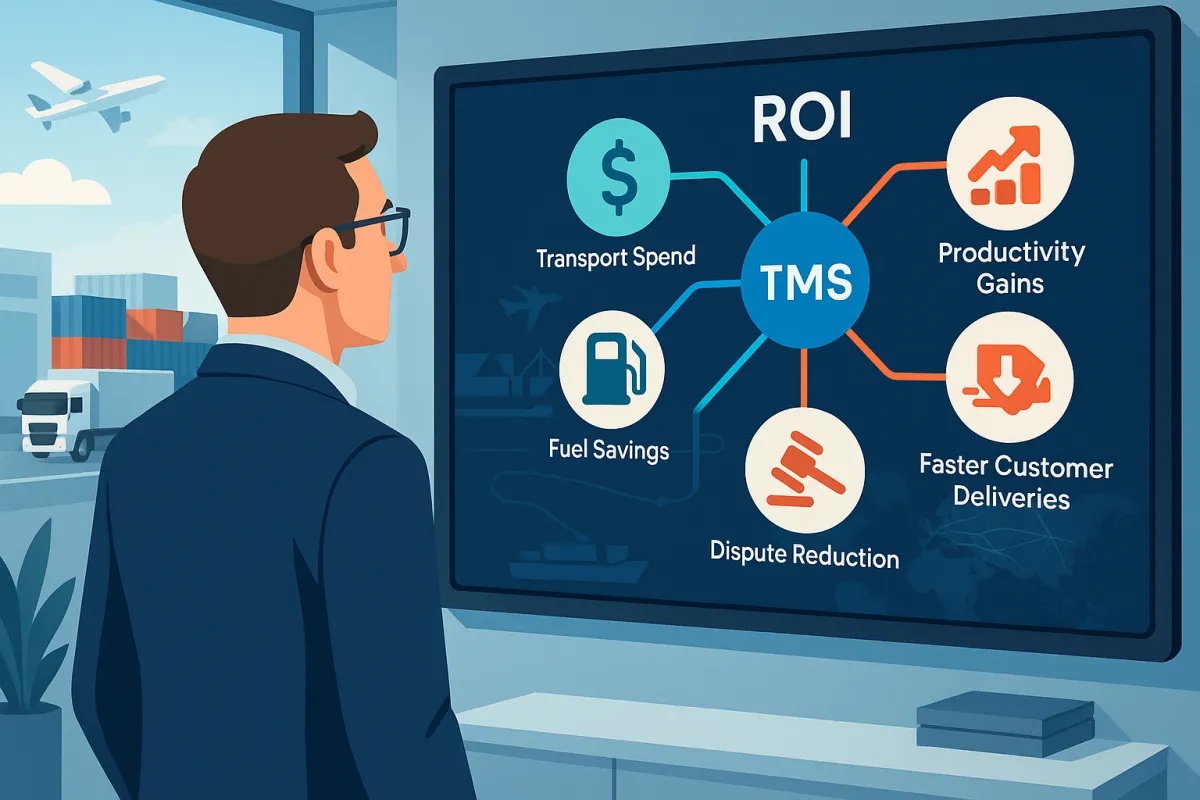
Start with this framework from a successful European manufacturer: A European manufacturer with €2M annual transport spend invests €200K in a TMS implementation. The annual gains break down to: €85K in fuel savings through route optimization (4.25% of transport spend) €120K in productivity gains from automated planning (equivalent to 1.5 FTE transport coordinators) €25K in dispute reduction through improved documentation · €50K in additional revenue from faster customer deliveries · Total annual benefit: €280K.
This delivers a 40% net ROI in year one, demonstrating how comprehensive cost accounting reveals TMS value beyond basic freight optimization.
Direct Cost Savings Categories
Freight management automation generates the most visible savings through multi-carrier rate comparison and route optimization. Through end-user conversations, Nucleus found that TMS can reduce transportation costs by 15 percent, decrease demurrage costs by 47 percent, decrease fuel usage by 12 percent, and improve load completion times by 50 percent. Nucleus found TMS can reduce transportation costs by 15 percent, decrease demurrage costs by 47 percent, and decrease fuel usage by 12 percent
Carrier contract management provides ongoing value through data-driven negotiations. Your TMS tracks actual performance metrics, delivery times, and service quality across carriers. This information becomes powerful leverage during annual contract renewals, typically delivering 3-7% additional rate reductions beyond market competitive pricing.
Audit automation eliminates the manual overhead of invoice matching and dispute resolution. Including technology and staff, how much does your organization spend on estimating freight cost per load, matching carrier invoices, approving disputes, and reconciling transportation costs to orders? European manufacturers report reducing freight audit staffing by 60-75% while improving accuracy and dispute resolution speed.
Hidden Benefits Often Missed in Business Cases
Disruption avoidance represents significant but hard-to-quantify value. When carriers face capacity constraints or service disruptions, TMS platforms with robust carrier networks automatically reroute shipments to backup providers. The cost of late deliveries, production delays, or customer satisfaction issues often exceeds annual TMS licensing fees.
Regulatory compliance value increases under European regulations. The eFTI regulation creates a compelling compliance argument for TMS investment. Instead of viewing regulatory requirements as additional cost, frame them as competitive advantage. Your business case should position the TMS as insurance against regulatory risk. Non-compliance costs include fines, delayed shipments at customs, and manual workarounds when paper processes fail.
Supply chain visibility enables proactive exception management. When systems can predict delays before they impact customers, the value shows up in retained business, reduced expediting costs, and improved customer satisfaction scores that translate to revenue protection.
Implementation Speed Impact on ROI Timing
Implementation speed matters for ROI timing. Cloud-native solutions like Cargoson report 6-12 weeks to value, while enterprise platforms like Blue Yonder might require 6-12 months. Factor this into your cash flow projections. The difference between 3-month and 12-month implementations changes your first-year ROI calculations significantly.
Cloud deployment advantages extend beyond implementation speed. Meanwhile, cloud deployment is expanding at 14.92% CAGR because it cuts capital costs and speeds implementation. Cloud-based TMS solutions are expected to register the fastest growth at 18.6% CAGR due to quick setup, low initial costs, and reduced hardware requirements.
API integration capabilities accelerate carrier onboarding. Cargoson offers direct API/EDI integrations with carriers across all transport modes, while Transporeon connects 150,000+ carriers but many integrations are standard EDIs or PDF/email transmissions rather than true API connections. True API connections reduce integration time from months to weeks, accelerating time-to-value.
Cash Flow Projections and Payback Periods
Cloud pricing models offer predictable cost structures for financial planning. Licensed TMS software runs $50,000-$400,000+ with annual maintenance charges ranging from 15-20% of license costs. Compare this to cloud solutions typically priced €1-4 per load processed, creating variable cost structures that scale with business growth.
Calculate break-even points using conservative projections. A European manufacturer processing 1,000 loads monthly with €2M annual transport spend could justify a €200K TMS investment through 10% transport cost reduction (€200K annually) plus 50% reduction in planning labor costs (additional €75K annually). Break-even occurs in 9 months with conservative 8% savings assumptions.
Include working capital impacts in your projections. Faster invoice processing and automated payment matching can reduce days sales outstanding by 5-10 days, freeing significant working capital for growing businesses.
Common ROI Calculation Mistakes European Shippers Make
The most expensive mistake is platform selection without regional carrier compatibility verification. A German automotive parts manufacturer just learned what a €800,000 TMS implementation mistake looks like. They chose a North American-focused platform six months before discovering their primary carriers couldn't integrate without costly custom development. This failure pattern repeats when companies prioritize feature lists over carrier ecosystem compatibility.
Vague operational benefits don't survive CFO scrutiny. Leaders now demand tangible proof before validating IT budgets, particularly in transport where margins are shrinking. This skepticism stems from recent experience. European manufacturers watched supply chain investments during 2020-2022 deliver mixed results. Your business case must include specific, measurable financial benefits with realistic timelines.
Underestimating implementation complexity leads to budget overruns and delayed ROI realization. Some TMS implementations took 18 months instead of 6. Others required expensive customizations not included in initial budgets. Conservative implementation timelines and comprehensive cost estimates prevent these failures.
Regional Considerations for European Market
European carrier landscapes require specialized connectivity approaches. According to IRU's 2024 driver shortage survey, there are 426,000 unfilled truck driver positions across Europe, while heavy goods vehicle registrations fell by 16% between Q1 2024 and Q1 2025. This capacity constraint makes carrier network breadth critical for European shippers.
eFTI regulation compliance adds quantifiable value to TMS investments. It could save the EU transport and logistics sector up to €1 billion per year. By creating common standards and making systems work together, eFTI paves the way for fully paperless transport in the EU. Early compliance through modern TMS platforms provides competitive advantage and regulatory risk mitigation.
Multi-country operations require platforms with comprehensive European carrier integration. Successful implementations across platforms including Cargoson, nShift, and Transporeon share this common trait: extensive pre-built carrier connections that eliminate custom integration costs.
Building Your TMS Business Case Template
Structure your business case using proven financial frameworks that CFOs understand. Start with current-state cost analysis across four categories: transportation execution, carrier management, administrative overhead, and opportunity costs from manual processes.
Successful implementations from Transporeon, Oracle TM, and Alpega share common traits: conservative ROI projections, comprehensive cost accounting, and realistic timelines. The difference lies in treating the TMS as a business investment, not a technology purchase.
Include contingency planning for implementation challenges. Budget 15-20% above initial estimates for unexpected integration requirements, data migration issues, or extended testing periods. Conservative projections that deliver exceed expectations generate confidence in future technology investments.
Model different vendor scenarios with realistic cost comparisons. Cloud-native solutions like Cargoson, established platforms like MercuryGate, and European specialists like nShift offer different cost structures, implementation timelines, and ongoing support requirements. Your business case should compare total cost of ownership across 3-5 year periods.
Measuring and Reporting ROI Post-Implementation
Establish baseline measurements before implementation begins. Document current transport costs, processing times, carrier performance metrics, and administrative overhead. These benchmarks become the foundation for ROI validation.
Create automated reporting that tracks key performance indicators monthly. Monitor freight cost per kilometer, carrier performance scores, processing time reductions, and exception management efficiency. Quarterly ROI reports demonstrate ongoing value and justify additional TMS modules or integrations.
Document soft benefits that become quantifiable over time. Customer satisfaction improvements, employee productivity gains, and strategic flexibility often exceed initial projections but require consistent measurement to capture their financial impact.
Your next step: Use this framework to build your business case, but customize it for your specific situation. Include your actual transport data, realistic benchmarks for your industry, and vendor options that match your technical requirements. The companies getting approval in 2025 are those showing CFOs exactly how their TMS investment delivers measurable business value from day one.