
The €800K TMS Implementation Mistake: How European Shippers Can Calculate Hidden Carrier Integration Costs Before Vendor Consolidation Destroys Their Budgets
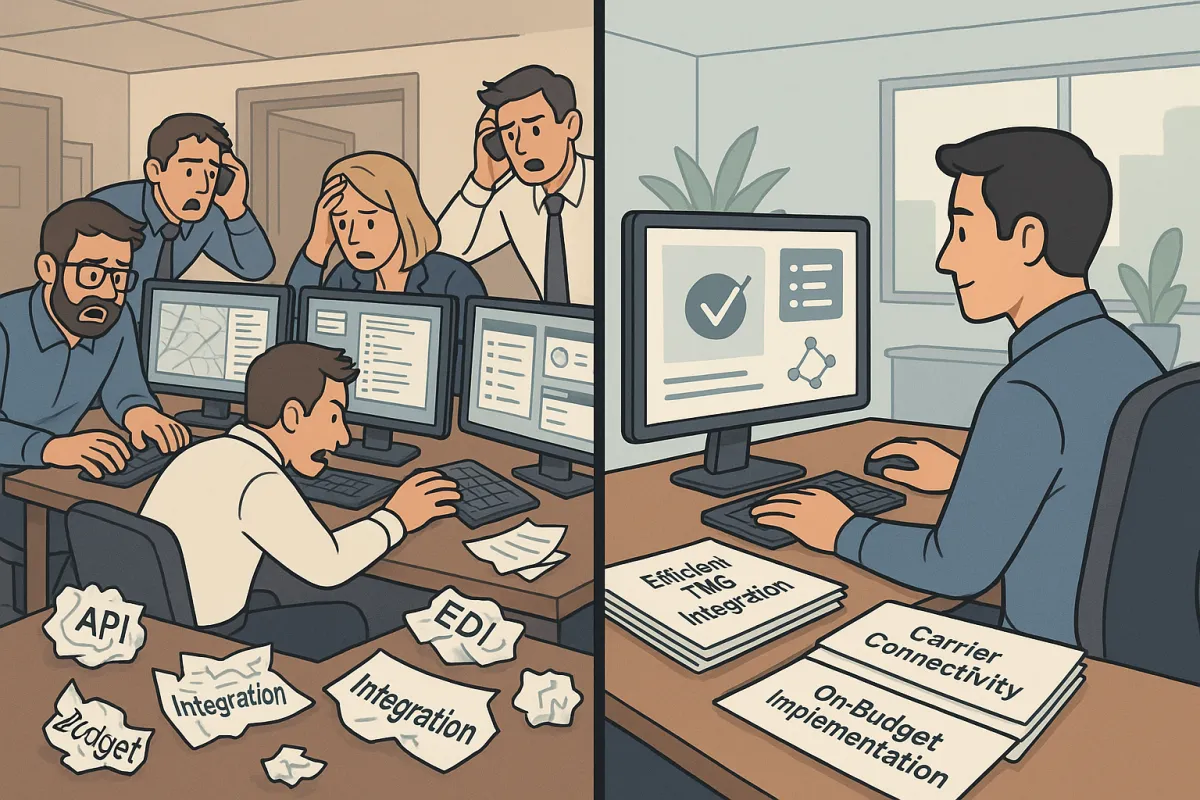
A German automotive parts manufacturer discovered their €800,000 TMS implementation mistake the hard way. Six months into deployment, they found their European carriers couldn't integrate without costly custom development work - turning their "smart procurement decision" into a complete platform re-implementation. Sound familiar? Budget overruns hit 75% of European TMS implementations, yet most shippers focus only on subscription costs when evaluating systems.
You're facing an unprecedented convergence: WiseTech Global's $2.1 billion acquisition of E2open and Descartes Systems Group's acquisition of 3GTMS for USD 115 million in March 2025 signal the most significant vendor consolidation wave in TMS market history. Meanwhile, hidden costs in TMS procurement consistently add 25-30% more than initial estimates, turning what looked like smart investments into budget disasters. This guide breaks down exactly where those hidden costs emerge and provides a bulletproof framework to avoid the budget disasters hitting three-quarters of European TMS projects.
The €800,000 Wake-Up Call: Why 76% of European TMS Projects Exceed Budget
The German automotive manufacturer's story reveals the core problem with European TMS implementations. European shippers consistently underestimate TMS implementation costs because they conflate software subscription fees with total project expense. The "long pole of the tent" of implementation time, and therefore cost, resides in the design, build, and testing of integrations. Adding regulatory compliance requirements to already complex integrations multiplies both risk and cost exponentially.
According to the Standish Group's CHAOS 2020 report, 66% of technology projects end in partial or total failure, with McKinsey research showing that 17% of large IT projects threaten the very existence of the company. The vendor consolidation happening now makes these statistics even more concerning. WiseTech's acquisition of e2open for $3.30 per share in cash equating to an enterprise value of $2.1 billion marks the largest TMS industry acquisition to date, while Descartes Systems Group has acquired Columbus, Ohio-based 3Gtms for $115 million USD in cash, reshaping vendor options for European buyers.
Consider how this consolidation extends integration timelines. Product roadmap uncertainties are already surfacing. When two TMS platforms merge, customers inevitably face decisions about which system to standardize on, what features will be deprecated, and how long dual support will continue.
The 7 Hidden Cost Categories That Catch European Shippers Off-Guard
Implementation costs range from €30,000 to €900,000, and for shippers with freight spend exceeding $250M annually, implementation can cost 2-3 times the subscription fee. Here's where those costs actually emerge:
Implementation Services (25-40% of total cost): Cloud TMS implementations often conclude within eight weeks, compared to 6-18 months for traditional systems. But even cloud implementations require extensive configuration for European cross-border operations. Project managers, solution architects, and integration specialists don't come free.
System Customization and Training (10-20%): European regulatory requirements demand customizations that North American-focused vendors rarely include in base packages. The purchase and installation of a tachograph costs about 1,000 euros without installation, while companies need to issue driver cards and company cards, train staff, and update internal procedures and data reading software.
Regulatory Compliance Preparation: From July 1, 2026, vans weighing 2.5-3.5 tons performing international transport of goods will be subject to the obligation to use second-generation smart tachographs (G2V2). Plan for 15-20% budget increases in 2026-2027 if reactive, or 8-12% if proactive with proper contract protection.
Hidden Licensing Fees: Additional fees cover third-party application integration, such as SMC or PC Miler license costs. Vendors don't always disclose these upfront.
Carrier Integration: The Biggest Budget Killer for Cross-Border Operations
Carrier integration represents the biggest hidden cost category for European shippers. Basic API integrations cost €5,000-€15,000, while complex ERP connections exceed €50,000. Basic API integrations cost €5,000-€15,000, while complex ERP connections exceed €50,000. A basic domestic shipper requires 10-15 integrations minimum, potentially totaling 1,000-1,500 hours of labor.
Most European manufacturers work with 20-30 regular carriers but could benefit from access to 200-300 qualified providers. Each connection creates ongoing maintenance requirements. The financial and resource implications of building integrations are significant. Developing and maintaining a single integration can cost up to $50,000 per year. However, this figure doesn't account for the opportunity costs involved. Allocating developers to work on integrations means those resources are not available to focus on your core product, thereby reducing your product velocity.
Each connection requires testing, documentation, and ongoing maintenance that vendors don't include in their initial quotes. European manufacturers face particular challenges because cross-border operations multiply integration complexity. If you manage a custom-built site or a site built on a highly customizable platform like Magento, you may face ongoing development work, testing, and redeployments as carriers make changes to their API integrations.
How Vendor Consolidation Multiplies Integration Risks and Costs
Companies undergoing integration often experience 12-18 months of reduced innovation while they harmonize platforms and teams. The financial impact of integration disruptions often exceeds initial procurement budgets. Licensed TMS software runs $50,000-$400,000+ with annual maintenance charges ranging from 15-20% of license costs, with a 100-truck operation's initial $100,000 investment becoming $200,000+ in the first year when factoring in implementation, training, and infrastructure requirements. Vendor acquisitions compound these costs through forced migrations, system re-integrations, and compliance timeline pressures.
When your TMS vendor becomes an acquisition target, you inherit integration complexity without managing the project timeline. First, you lose control over technology roadmaps. For current e2open customers, the key question is whether WiseTech can maintain product investment and innovation while managing complex integration, with the main concern being whether innovation and product investment will be maintained during integration. Your feature requests get deprioritized as the new parent company focuses on platform consolidation rather than customer-specific enhancements.
The major consolidation players include established platforms like MercuryGate (now Infios), Descartes, E2open/WiseTech, Manhattan Active, Oracle TM, and SAP TM. European alternatives gaining market share include Alpega, nShift, Transporeon, and Cargoson, which focuses specifically on cross-border European operations.
The True Total Cost of Ownership Model for European TMS
Cloud TMS pricing ranges from $1.00 to $4.00 per freight load booked in the system, while licensed options demand significant upfront investment plus ongoing maintenance fees. Cloud economics work differently than traditional software models. For many European shippers, this translates to predictable monthly costs that scale with business growth rather than fixed infrastructure investments.
Base licensing represents only 20-30% of your total five-year investment. Here's the realistic breakdown:
- Implementation services: 25-40%
- Carrier integration: 15-25%
- Customization and training: 10-20%
- Ongoing support: 15-20%
A U.S.-based shipper using Kuebix achieved $2.2 million in logistics cost avoidance in one year—thanks to automated rate comparisons and real-time shipment tracking. The European equivalent would need to account for VAT implications and multi-currency operations, but the fundamental ROI drivers remain consistent. Modern Transportation implemented BeyondTrucks TMS across 20 terminals, leading to approximately $5 million in annual savings by minimizing invoice errors and optimizing asset utilization. That's €200,000 per terminal in verifiable cost avoidance.
Building a Bulletproof TMS Cost Framework Before Vendor Selection
European shippers who act decisively within the next 90 days—with proper frameworks that account for both capacity and consolidation scenarios—position themselves to navigate 2026's perfect storm successfully. Your framework needs five evaluation phases:
Vendor Financial Analysis: While WiseTech has demonstrated consistent profitability and growth, e2open has struggled with financial performance in recent years, reporting declining revenue and net losses in recent fiscal years. Furthermore, e2open's recent financial struggles—marked by a 70% share price decline over three years—raise questions about customer retention and the scalability of its BCO-focused tools.
European Compliance Verification: CBAM (Carbon Border Adjustment Mechanism) definitively applies from 2026 after the transitional phase ends. TMS platforms must integrate carbon reporting capabilities with customs documentation workflows. Vendors demonstrating integrated CBAM compliance show commitment to European market requirements beyond basic transport management.
Carrier Integration Assessment: Your carrier network complexity determines integration costs more than any other factor. Map your current carrier relationships, evaluate which require custom integrations, and identify pre-built connections available from different vendors.
TCO Modeling Over 5-7 Years: Your TCO calculator should include separate line items for eFTI compliance costs, whether built into transaction fees or charged separately. Factor in regulatory changes, expected carrier additions, and potential vendor acquisition impacts.
Protecting Your Investment: Contract Clauses That Survive Vendor Acquisitions
Standard TMS procurement contracts don't address vendor acquisition scenarios, leaving European shippers vulnerable to post-acquisition changes without recourse. Acquisition-resistant contracts require specific protections including 12-18 months advance notice for ownership changes, guaranteed functionality preservation for minimum periods, and migration assistance rights.
12-18 months advance notice requirements: Include specific clauses requiring 12-18 months advance notice of ownership changes, with automatic contract review rights triggered by acquisition announcements. This provides time to evaluate alternatives or negotiate protection.
Price protection during integration periods: Price protection clauses should lock pricing for 24 months following ownership changes, preventing immediate cost increases during integration periods. Acquisition-driven cost increases often exceed 20-30%.
Functionality guarantee provisions: Functionality guarantee clauses protect against feature deprecation common during platform consolidation. Specify that current functionality levels must be maintained for minimum periods, with migration assistance provided if features are discontinued.
Performance benchmark maintenance: Define specific uptime, response time, and integration performance standards that survive ownership changes. Include penalties for degraded performance during vendor transitions.
The TMS market will continue consolidating throughout 2026 and beyond. European shippers investing in acquisition-resistant vendor selection frameworks today position themselves to navigate this consolidation successfully, avoiding the integration failures and budget overruns that threaten 66% of technology projects. Your transport management software selection determines whether vendor consolidation becomes a competitive advantage or an expensive operational disruption.
Start building your bulletproof TMS cost framework now. The procurement window for 2026 compliance is narrowing, and companies that haven't initiated TMS selection processes by mid-2026 will find significantly fewer viable options as vendors focus resources on existing customer compliance rather than new client acquisition. Those who delay join the statistics of failed implementations that plague reactive procurement strategies.