
The €50,000+ Hidden Cost Trap: 7 TMS Implementation Expenses European Procurement Teams Miss Until It's Too Late
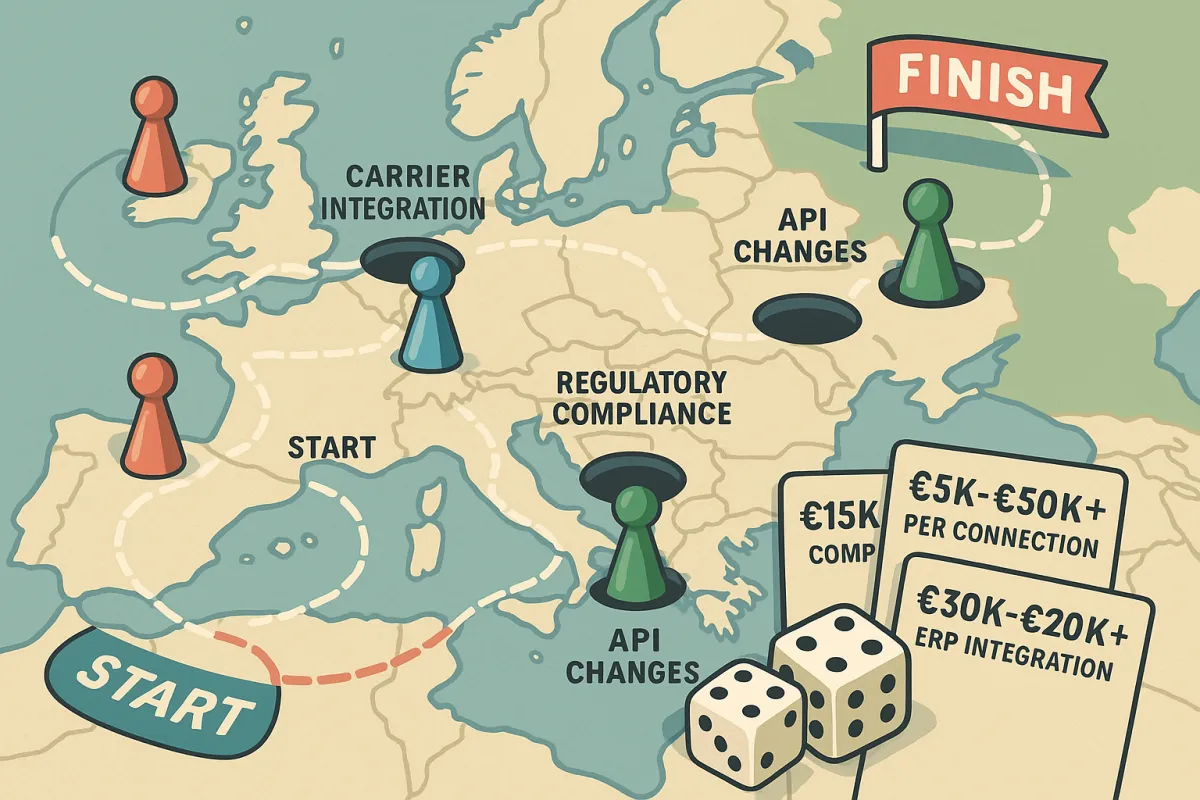
A German automotive manufacturer just paid €800,000 for a TMS that doesn't work. European shippers face a sobering reality: 66% of technology projects end in partial or total failure, while a German automotive parts manufacturer discovered their €800,000 TMS implementation mistake six months into deployment when they realized their new system couldn't handle their complex carrier network across 12 European countries.
This story isn't unique. A staggering 76% of logistics transformations never meet their budget, timeline, or performance targets, and hidden costs in TMS procurement consistently add 25-30% more than initial estimates, turning what looked like smart investments into budget disasters. While procurement teams focus on feature comparisons and license fees, budget overruns hit 75% of European TMS implementations.
The culprit isn't bad software or poor planning - it's systematic underestimation of hidden costs that blindside European procurement teams every time.
The European TMS Implementation Crisis: Why 75% Exceed Budget
Your TMS budget isn't just wrong - it's dangerously optimistic. Software license is typically only 20–25% of total cost of ownership—so "cheap" tools can still get expensive fast. While your CFO approves subscription costs, the real financial impact lives in implementation complexity, carrier integration charges, and ongoing maintenance expenses that vendors exclude from initial quotes.
The numbers tell the story. TMS implementation costs range from €30,000 to €900,000, depending on complexity and vendor approach. For shippers with freight spend exceeding $250M annually, implementation can cost 2-3 times the subscription fee.
European operations compound these challenges. Unlike single-market implementations in North America, European shippers operate across 27 different regulatory frameworks, each requiring specific data formats, reporting schedules, and compliance documentation. When Oracle TM or SAP TM promise "comprehensive European coverage," they mean their software runs in European data centers - not that they've solved cross-border integration complexity.
Modern solutions like Cargoson or nShift build specifically for European cross-border operations, while legacy platforms force you to customize around their North American-centric architectures.
Hidden Cost Category #1: Carrier Integration Reality (€5K-€50K+ Per Connection)
Vendors present carrier APIs as "included" functionality. Don't fall for it.
Basic API integrations cost €5,000-€15,000, while complex ERP connections exceed €50,000. Here's the reality check: many carriers aren't willing or able to create API connections, and even when they are, they'll charge integration costs to you.
A basic domestic shipper needs 10-15 integrations minimum, totaling 1,000-1,500 hours of labor, while most shippers today require an average of 40 integrations. European shippers working with 20-30 regular carriers face substantial connectivity expenses that vendors rarely discuss during initial demos.
Each connection requires testing, documentation, and ongoing maintenance that vendors exclude from initial quotes. When DHL changes their API specifications or UPS updates their authentication protocols, you pay for those modifications - not your TMS vendor.
Consider the complexity when your operations span multiple countries: German carriers use different EDI standards than French ones, Polish documentation requirements differ from Dutch customs processes, and Italian last-mile providers may still rely on fax communication.
Hidden Cost Category #2: Regulatory Compliance Integration (€15K-€100K+)
The 2026 regulatory convergence represents the most significant cost multiplier in European TMS history. These regulatory requirements multiply TMS implementation costs through mandatory integrations with government systems, telematics providers, and customs platforms.
Your integration budget needs separate line items for ICS2 connectivity, eFTI compliance capabilities, and Smart Tachograph data processing. Carriers and importers must integrate ERP and TMS systems with the ICS2 platform, with failure to report potentially resulting in a fine of up to 5,000 euros. With multiple daily shipments, non-compliance costs add up faster than implementation expenses.
Beyond eFTI, European shippers must navigate ICS2 customs requirements, EU ETS emissions reporting, and country-specific digital documentation standards. Each regulatory framework demands specific API connections, data validation rules, and reporting workflows that didn't exist in your original TMS specification.
European specialists like Alpega, nShift, and Cargoson build compliance capabilities directly into their platforms, while global vendors like Oracle TM and SAP TM charge separately for European regulatory modules that may not even exist yet for 2026 requirements.
Hidden Cost Category #3: ERP Integration Complexity (€30K-€200K+)
ERP integration represents the "long pole of the tent" in TMS implementations - and the most underestimated cost component.
Consequently, many interfaces between TMS and ERP systems require custom-developed transformations and processing. This technical reality explains why so many integration projects exceed budgets and timelines. ERP projects typically take 15–20 months to complete, with 75% of implementations exceeding their original timelines.
Your ERP system uses proprietary data tags that must be transformed before uploading to your TMS. SAP's IDOC formats differ from Oracle's XML structures, while legacy mainframe systems require completely custom integration layers. Each transformation point adds complexity, cost, and potential failure modes.
Hub-and-spoke versus point-to-point integration strategies create fundamentally different operational outcomes. Hub-and-spoke architectures centralize data transformation and business logic, simplifying compliance management and reducing maintenance overhead.
Modern TMS platforms prioritize API-first architectures that simplify ERP connections, while legacy systems force you through complex middleware layers that multiply licensing costs and maintenance requirements.
Hidden Cost Category #4: Implementation Services & Project Management (25-40% of Total Cost)
Subscription fees represent only 20-25% of total cost of ownership. Implementation services consume the largest budget allocation in successful TMS projects.
Consider these TCO components: base licensing (20-30% of total), implementation services (25-40%), carrier integration (15-25%), customization and training (10-20%), and ongoing support (15-20%). A basic domestic shipper requires 10-15 integrations minimum, potentially totaling 1,000-1,500 hours of labor.
Implementation team quality varies dramatically between vendors. Some ERP vendors delegate TMS implementation to external partners, potentially resulting in suboptimal configurations and extended timelines. Cargoson and other modern European TMS providers often include implementation support in their pricing models, contrasting with traditional enterprise vendors who separate these services.
Fixed-price implementation contracts protect against scope creep, but time-and-materials models often reflect actual complexity more accurately. When vendor consolidation happens mid-implementation, your project timeline extends while support resources get redistributed.
Hidden Cost Category #5: Change Management & Training (€10K-€50K+)
Training and change management across multiple European countries creates another substantial cost layer. Properly trained employees are key to maximizing the benefits of your TMS, with investing in comprehensive training preventing costly errors. A manufacturing company that fails to adequately train its workforce on the new TMS might experience production line disruptions, leading to delays and lost revenue.
European implementations face unique challenges: multiple languages, varying transport regulations across countries, and different operational workflows in each subsidiary. Your German operations team understands customs documentation that confuses your Polish logistics coordinators, while UK teams post-Brexit require completely different training modules.
Baseline functionality in 6-8 weeks is realistic. Full value realization (integrations, training, adoption, process change) takes 4-6 months minimum. Budget for ongoing training as carriers change their processes, regulations update, and your transport volumes scale.
Hidden Cost Category #6: Ongoing Support & Maintenance (15-20% Annual)
Licensed TMS models create expensive maintenance cycles that cloud solutions avoid. Licensed TMS models include annual maintenance charges ranging from 15-20% of license costs, while traditional software maintenance fees often run around 20% of the license fee annually for support and minor upgrades. Oracle TM and SAP TM exemplify this pricing complexity through multi-layered fee structures that include base licenses, user counts, transaction volumes, and regional modules.
Beyond software maintenance, your IT team needs ongoing carrier relationship management. When FedEx updates their API, Schenker changes their EDI requirements, or DPD modifies their tracking protocols, someone must test and implement those changes across your entire transport network.
In a survey across various industries, unplanned downtime costs a business $260,000 per hour on average, making rapid issue resolution critical for TCO control. Choose vendors with European support teams that understand cross-border complexities rather than routing your transport emergencies through offshore call centers.
Cloud TMS pricing based on percentage of freight under management scales with your business growth, while licensed models hit you with capacity expansion charges that penalize success.
Hidden Cost Category #7: Vendor Consolidation Risk (Unpredictable Impact)
The 2024-2026 vendor consolidation wave creates unprecedented procurement risks. WiseTech's acquisition of E2open in 2025, Descartes' purchase of 3GTMS for $115 million in March 2025, and Körber's transformation of MercuryGate into Infios following their 2024 acquisition represent just the beginning of a fundamental market restructuring.
Companies undergoing integration often experience 12-18 months of reduced innovation while they harmonize platforms and teams. When your TMS vendor becomes an acquisition target, you inherit integration complexity without controlling the timeline.
Product roadmap uncertainties surface immediately. When two TMS platforms merge, customers face decisions about which system to standardize on, what features will be deprecated, and how long dual support continues. Implementation costs amplify during vendor transitions.
Contract renegotiation often follows major acquisitions. Your favorable pricing terms may disappear when new ownership restructures their customer base or discontinues specific product lines.
Building a Bulletproof TMS Cost Framework: Prevention Strategies
European procurement teams can avoid joining the 75% failure rate through disciplined cost modeling that accounts for implementation complexity, not just software functionality.
Start with comprehensive TCO analysis across 5-7 year periods. Include scenarios for business growth, regulatory changes, and potential vendor acquisition that could affect pricing or service levels. Create vendor comparison templates covering these elements: base licensing (per user, per shipment, or hybrid), implementation services (fixed price or time and materials), carrier integration costs (included or per-connection), training and support (included or separate), and customization charges (configuration versus coding).
Focus on change order controls. Most budget overruns happen when vendors discover "additional complexity" during implementation that requires expensive customization. Negotiate fixed-price contracts with detailed scope definitions and penalty clauses for timeline extensions.
Evaluate vendor financial stability beyond current revenue figures. Understand how recent acquisitions impact development priorities, customer service capacity, and long-term viability. This consolidation creates three distinct vendor categories for European shippers: global mega-vendors (Oracle TM, SAP TM, E2open/WiseTech), European specialists (Alpega, nShift, Transporeon), and emerging European-native solutions like Cargoson that focus specifically on cross-border European operations.
Time your procurement window strategically. The procurement window for securing optimal TMS platforms before vendor consolidation eliminates choices and capacity shortages worsen cost structures runs through Q1 2026. Regulatory deadlines demand core functionality by Q2-Q3 2025, with full compliance readiness by Q1 2026.
Success requires treating these hidden costs as core procurement criteria, not edge cases that "probably won't apply to us." European shippers who invest in comprehensive TCO analysis avoid joining the 75% failure rate while positioning themselves for long-term competitive advantage. The difference between budget success and failure lies in understanding these costs before contract signature, not after the invoice arrives.