
Silent Carrier Integration Failures in Production TMS: How European Shippers Can Build Multi-Layer Monitoring Systems That Detect API Authentication Cascades and Operational Disruptions Before They Cost €500,000+ in Lost Shipments
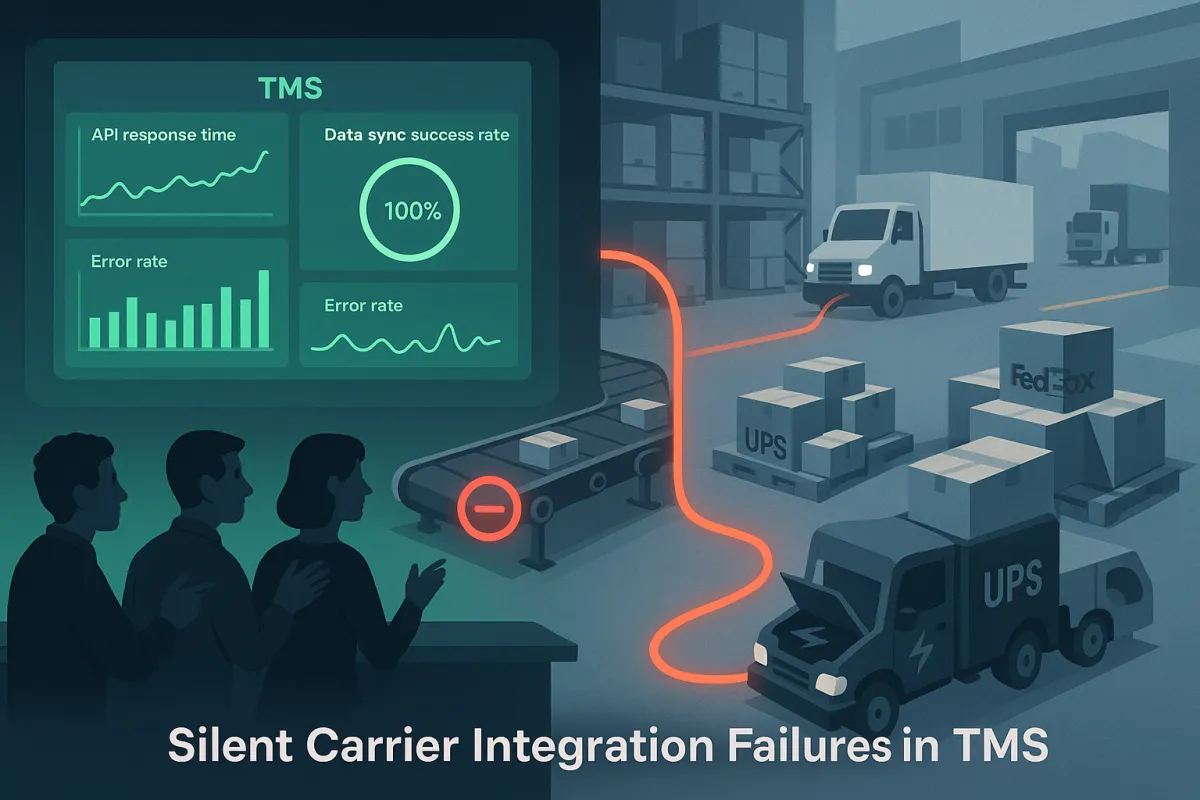
By February 3rd, 73% of integration teams reported production authentication failures after UPS's OAuth 2.1 migration. You check your TMS dashboard. Everything looks green. Your shipments are processing. Your APIs are responding. Yet €47,000 worth of critical automotive parts just sat at the wrong depot for six hours because your carrier integration silently failed to update tracking coordinates.
Sound familiar? European shippers are discovering that 66% of technology projects end in partial or total failure, while a staggering 76% of logistics transformations never meet their budget, timeline, or performance targets. The hidden crisis isn't API downtime anymore. This is why many teams experience so-called "silent failures": incidents where dashboards look green, but users are already impacted.
The Hidden Crisis: Why 73% of European TMS Teams Miss Critical Production Failures
The Web Tools API platform shut down on Sunday, January 25, 2026, marking just the beginning of a massive wave of carrier API retirements hitting enterprise integration teams. June 2026: Remaining SOAP-based endpoints will be fully retired. After this, integrations must use FedEx's REST APIs to access rates, labels, tracking, and future service updates.
Here's what most teams miss: REST APIs return different error codes than SOAP. HTTP 429 (rate limited) becomes your new nemesis. Your monitoring needs to distinguish between temporary throttling and actual service failures, because your response strategy differs completely.
Traditional TMS platforms like MercuryGate (now Infios), Descartes, and Oracle TM handle this transition differently. Enterprise TMS platforms like Cargoson, Manhattan Associates, and SAP TM have already implemented FedEx REST endpoints and are managing dual-API operations for clients during the transition period. But legacy monitoring approaches leave dangerous blind spots.
The problem? This is where status-code-based monitoring falls short. A 200 OK response doesn't guarantee the API is behaving correctly. Your integration might receive a successful response while silently dropping crucial shipment updates, creating operational chaos downstream.
Beyond API Response Times: The Four Monitoring Layers European Shippers Need
Effective TMS production monitoring requires a multi-layer approach. Monitor both technical and operational measures continuously. Track API response times, data synchronization success rates, and error frequencies alongside operational measures like carrier onboarding speed and compliance reporting accuracy.
Layer 1: API Health Monitoring
Traditional uptime checks miss the nuance of carrier API behavior. An API may be reachable from inside your infrastructure while being unavailable to users in specific regions. DNS failures, TLS issues, routing problems, or ISP-level disruptions can prevent requests from reaching the API, even though internal checks pass.
Layer 2: Data Quality Validation
Many API failures don't result in error codes. Instead, the API responds successfully but returns incorrect, incomplete, or unexpected data. These issues often go undetected until users complain or downstream systems break.
Layer 3: Business Process Monitoring
This layer tracks whether your TMS actually accomplishes business objectives. Are shipments reaching customers on time? Are carrier rates being calculated correctly? Are compliance documents being generated and transmitted?
Layer 4: Cost Impact Tracking
Monitor the financial impact of integration failures. Track metrics like cost per failed shipment, revenue at risk from delayed deliveries, and penalty costs from SLA breaches.
While platforms like Cargoson provide built-in monitoring across these layers, legacy TMS systems typically require custom development to achieve comprehensive visibility.
Real-Time Detection Framework for Carrier API Authentication Cascades
Authentication cascade failures represent one of the most expensive failure modes in production TMS environments. UPS completed their OAuth 2.1 migration on January 15, 2025. By February 3rd, 73% of integration teams reported production authentication failures. Major carriers including USPS and FedEx followed suit, making PKCE mandatory across their APIs.
The challenge: token expiration chains can cascade across multiple carrier integrations simultaneously. When your OAuth tokens expire during peak shipping periods, you're not just losing one carrier's capacity. You're potentially losing access to your entire multi-carrier network.
Here's how cascade detection works in practice:
Circuit Breaker Implementation
When the new USPS API hits rate limits or returns errors, your circuit breaker should immediately route traffic to backup services. Use retry logic to handle transient failures without disrupting the user experience. Configure different thresholds for different carriers based on their historical reliability patterns.
Authentication State Monitoring
Track token expiration times across all carrier integrations. Set up predictive alerts that trigger token refresh procedures 15-20 minutes before expiration. Monitor refresh success rates and establish secondary authentication pathways for critical carriers.
Dependency Chain Analysis
Map the relationships between carrier APIs in your integration architecture. When DHL's API starts returning authentication errors, your monitoring system should immediately check the health of geographically related carriers like DPD and GLS, since regional infrastructure issues often affect multiple providers.
Building Early Warning Systems for Silent TMS Failures
Silent failures occur when your TMS continues processing transactions while producing incorrect or incomplete results. These are silent failures and they're one of the most dangerous reliability risks in modern distributed systems. A silent failure in microservices occurs when a service appears healthy (passes health checks) but returns incorrect, incomplete, delayed, or degraded responses. Unlike system crashes, silent failures bypass traditional monitoring because infrastructure metrics remain "green" while user experience deteriorates.
Synthetic Transaction Monitoring
Use actual historical data for integration testing, not synthetic test cases. Validate data flows under peak load conditions, not just steady-state operations. Test failure scenarios and recovery procedures before production deployment.
Create synthetic shipments that mirror your actual shipping patterns. Send test shipments from your primary distribution centers to known addresses using each carrier integration. Track the complete lifecycle: rate calculation, label generation, tracking updates, and delivery confirmation.
Business KPI Threshold Alerts
Establish baseline performance metrics for each carrier integration. If UPS's average rate calculation time increases by 40% over a 15-minute window, or if 5% of DHL tracking updates fail to appear in your system within the expected timeframe, trigger immediate investigation.
Different TMS platforms handle this monitoring differently. While enterprise solutions like SAP TM and Blue Yonder require custom development for comprehensive synthetic monitoring, platforms like Cargoson provide these capabilities out-of-the-box with pre-configured synthetic transaction templates.
Operational Impact Monitoring: From Technical Alerts to Business Intelligence
Technical monitoring tells you what happened. Operational monitoring tells you what it means for your business. Real downtime isn't theoretical; it has a measurable financial impact. According to Gartner, the average IT outage costs about $5,600 per minute, or roughly $300,000 per hour for many organizations. And in independent research, more than 90% of mid-size and large firms report hourly downtime costs above $300,000, with 41% saying outages can exceed $1 million per hour.
Shipment Delay Detection
Monitor the time gap between expected and actual carrier pickup confirmations. If your normal pickup window is 4-6 hours and you're seeing 8-10 hours consistently with a specific carrier, investigate whether their API is providing accurate pickup scheduling data.
Cost Overrun Alerts
Track discrepancies between quoted rates from carrier APIs and actual billed amounts. A 15% variance might indicate API rate data staleness or zone skipping calculation errors in your TMS integration.
Compliance Violation Monitoring
European shippers must navigate ICS2 customs requirements, EU ETS emissions reporting, and country-specific digital documentation standards. Failure to comply with the regulations can result in severe penalties, which in some countries can reach up to 30,000 euros.
Monitor document generation success rates for each carrier integration. If your USPS integration successfully generates shipping labels but fails to produce the required customs documentation 12% of the time, you're facing potential customs delays and penalty exposure.
Integration Health Scoring for Multi-Carrier Environments
European logistics operations face unique challenges. Leading TMS providers like MercuryGate, Descartes, and Cargoson are already preparing eFTI-compatible solutions. But when your TMS can't handle carrier connectivity protocols that vary dramatically by country, operational complexity multiplies.
French carriers might use different API standards than German logistics providers, while Scandinavian forwarders often require specialized integration approaches. Your health scoring system needs to account for these regional variations.
Carrier-Specific Health Metrics
Weight response time monitoring by carrier volume and criticality. A 500ms delay from your primary last-mile carrier matters more than the same delay from a backup international freight forwarder you use twice monthly.
Regional Performance Baselines
Establish different performance expectations for carriers operating in different European regions. Nordic carriers might have different API response patterns than Mediterranean providers due to infrastructure and operational differences.
Escalation Protocol Integration
When Cargoson, Transporeon, or nShift detects carrier integration degradation, they can automatically route shipments to backup carriers. Enterprise TMS solutions often require manual intervention or custom scripting for similar failover capabilities.
Cost Impact Prevention: Monitoring That Saves €500,000+ in Remediation
A German automotive parts manufacturer discovered their €800,000 TMS implementation mistake the hard way. Six months into deployment, they found their European carriers couldn't integrate without costly custom development work. The lesson? Cost-aware monitoring prevents expensive discoveries during production operations.
Integration Cost Tracking
Monitor the hidden costs of carrier integration maintenance. Track developer hours spent troubleshooting API changes, emergency fixes during carrier system updates, and business disruption costs during integration failures.
ROI Protection Metrics
Measure the business value delivered by each carrier integration. If your DPD integration processes 200 shipments daily with a 99.2% success rate, calculate the revenue at risk during degraded performance periods.
Escalation Trigger Economics
Set cost-based escalation triggers. If carrier integration issues cost more than €1,000 in delayed shipments within a 4-hour window, automatically escalate to senior operations staff and consider activating backup carrier capacity.
FreightPOP, ShipEngine, and Cargoson each approach cost-aware monitoring differently. Platforms with built-in carrier redundancy can automatically calculate the cost impact of switching traffic between carriers during outages.
Emergency Response Playbooks for Production Carrier Outages
Production-ready architectures require more than hoping the new APIs work. Companies using multi-carrier platforms like Cargoson, ShipperHQ, or Shippo benefit from infrastructure that's already battle-tested against carrier API failures.
Incident Response Procedures
Document specific response procedures for common carrier API failure modes. When UPS's rating API starts returning HTTP 429 errors consistently, your playbook should specify: switch to backup carrier for urgent shipments, activate manual rate calculation procedures, and establish communication timelines with affected customers.
Failover Strategies
Never switch entirely at once. Build adapter layers that can route requests to either legacy or modern APIs based on configuration flags. This lets you test production traffic loads against new endpoints while maintaining fallback capability.
Communication Plans
Establish predefined communication templates for different stakeholder groups. Operations teams need technical details about carrier API status. Customer service teams need estimated resolution times and alternative shipping options. Finance teams need impact assessments and cost projections.
Platform-specific guidance varies significantly. MercuryGate/Infios, Descartes, Oracle TM, and SAP TM typically require custom development for comprehensive failover automation, while platforms like Cargoson and Blue Yonder include failover capabilities as core features.
Implementation Guide: Building Bulletproof TMS Monitoring in 90 Days
You can't implement comprehensive TMS monitoring overnight. But you can establish foundational monitoring capabilities within 90 days using a structured approach.
Weeks 1-2: Assessment and Planning
Audit your current monitoring capabilities across all four layers. Identify which carriers represent the highest business risk and the largest operational volume. Map dependencies between your TMS platform and carrier integrations.
Weeks 3-4: Layer 1 Implementation (API Health)
Implement third-party API monitoring to track uptime, latency, and error rates in real time. Don't just monitor your application. Monitor the carrier APIs themselves, because logistics saw the sharpest decline in API uptime as providers expanded their digital ecosystems.
Weeks 5-8: Layer 2 Implementation (Data Quality)
Set up response validation monitoring for critical carrier APIs. Verify that shipment tracking updates contain expected data fields, rate calculations fall within acceptable ranges, and label generation produces valid output formats.
Weeks 9-12: Layer 3 Implementation (Business Process)
Deploy synthetic transaction monitoring that mirrors your actual shipping workflows. Establish baseline performance metrics for each carrier integration and configure business KPI threshold alerts.
Different platforms require different implementation approaches. MercuryGate/Infios, Descartes, Oracle TM, and SAP TM implementations typically require significant custom development work and integration specialist expertise. Cargoson and Blue Yonder platforms often include pre-built monitoring templates that reduce implementation time by 60-70%.
The monitoring system you build today determines whether carrier API migrations become manageable upgrades or business-threatening crises. The companies that survive 2026's migration crisis won't be the ones with perfect technical execution. They'll be the ones who recognized that carrier integrations are infrastructure, not features, and invested accordingly.
Start with Layer 1 monitoring this week. Monitor the APIs that drive 80% of your shipping volume. Build from there. Your €500,000 mistake prevention system pays for itself with the first major failure you detect before it impacts customers.