
Semantic API Monitoring for Carrier Integrations: How European Shippers Can Detect Silent Failures in Production Before They Cost €50,000+ in Lost Shipments
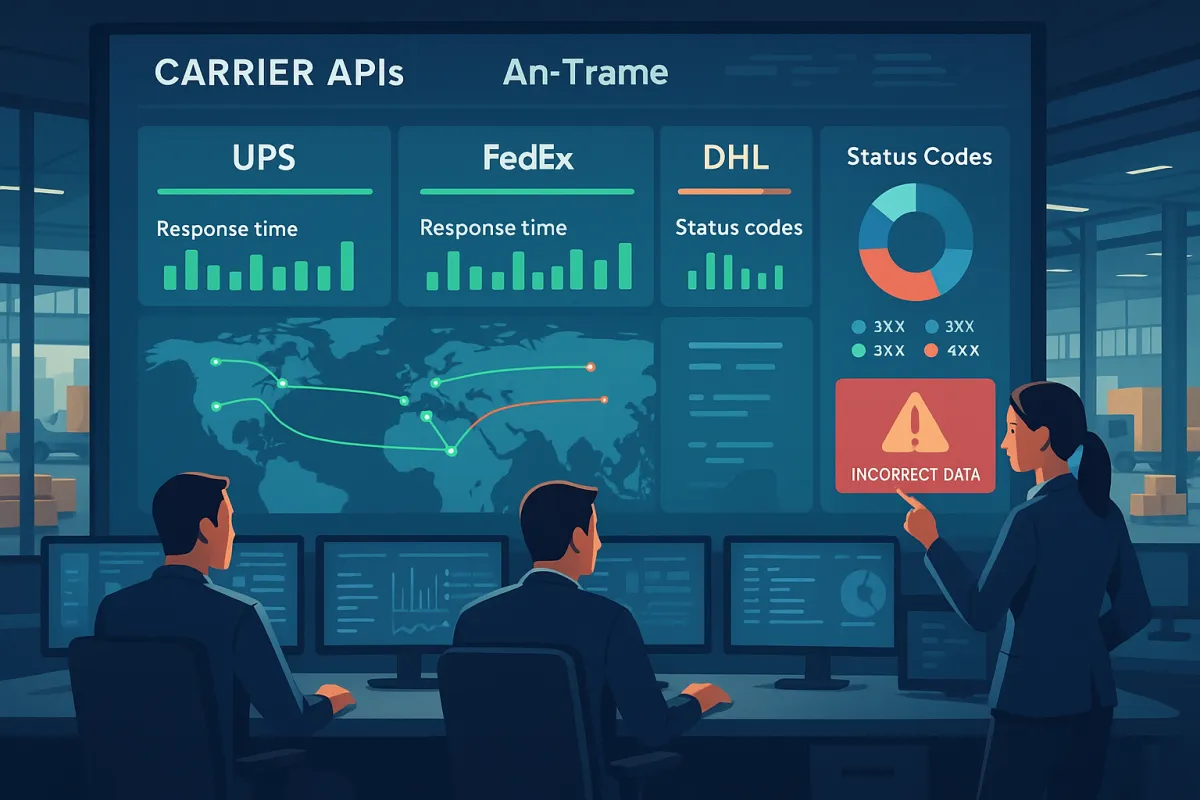
Last month, a checkout flow that worked perfectly in staging cost $50,000 in lost revenue when an API returned HTML instead of JSON and a poorly written try-catch block hid the error. This ran for three weeks before anyone noticed. Sound familiar?
This is semantic API monitoring for carrier integrations in a nutshell: an API can return 200 OK while delivering incorrect, incomplete, or stale data, and your traditional monitoring dashboards will show everything as healthy while your shipments fail silently in production.
European shippers managing dozens of carrier APIs face this challenge daily. A UPS rate request succeeds but returns outdated pricing. FedEx label generation completes but creates labels with missing customs data. DHL tracking responds correctly but with 6-hour-old information. Silent failures are one of the most costly, and hardest to detect, classes of API issues. They occur when an API continues to respond successfully, but no longer behaves as expected.
The Hidden Cost of Silent API Failures in Carrier Integrations
Traditional monitoring tools like Datadog and New Relic excel at tracking uptime, response times, and HTTP status codes. But they miss the patterns unique to carrier APIs where from a monitoring perspective, everything looks healthy. From a user's perspective, something is clearly broken.
Carrier APIs have distinct failure modes that generic monitoring can't catch. During Black Friday 2024, multiple European retailers experienced what appeared to be perfect FedEx API performance - sub-200ms response times, 100% uptime, all 200 status codes. Yet rate shopping was returning prices from October while label generation was silently failing address validation for UK addresses post-Brexit.
The cost isn't just the failed shipments. It's the customer complaints, the manual intervention to fix orders, the emergency weekend deployments to switch carriers, and the reputation damage when delivery promises aren't met. Companies using modern TMS platforms like Cargoson, nShift, or FreightPOP have built-in monitoring that catches many of these issues, but most European shippers still rely on legacy systems or custom integrations that lack this protection.
What Makes Carrier API Failures Different
Carrier APIs don't fail uniformly. Rate shopping might work perfectly while label creation fails silently. Tracking updates could be delayed by hours without any HTTP error status. This complexity stems from how carriers architect their systems - different services, different databases, different update cycles.
Here's how carrier APIs performed during Cyber Monday 2024: Warehouses and automated sortation require local rating engines that return decisions in milliseconds, not seconds, to keep operations seamless. But what monitoring tools miss is that carriers increasingly roll out new API versions with shortened migration windows. UPS might deprecate v1.0 endpoints with 90 days notice while simultaneously updating their rate calculation logic. DHL switches from EDI to REST APIs for certain regions while maintaining backwards compatibility that doesn't quite work as expected.
The seasonal patterns matter too. Carriers handle different volumes and have different failure patterns during peak shipping periods. FedEx Express might have perfect domestic performance but degraded international tracking during December. DHL could maintain excellent tracking accuracy but experience rate calculation delays during summer vacation periods when their European data centers undergo maintenance.
Understanding Semantic Monitoring Beyond Status Codes
Semantic monitoring shifts focus from "is the API responding?" to "is the API behaving correctly?" Instead of testing endpoints in isolation, it analyzes how APIs behave when executed as part of complete interaction flows. This approach validates what matters to your business operations, not just technical availability.
Traditional monitoring validates syntax - is this valid JSON with the expected schema? Semantic monitoring validates semantics - does this rate quote make business sense given current fuel surcharges and dimensional weight rules? Does this tracking update follow logical sequence patterns?
Semantic Runtime Validation focuses on these behaviors. Instead of testing endpoints in isolation, it analyzes how APIs behave when executed as part of complete interaction flows. For carrier APIs, this means understanding that a successful rate request should return prices within reasonable bounds of yesterday's quotes, that label generation should produce tracking numbers matching carrier format patterns, and that tracking events should follow logical geographical and temporal sequences.
The Four Pillars of Semantic Carrier API Monitoring
Response correctness validation goes beyond schema checking. For DHL Express, this means validating that international shipments include proper customs documentation fields, that delivery date estimates account for weekends and holidays in the destination country, and that rate calculations include all applicable surcharges.
Business workflow validation tracks end-to-end transaction flows. A typical European cross-border shipment involves rate shopping, address validation, customs document generation, label creation, manifest submission, and pickup scheduling. Each step must complete successfully and pass relevant data to the next. Traditional monitoring might catch a failed label request, but semantic monitoring catches when label data lacks the commodity codes required for customs clearance.
Performance semantics focus on response time patterns that affect operations. It's not just whether UPS responds in under 500ms, but whether rate calculation times remain consistent throughout the day. Sudden increases in response time often indicate backend issues that lead to incomplete or cached responses being returned.
Contextual error detection identifies errors that only appear in specific business scenarios. FedEx might handle standard domestic shipments perfectly but fail silently when processing hazardous materials shipments to certain postal codes. These context-dependent failures are invisible to traditional monitoring because they only affect a subset of traffic.
Implementing Assertion-Based Monitoring for Carrier APIs
The core of semantic monitoring lies in validating what APIs return, not just that they respond. This requires building test assertions that understand carrier-specific response patterns and business rules.
For UPS rate requests, assertions might validate that Ground service is always cheaper than Next Day Air, that residential surcharges are applied to non-commercial addresses, and that international rates include customs clearance fees. These aren't arbitrary technical constraints - they're business rules that ensure your customers see accurate shipping options.
FedEx label generation requires different assertions. Successful responses should include tracking numbers that match FedEx's format patterns (typically 12 digits starting with specific ranges), return addresses formatted according to destination country postal requirements, and customs forms for international shipments that include all mandatory fields like HS codes and country of origin.
DHL tracking validation involves temporal and geographical consistency. Tracking events should follow logical sequences - a package can't be "out for delivery" in Berlin before it was "cleared customs" in Frankfurt. Events should include timestamps, location codes that match DHL's facility database, and status codes that correspond to actual operational states.
Platforms like Cargoson, Transporeon, and nShift handle much of this validation natively because they maintain databases of carrier business rules and update them as carriers change their requirements. But if you're building custom integrations, you need to implement these validations yourself.
Production-Ready Implementation Patterns
Start with your highest-volume carrier endpoints. If you process 10,000 UPS shipments daily but only 100 DHL Express shipments, focus your initial semantic monitoring on UPS. Implement schema validation first, then baseline performance tracking, and finally add SLO-based alerting that reflects business impact rather than arbitrary technical thresholds.
Multi-step transaction monitoring becomes critical for complex shipping workflows. European cross-border shipments often involve rate shopping across multiple carriers, address validation against postal databases, customs document generation, and manifesting - all before the actual pickup occurs. Semantic monitoring should track the entire flow and alert when any step produces results inconsistent with business expectations.
For multi-tenant environments, isolation matters. Your monitoring should track performance and validation data per customer or business unit while efficiently sharing carrier connections. This allows you to identify when specific customers experience issues due to their unique shipping patterns or carrier agreements without impacting visibility into overall system health.
Building Business Logic Validation Rules
Logistics operations are built on exceptions that signal changing conditions rather than system failures. A "delivery delayed due to weather" status isn't an error - it's valuable business intelligence that affects customer expectations and inventory planning. Your monitoring needs to understand these nuances.
Rate validation rules must account for market dynamics. Fuel surcharges change weekly, dimensional weight calculations vary by carrier and season, and residential delivery fees differ between urban and rural areas. Your semantic monitoring should flag sudden rate changes that exceed normal variance thresholds while accepting gradual adjustments that reflect market conditions.
Delivery promise accuracy requires historical context. If DHL typically delivers to Munich in 1-2 business days, a sudden shift to 3-4 days might indicate operational issues, seasonal capacity constraints, or changes in service routing. This pattern wouldn't trigger traditional monitoring but could significantly impact customer satisfaction and order fulfillment planning.
International shipping compliance validation ensures that customs documentation meets destination country requirements. This involves validating HS codes against current trade databases, ensuring commercial invoice values align with order totals, and confirming that restricted goods restrictions are properly flagged for manual review.
Real-World Validation Scenarios
Address validation failures often break silently when carriers accept addresses that later cause delivery issues. A FedEx API might return success for "123 Main Street, Hamburg" without specifying which Hamburg (Germany, New York, or Pennsylvania). Your semantic validation should catch ambiguous addresses before labels are printed.
Rate calculation discrepancies appear correct in isolation but become obvious when compared across carriers or historical patterns. If UPS Ground suddenly costs more than UPS 2-Day Air for the same shipment, that's worth investigating even if both APIs returned valid responses.
Tracking event validation requires understanding carrier operational patterns. DHL Express packages moving from Leipzig to London should show customs clearance events, while domestic German shipments should not. Packages can't be delivered on Sundays in most European countries, so a delivery event timestamped on Sunday requires validation.
International shipping compliance failures are expensive to fix after the fact. Your monitoring should validate that hazardous materials shipments include proper IATA declarations, that pharmaceutical shipments to EU countries include GDP compliance documentation, and that commercial shipments over certain value thresholds include proper commercial invoices.
Monitoring Architecture for European Multi-Carrier Operations
European shippers typically work with 5-15 carriers depending on their geographic coverage and service requirements. Your monitoring architecture should separate concerns by function (rate shopping, labelling, tracking) rather than by carrier, with monitors that understand specific response patterns and failure modes for each service type.
Integration with existing TMS platforms varies significantly. Modern systems like Cargoson provide API monitoring as part of their core platform, automatically detecting carrier API changes and adjusting business rules accordingly. Legacy systems like Manhattan Active or Blue Yonder often require custom monitoring solutions that bridge between the TMS and your carrier APIs.
Multi-tenant monitoring architecture becomes complex when serving different business units with different carrier contracts, shipping patterns, and SLA requirements. You need monitoring that isolates performance data and alerting per tenant while efficiently sharing carrier connections and maintaining visibility into system-wide trends.
Alert Strategy and Escalation
SLO-based alerting focuses on business impact rather than arbitrary technical thresholds. Instead of alerting when FedEx response times exceed 500ms, alert when rate shopping requests take longer than the 2-second limit that prevents checkout abandonment. Instead of alerting on any tracking API error, alert when tracking success rates drop below the 99.5% threshold that affects customer satisfaction metrics.
Business impact correlation connects technical metrics to revenue and customer experience. A 10% increase in UPS label generation failures might represent thousands of euros in delayed shipments and dozens of customer service calls. Your alerting should quantify this impact and route notifications to the appropriate teams based on severity.
Integration with incident management workflows ensures that semantic monitoring alerts don't get lost in noise. When DHL tracking APIs start returning stale data, your monitoring should automatically create incident tickets, page the appropriate on-call engineer, and begin collecting relevant diagnostic information.
Measuring Success: KPIs and ROI
Silent failure detection rate measures how effectively your semantic monitoring catches issues that traditional monitoring would miss. A good target is detecting 80-90% of silent failures within 15 minutes of occurrence, compared to the hours or days it typically takes for customer complaints to surface issues.
Mean time to detection (MTTD) reduction shows the operational impact of semantic monitoring. Traditional approaches often allow issues to run for three weeks before anyone notices. Effective semantic monitoring should reduce this to minutes for critical shipping operations.
Customer complaint reduction provides a direct business metric. If your semantic monitoring successfully catches rate calculation errors before they affect customer orders, you should see a measurable decrease in "shipping cost was wrong" support tickets and checkout abandonment rates.
Cost avoidance calculations become significant when you consider the full impact of silent failures. The $50,000 lost revenue from a single silent API failure represents just the immediate impact - not the long-term customer relationship costs, operational overhead to fix incorrect shipments, or competitive disadvantage from unreliable shipping options.
Companies implementing comprehensive carrier API monitoring through platforms like Cargoson typically see ROI within 3-6 months through reduced operational overhead, improved customer satisfaction, and better carrier performance management. The investment in proper monitoring infrastructure pays dividends when you avoid your first major silent failure incident.
The shift toward semantic API monitoring isn't just about catching more errors - it's about building shipping operations that can adapt to the constantly changing carrier landscape while maintaining the reliability your customers expect. As carrier APIs continue to evolve and European shipping complexity increases, the organizations with robust semantic monitoring will maintain their competitive advantage while others struggle with silent failures and their hidden costs.