
Production OAuth Monitoring for European Carrier Integrations: How to Build Authentication Health Systems That Prevent the 73% Failure Rate During 2026's API Migration Crisis
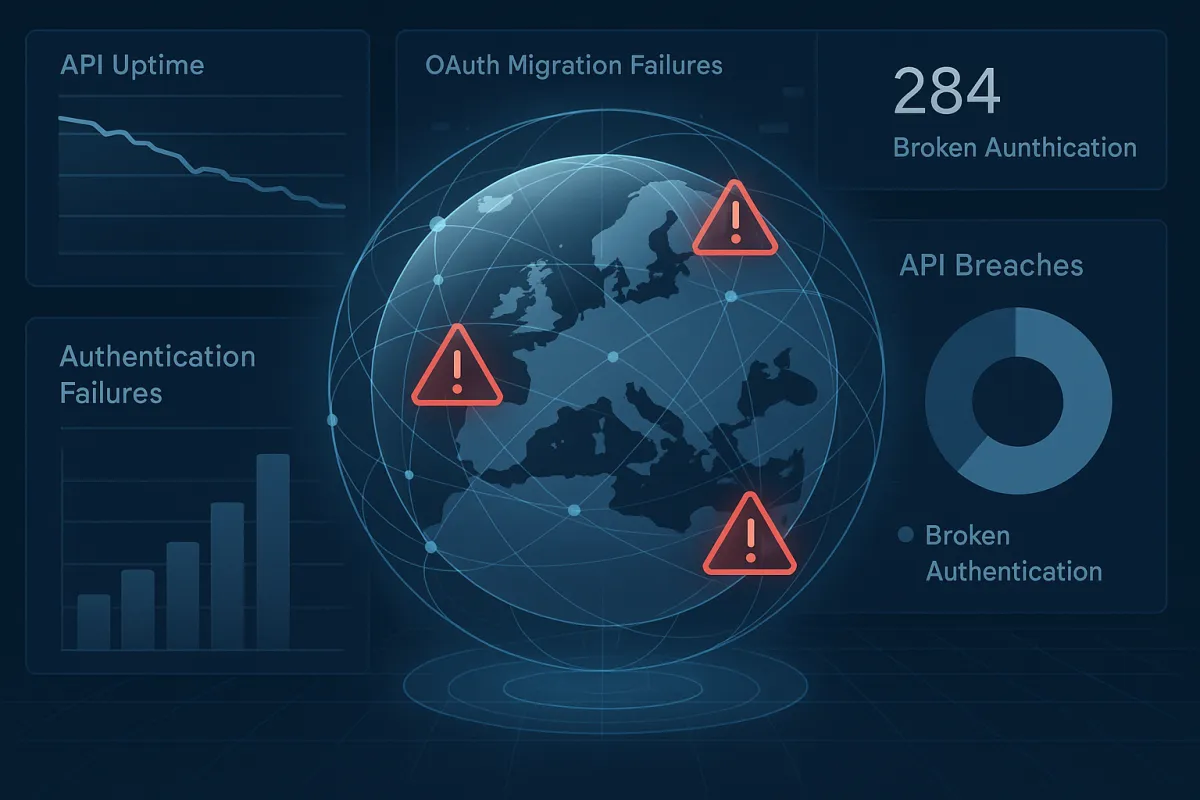
February 3rd wasn't just another day for carrier integrations. By February 3rd, 73% of integration teams reported production authentication failures following UPS's OAuth migration. Your sandbox testing passed with flying colors. Authentication flows worked perfectly. Rate requests returned clean responses. Then production deployment exposed what most teams discover too late: production authentication failures within weeks of carrier API deployments that sailed through sandbox testing.
The scale of this authentication crisis isn't a minor technical hiccup. 73% of integration teams reported production authentication failures after similar UPS OAuth migrations, while 52% of API breaches in 2025 were caused by broken authentication, and average API uptime fell from 99.66% to 99.46% between Q1 2024 and Q1 2025, resulting in 60% more downtime year-over-year. When authentication patterns fail in production, they cascade through your entire shipping workflow faster than traditional monitoring can detect.
The 2026 Authentication Crisis Hitting European Shippers
Three major carrier API retirements created the perfect storm for authentication failures. USPS Web Tools shut down on January 25, 2026, and FedEx SOAP endpoints retire on June 1, 2026. Add RFC 9700: Best Current Practice for OAuth 2.0 Security, with RFC 9700 now mandating PKCE for all client types, including server side apps, and you have regulatory pressure forcing every integration team to rebuild their authentication systems simultaneously.
USPS added PKCE mandatory requirements across their APIs in early 2025. Major carriers including USPS and FedEx followed suit, making PKCE mandatory across their APIs. The compliance gap hits harder than most teams expect. Teams using older OAuth implementations suddenly face authentication failures that their monitoring systems classify as temporary network issues.
Platforms like Cargoson, MercuryGate, and SAP TM demonstrate different approaches to handling this complexity, but the most resilient implementations treat authentication monitoring as business-critical infrastructure. Cargoson, along with competitors like MercuryGate and BluJay, built abstraction layers that handle the OAuth complexity, implement intelligent rate limiting queues, and provide fallback mechanisms when USPS quotas are exceeded.
Why Sandbox Success Doesn't Predict Production Performance
Sandbox environments don't replicate the authentication pressure that breaks production systems. Production authentication failures happen because sandbox environments don't replicate RFC 9700 compliance requirements under load. 73% of integration teams reported production authentication failures within weeks of carrier API deployments that sailed through sandbox testing.
Scope creep becomes particularly dangerous when carriers modify permission requirements without notice. Scope creep happens when carriers modify permission requirements without notice. USPS added PKCE mandatory requirements across their APIs in early 2025. Your contract tests validated authentication grants, but production environments enforce different scope validation rules that sandbox testing never exposed.
The authentication timing differences matter more than most teams realize. Effective monitoring starts with carrier-specific performance baselines. UPS APIs typically respond within 200-400ms for authentication requests. DHL SOAP endpoints take 800-1200ms. When these baselines shift during production load, it indicates RFC 9700 compliance gaps affecting your traffic before causing outright failures.
Building Carrier-Aware Authentication Monitoring
Standard monitoring tools like Datadog and New Relic miss the authentication patterns that actually break carrier integrations. Standard monitoring tools like Datadog and New Relic miss the authentication patterns that break carrier integrations. They track HTTP status codes and response times, but they can't detect when OAuth token refresh logic fails under concurrent load or when carrier-specific rate limits create authentication cascades.
Authentication health monitoring requires carrier-specific intelligence. Carrier APIs don't follow consistent header standards. FedEx uses proprietary headers, UPS implements rate limiting through error codes, and DHL varies by service endpoint. Generic monitoring tools treat all APIs identically, but that assumption breaks quickly when managing multiple carriers with different authentication patterns.
Circuit breaker patterns become essential when implementing carrier-specific thresholds. Consider implementing circuit breaker patterns with carrier-specific thresholds. UPS might handle 100 requests per minute reliably, while FedEx starts rate-limiting at 75. Your monitoring should understand these per-carrier characteristics and adjust alerting accordingly.
Token health scoring systems provide early warning indicators before failures cascade. Token health scoring predicts failures before they affect shipments. Assign scores based on token age, refresh frequency, and recent authentication latency. Tokens nearing expiration with elevated refresh times indicate authentication infrastructure stress.
Essential Authentication Metrics Beyond Uptime
Authentication-specific metrics reveal problems that uptime checks miss entirely. Authentication-specific metrics matter more than generic uptime checks. Track token refresh frequency, scope validation success rates, and permission error patterns.
Authentication failures are particularly dangerous because they often go unnoticed. An expired token or misconfigured permission can block users while unauthenticated checks continue to pass. Your monitoring architecture needs to track authentication health per tenant, not just aggregate metrics across all carrier connections.
Multi-tenant considerations complicate authentication monitoring when serving multiple shippers. Multi-tenant considerations become complex when serving multiple shippers. Each client's carrier credentials operate under different rate limits and authentication requirements. Your monitoring needs to track authentication health per tenant, not just aggregate metrics.
RFC 9700 Compliance Implementation Framework
RFC 9700 now mandating PKCE for all client types, including server side apps represents the most significant change to OAuth implementations since the original specification. The security requirements aren't optional recommendations anymore—they're mandatory compliance checkpoints that carrier APIs actively enforce.
PKCE implementation validation requires testing your code challenge generation and verification logic across all carrier integrations. Your compliance audit should verify these RFC 9700 mandates: PKCE Implementation Validation: Authorization servers MUST provide a way to detect their support for PKCE. Check whether your UPS, FedEx, and DHL integrations properly generate code challenges and verify code responses during token exchange.
Token replay detection becomes essential under RFC 9700's security framework. Token replay detection becomes essential under RFC 9700. Your monitoring system should track token usage patterns and flag anomalous authentication attempts that indicate potential security compromises or implementation bugs.
Redirect URI security requirements eliminate HTTP webhooks that violate HTTPS-only mandates. Redirect URI Security: Strivacity does not allow redirection URIs that use the HTTP scheme except for native clients that use loopback interface redirection. Many legacy carrier integrations use HTTP webhooks that violate RFC 9700's HTTPS-only requirements.
Preventing Authentication Cascade Failures
Cascade detection identifies when authentication failures spread across multiple carrier services. Authentication cascade detection identifies when token failures spread across services. Monitor correlation between OAuth service response times and downstream carrier API error rates. When UPS authentication latency increases by 300ms, expect shipping label failures to follow within 15 minutes.
Carrier domino effects exhaust your available options faster than manual intervention can prevent. We documented specific cascade patterns: FedEx rate limits trigger failover to UPS, which then hits its limits and fails over to DHL, creating a "carrier domino effect" that exhausts all available options within 90 seconds.
Emergency response protocols must distinguish between individual token problems and carrier-wide authentication issues. When authentication starts failing across multiple tenants simultaneously, that signals a carrier-wide issue requiring different escalation than individual token problems. When FedEx authentication fails for one tenant, monitor whether other tenants experience similar issues within the next few minutes. If so, escalate immediately to carrier communications rather than assuming isolated tenant problems.
Implementation Guide: Production-Ready OAuth Monitoring
Production-grade API monitoring tools need to understand OAuth flows, not just HTTP response codes. Real-time request/response monitoring with automated alerting requires tools that understand OAuth flows. API Monitoring allows us to set up complicated API monitors that include our OAuth layer with just a few clicks. Track token refresh events, scope validation, and permission changes as they happen.
Effective monitoring validates the complete authentication sequence, not just endpoint availability. This gap between "server is up" and "users can actually authenticate" creates a blind spot that leads to unexpected outages. API-based auth flow monitoring addresses this by validating the complete authentication sequence, not just endpoint availability.
Authentication monitoring tools should support common methods including API keys, bearer tokens, and OAuth 2.0 flows. A production-grade API monitoring tool should support common authentication methods such as API keys, bearer tokens, OAuth 2.0 flows, and custom request headers. It should also allow teams to update credentials easily and safely as tokens rotate or permissions change.
Here's how to implement carrier-specific authentication monitoring:
Step 1: Configure Carrier-Specific Baselines
Set up monitoring thresholds based on each carrier's normal response patterns. Monitor UPS authentication requests with alerts at 500ms latency, DHL endpoints with alerts at 1500ms, and FedEx APIs with alerts for any 401 responses during authenticated sessions.
Step 2: Implement Token Lifecycle Tracking
Monitor token refresh success rates, track token lifetime utilization, and alert on scope validation errors. You need token refresh logic, proper scope management, and error handling for authentication failures. Monitor authentication health by tracking token refresh success rates, token lifetime utilization, and scope validation errors.
Step 3: Build Business Logic Validation
Move beyond simple HTTP status checks to understand business logic failures. Modern carrier API monitoring needs to understand business logic failures. When DHL's API returns 200 OK but the response contains an empty tracking array, your monitoring should flag this as a functional failure, not a success.
Testing and Validation Framework
Contract testing validates authentication flows against expected carrier behavior patterns. Contract testing validates authentication flows against expected carrier behavior. Testing OAuth scope changes requires monitoring actual permission grants, not just successful token acquisition. USPS recently modified address validation scopes to require additional permissions. Teams discovered this only when their production requests started returning authorization errors despite valid tokens.
Automated testing frameworks should simulate RFC 9700 compliance failures under load. Your automated testing framework should simulate PKCE validation failures, token expiration under concurrent requests, and scope creep scenarios. Production stress testing reveals authentication system behavior under concurrent load that sandbox environments never replicate.
Validation checklists must verify carrier-specific authentication field requirements. Validating carrier-specific authentication fields prevents integration failures. FedEx requires different OAuth client configurations for rate requests versus label generation. Your contract tests should verify that authentication grants include all necessary scopes for your application's use cases.
Long-term Monitoring Strategy for European Operations
Maintenance schedules for token rotation systems prevent expiry-related failures that affect 40% of carrier API issues. Authentication token expiry represents 40% of carrier API failures. OAuth tokens expire, API keys get rotated, or password changes break connections. The fix is straightforward once you identify it, but detection takes time without proper monitoring.
Future regulatory changes will continue affecting authentication requirements through 2027. The eFTI regulation implementation and continued carrier API modernization efforts mean authentication monitoring systems need flexibility to adapt to changing compliance requirements without complete rebuilds.
Cost-benefit analysis for in-house versus outsourced monitoring depends on your integration complexity. Platforms like Cargoson, nShift, Transporeon, and FreightPOP demonstrate actual API connectivity rather than marketing promises. Teams managing 20+ carrier integrations across multiple European countries typically benefit from managed solutions that handle authentication monitoring complexity automatically.
Building resilience against future carrier API changes requires monitoring systems that understand the broader carrier ecosystem context. Choose monitoring tools that understand carrier ecosystems. Multi-carrier platforms like Cargoson, EasyPost, nShift, and ShipEngine handle this complexity through abstraction layers. Vendor-agnostic monitoring becomes crucial when managing platforms like EasyPost, nShift, and Cargoson simultaneously.
The authentication crisis of 2026 reveals a fundamental truth: generic monitoring approaches fail when managing carrier API complexity. Teams that implement carrier-aware authentication monitoring systems now will maintain competitive advantages as regulatory requirements continue expanding and authentication patterns become more sophisticated. Start with your highest-risk carrier integrations, validate the monitoring approach under real production traffic, then expand coverage systematically across your entire carrier network.