
Parallel API Testing Strategy for Carrier SOAP-to-REST Migrations: How European TMS Teams Can Safely Navigate FedEx June 2026 Retirement While Maintaining Operational Continuity
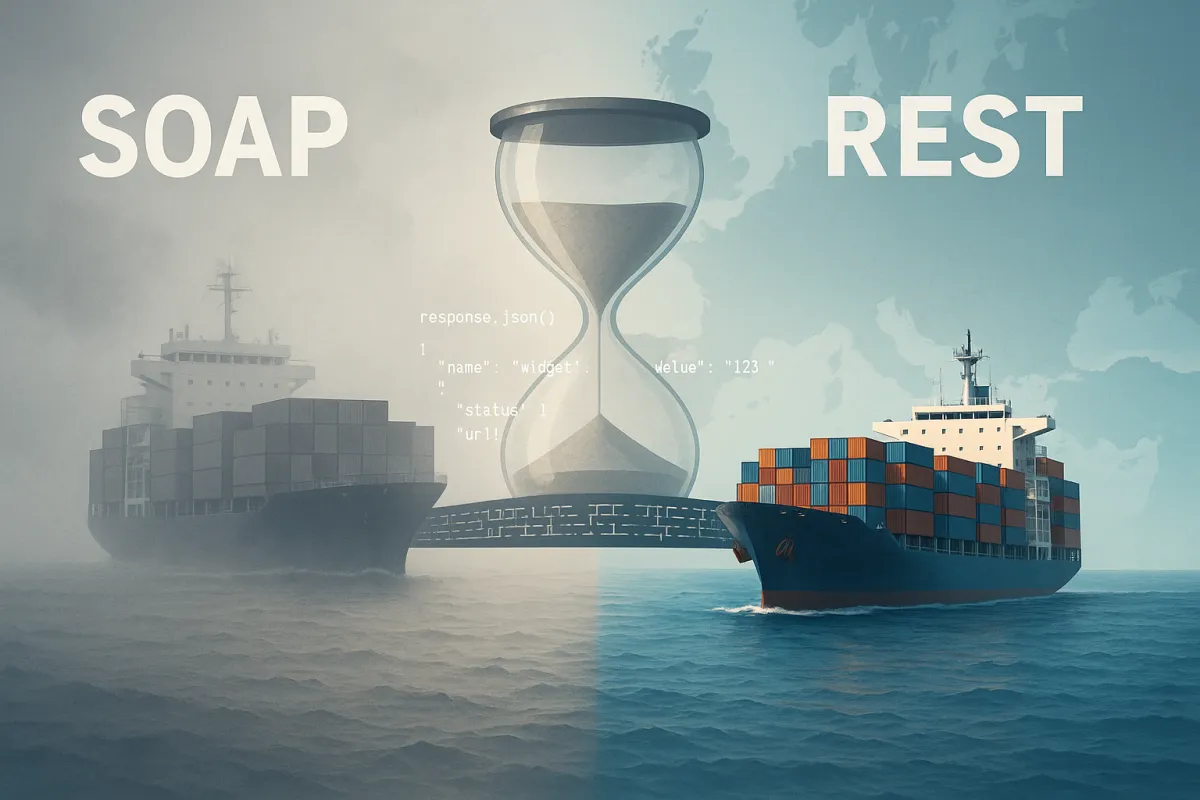
European TMS teams face an unprecedented challenge in 2026. FedEx SOAP Web Services will be retired on June 1, 2026, and USPS Web Tools API already shut down on Sunday, January 25, 2026. For thousands of companies still running legacy integrations, this forces a complete rebuild of carrier connectivity just months before critical shipping deadlines. While data migration failure rates drop by 73% with proper planning, most teams are discovering these deadlines months too late.
The difference between a successful migration and operational disaster comes down to one strategy: parallel API testing. Instead of attempting a risky cut-over approach, European TMS teams need to run both SOAP and REST endpoints simultaneously during the transition period, comparing results to identify discrepancies before production deployment.
The European Carrier API Migration Crisis of 2026
For the thousands of companies still running legacy integrations, this isn't just a technical upgrade. It's a forced march through production deployment hell. The scale extends beyond individual companies. European manufacturers relying on FedEx for B2B shipments, retailers processing thousands of daily orders, and wholesalers managing complex distribution networks all face the same June deadline.
Consider the authentication complexity alone. Both carriers are moving to a RESTful API using a more advanced security model like OAuth 2.0 instead of single access key authentication. Your existing SOAP integration that worked reliably for years suddenly requires OAuth token management, refresh logic, and PKCE compliance.
The financial impact compounds quickly. Enterprise shipping operations typically budget 2-3x their annual subscription fees for complex API migrations. When you factor in development resources, testing environments, and the risk of shipping disruption during peak seasons, the total cost easily reaches six figures for mid-sized operations.
Why Parallel API Testing is the Safe Migration Path
Unlike USPS's abrupt cutoff, FedEx provides a longer transition period. Use it. Run parallel systems where your application calls both SOAP and REST endpoints simultaneously, comparing results to identify discrepancies before the June deadline.
Here's what enterprise implementations have learned: companies using parallel testing strategies avoid the 73% failure rate that plagued teams attempting direct cut-over approaches. Run SOAP and REST in parallel to compare results and detect issues, particularly around service mapping complexity where rate shopping, label generation, and tracking require completely different endpoint structures.
The testing window advantage becomes obvious when you examine what goes wrong during rushed migrations. Service Mapping Complexity: Your existing SOAP calls don't translate one-to-one. Rate shopping, label generation, and tracking require new endpoint structures, different request formatting, and updated response parsing. The JSON payloads use different field names, nesting structures, and data types than your SOAP XML.
Modern TMS platforms like Cargoson, nShift, Manhattan Associates, and SAP TM have already implemented parallel testing architectures internally. They're running dual API calls during the transition period to validate that REST endpoints produce identical business logic results as their existing SOAP integrations.
Building Your Parallel Testing Architecture
Start with an adapter layer that sits between your TMS application and carrier APIs. This abstraction routes requests to both SOAP and REST endpoints simultaneously, capturing responses for comparison. Design configuration flags that allow you to switch traffic percentages. Begin with 10% of production traffic hitting REST endpoints while 100% continues through SOAP, gradually increasing REST traffic as confidence builds.
Your response comparison methodology needs to account for format differences. JSON responses use camelCase field naming conventions, while SOAP XML typically uses PascalCase or nested structures. Build transformation functions that normalize both response types into a common format for meaningful comparisons.
You can use tools like SoapUI, Postman, or Rest-Assured to create and execute your RESTful API tests and use frameworks like JUnit, TestNG, or Mocha to automate and report your RESTful API tests. For enterprise-scale operations processing thousands of shipments daily, you need automated comparison logic that flags discrepancies in rates, delivery dates, or service availability.
Real-World Implementation: FedEx SOAP to REST
FedEx's API migration involves more than authentication changes. The rate shopping endpoint structure completely changes from SOAP's nested XML operations to REST's resource-based design. Where SOAP required complex envelope structures with multiple namespaces, REST endpoints use clean JSON payloads with straightforward field mapping.
Authentication represents the biggest complexity jump. UPS completed their OAuth 2.1 migration on January 15, 2025. By February 3rd, 73% of integration teams reported production authentication failures. Major carriers including USPS and FedEx followed suit, making PKCE mandatory across their APIs. OAuth token refresh logic, error handling for expired tokens, and PKCE implementation all require careful testing under production load conditions.
Request format transformations demand detailed attention. Your XML-based rate shopping request with nested shipper and recipient address blocks becomes a flattened JSON structure with different field names. Legacy field mappings like "RecipientAddress.StateOrProvince" become "recipient.stateProvince" with different validation requirements.
Enterprise platforms handle this abstraction automatically. Cargoson, along with competitors like nShift, FreightPOP, and ShipperHQ, maintain mapping layers that translate between different carrier API formats. Their customers avoid the technical complexity of managing multiple API versions while benefiting from seamless failover mechanisms.
Step-by-Step Parallel Testing Implementation Guide
Phase 1: Environment Setup and Endpoint Configuration
Configure your development environment to support both SOAP and REST credential sets. FedEx requires separate API keys for REST endpoints, distinct from your existing SOAP authentication. Set up isolated test environments that mirror your production traffic patterns without affecting live shipments.
Phase 2: Parallel Request Routing and Response Capturing
Implement request routing that sends identical business logic to both SOAP and REST endpoints. Capture all responses with timestamps, request identifiers, and environment context. Functionally test REST endpoints to ensure parity with SOAP. Conduct performance, load, and security tests (OAuth 2.0 validation).
Phase 3: Data Validation and Discrepancy Identification
Build automated comparison logic that identifies discrepancies in rates, service options, delivery estimates, and label formatting. Pay particular attention to currency formatting, date representations, and service code mappings. European operations often encounter issues with postal code validation differences between SOAP and REST implementations.
Phase 4: Performance Testing Under Production Loads
Test OAuth token refresh behavior under high-volume conditions. FedEx REST APIs have different rate limiting characteristics than SOAP endpoints. Validate that your application handles OAuth token expiration gracefully during peak shipping periods without causing transaction failures.
Managing Risk During the Transition Window
Implement fallback mechanisms that automatically route traffic back to SOAP endpoints when REST API calls fail. Design circuit breakers that monitor REST endpoint health and switch to SOAP during service degradations. Implementing an adapter or proxy service to translate REST requests into SOAP-compatible formats and vice versa, ensuring backward compatibility during the transition provides insurance against unexpected issues.
Production traffic load testing reveals issues that development environments miss. OAuth authentication behavior changes under concurrent request loads. Token refresh timing becomes critical when processing batch shipments. Test your implementation against realistic European business hours traffic patterns, particularly during morning shipping rushes when authentication servers experience peak load.
Timeline planning requires 12-15 months for complex European operations with multiple carrier integrations, especially when regulatory requirements like Eircode for Ireland shipments add additional validation complexity. Budget implementation costs at 2-3x your annual carrier subscription fees for large operations requiring custom integration work.
Taking a phased migration approach can also be effective - it minimizes disruptions to current systems while providing ample time for thorough testing and fine-tuning. Start with your lowest-volume shipping lanes for initial REST testing, gradually migrating higher-volume routes as confidence builds.
Future-Proofing Your Carrier Integration Architecture
The 2026 migration wave won't be the last. Industry analysts predict UPS will announce similar SOAP retirements by 2028, forcing another round of integration rebuilds. European companies need abstraction strategies that survive future API changes without requiring complete redevelopment.
Multi-carrier redundancy extends beyond single API reliability. Enterprise shipping platforms like Cargoson, project44, and Descartes provide exactly this abstraction. They handle carrier API changes, manage authentication complexity, and provide unified interfaces that survive individual carrier migrations.
The architectural lesson from 2026's crisis: carrier integrations are infrastructure, not features. Companies that treat API connectivity as a core competency will spend the next decade debugging OAuth flows and rate limiting edge cases. Those that recognize carrier APIs as commodity infrastructure can focus development resources on business differentiation.
Integration platforms like Cargoson, nShift, Manhattan Associates, and ShipperHQ solve this infrastructure problem permanently. They maintain carrier integrations as a service, handling authentication complexity, API version management, and migration projects automatically. We support 75+ carrier integrations and manage all the technical updates for you. As new services and pricing structures roll out across carriers, ShipperHQ is right there with merchants, helping you take advantage of them without technical overhead.
Your choice for surviving 2026: spend the next six months implementing parallel testing architectures and managing OAuth complexity, or invest in platforms that solve carrier connectivity as an abstraction layer. Your choice: spend the next six months debugging OAuth flows and rate limiting edge cases, or let someone else handle that while you focus on growing your business.