
Multi-Carrier API Rate Limiting Crisis 2026: How European Shippers Can Build Intelligent Orchestration Systems to Prevent Cascade Failures When FedEx, UPS, and DHL Throttle Simultaneously During Peak Season
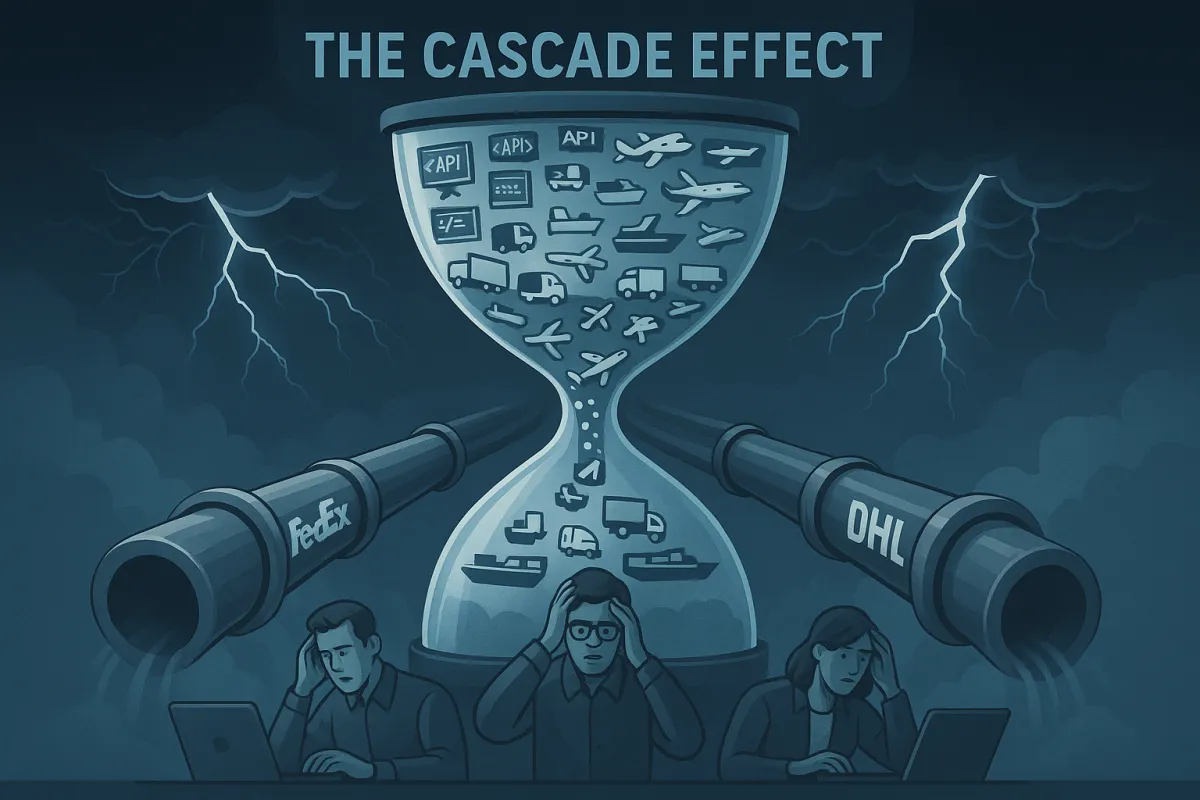
Major European shipping operations face an unprecedented challenge in 2026. FedEx's SOAP endpoints retire by June 2026, forcing integrations to REST APIs, while USPS caps address validation at just 60 requests per hour starting January 25—that's 6,000 times slower than before. But here's the real problem: when these restrictions hit simultaneously across multiple carriers during peak season, traditional rate limiting approaches fail catastrophically.
The cascading failure pattern we've witnessed in production environments tells a grim story. A manufacturing client's Black Friday operations collapsed when their TMS exhausted FedEx's daily limit by 11:30 AM, automatically failed over to DHL's system, which throttled within 45 minutes, then crashed UPS integration trying to process the backlog. 47% of organizations report rate limiting incidents cost more than $100,000, with 20% exceeding $500,000.
The Rate Limiting Perfect Storm Hitting European Shippers in 2026
Multiple carriers are simultaneously tightening their API restrictions. UPS, USPS, and FedEx are completing a years-long shift to modern, secure platforms with stricter limits. The timing creates a perfect storm where your backup carriers might also be throttling when your primary integration fails.
Consider the new landscape: USPS drops from 6,000 requests per minute to one per minute for address validation. FedEx reserves the right to change allocation "without prior notice" to maintain equitable access. UPS has been gradually reducing bulk operation limits throughout 2025. DHL's European regional variations mean different restrictions for different markets within the same day.
Modern TMS platforms handle this differently. Legacy systems like MercuryGate rely on simple request counting, while solutions like Cargoson build intelligent throttling directly into carrier connectivity. But even advanced platforms struggle when multiple carriers throttle simultaneously because they're designed around single-point failures, not coordinated restrictions.
The carrier domino effect plays out predictably. Your primary carrier hits its limit, TMS fails over to secondary, which quickly exhausts its quota handling the doubled load, then tertiary carrier gets overwhelmed by 3x normal volume. Within 90 seconds, every carrier option is throttled, leaving your fulfillment operations completely blocked.
Why Traditional Static Rate Limiting Fails in Multi-Carrier Environments
Static rate limiting assumes predictable, unchanging limits. But carriers change limits unilaterally while your TMS continues making requests at yesterday's assumptions. The traditional token bucket algorithm works beautifully for single APIs but breaks down when managing multiple carriers with different refresh cycles, burst allowances, and error recovery patterns.
When German manufacturing makes 500 DHL requests during shift changes while French retail needs 1,200 UPS shipments for flash sales, traditional rate limiting sees "1,700 total requests" and throttles everything. Smart systems recognize different carriers serving different business units with different constraints.
The oscillation problem creates sawtooth performance patterns. Rate limiting kicks in, requests queue up, limits reset, flood of requests hits carrier APIs again, triggering throttling within seconds. This 15-minute cycle confuses downstream warehouse automation systems that expect consistent 500ms response times but suddenly face 3.2-second spikes.
The Hidden Costs of Rate Limit Cascade Failures
85% of organizations experienced API-related incidents in the past year, with each costing an average of $580,000 and downtime reaching $9,000 per minute. But those figures don't capture the specific pain of multi-carrier failures during peak shipping periods.
When address validation hits USPS limits mid-batch, fulfillment processes stall, label generation stops, orders cannot move forward until addresses are verified, and nightly cleanup jobs fail. The manual recovery effort involves operations teams switching between carrier portals, IT staff deploying emergency fixes, and customer service handling delivery delay complaints.
European shippers face additional complexity with cross-border operations. GDPR compliance requirements mean you can't simply cache and reuse address data indefinitely. Multi-currency pricing APIs have their own rate limits. Customs documentation APIs throttle independently from shipping rate APIs, creating additional failure points during international shipment processing.
Intelligent Rate Limiting Orchestration Architecture for European TMS
Build a predictive system that coordinates across carriers before limits are reached. Instead of reactive throttling after 429 errors, monitor carrier API health signals and distribute load proactively. This requires moving beyond simple request counting to track response time degradation, error rate trends, and capacity utilization patterns across your carrier portfolio.
The architecture needs three layers. Circuit breaker patterns at the carrier level that open when error rates exceed thresholds, preventing cascade failures. Weighted round-robin with health scoring that considers current capacity, historical performance, and business rules like carrier preferences or pricing tiers. Redis-based coordination using Lua scripts for atomic operations that ensure consistent rate limiting across distributed TMS instances.
Here's how modern platforms like Cargoson, Transporeon, and nShift could implement intelligent orchestration. Each carrier gets a dynamic capacity score updated every 30 seconds based on recent response times, error rates, and known limits. High-priority shipments get carrier preference, while bulk operations use available capacity efficiently across all providers.
Pre-emptive Throttling Detection and Response Systems
Monitor carrier API health before 429 errors occur. Response time degradation often precedes hard limits by 5-10 minutes. FedEx APIs slow from 200ms to 800ms when approaching daily quotas. DHL starts returning 503 errors for 2-3 requests before full throttling. UPS response times spike when their load balancers detect high-volume clients.
Implement early warning systems that detect these patterns and shift load to healthier carriers automatically. Track the ratio of successful to retry requests, monitor for increasing 4xx error codes, and watch for response time percentile shifts. When P95 latency increases by more than 50% over a 5-minute window, start routing new requests to secondary carriers.
Use Redis for distributed state and always return rate limit headers so clients can self-regulate. Build feedback loops where carrier performance data informs routing decisions in real-time, creating a self-healing system that maintains operation resilience even during simultaneous carrier stress.
Implementation Guide: Building Multi-Carrier Rate Limiting Coordination
Start with distributed rate limiting using Redis and Lua scripts for atomic operations. Each carrier gets its own rate limit bucket, but the coordination layer manages distribution across carriers based on current capacity and business rules. Here's the step-by-step implementation for European operations:
First, implement carrier health monitoring. Track response times, error rates, and throughput for each carrier API every 30 seconds. Store this data in Redis with TTL to maintain recent performance history. Create health scores that combine these metrics with business weights like carrier preference, pricing, and service coverage.
Build the orchestration layer that makes routing decisions. When a shipping request arrives, check current capacity across all eligible carriers, factor in health scores and business rules, then route to the optimal choice. Use weighted round-robin with dynamic weights updated based on real-time carrier performance.
Implement graceful degradation patterns. When a carrier's health score drops below threshold, reduce its allocation gradually rather than cutting off completely. This prevents sudden load shifts that could overwhelm backup carriers. Set minimum allocation percentages to ensure all carriers stay warm and ready for traffic increases.
Carrier-Specific Rate Limiting Strategies
Each major carrier requires different approaches based on their API characteristics and business requirements. FedEx REST APIs have different throttling patterns than the retired SOAP endpoints, with more granular rate limiting per endpoint rather than global account limits.
UPS OAuth patterns require token refresh coordination across multiple instances. Their rate limiting applies per OAuth token, not per account, so proper token management becomes critical for distributed systems. Cache tokens centrally and implement refresh logic that doesn't trigger additional rate limiting.
DHL's European regional variations mean different limits for Germany versus France versus UK operations. Build region-aware rate limiting that tracks quotas separately for each DHL regional API endpoint. Consider time zone differences when calculating daily limits reset times.
For GDPR compliance, ensure your rate limiting implementation doesn't store personal data longer than necessary. Hash or encrypt any customer identifiers used in rate limiting keys. Implement data retention policies that automatically purge rate limiting history after appropriate periods.
Real-World Testing and Performance Validation
Test your rate limiting system before peak season using realistic failure scenarios. Build load testing that simulates simultaneous carrier throttling, network issues, and high-volume periods. Don't just test happy path scenarios where everything works perfectly.
Create carrier throttling simulations that reproduce the behavior you'll see in production. Use mock services that return 429 errors at specific thresholds, introduce network latency gradually, and simulate the response time degradation patterns you've observed from real carriers.
Validate your system's behavior during European peak periods. Test during different time zones when various regional carriers might have different capacity. Simulate scenarios like Black Friday traffic spikes, end-of-month shipping rushes, and seasonal peaks that affect different carriers differently.
Leading TMS platforms like Cargoson test their systems using chaos engineering principles. Randomly disable carriers, inject artificial delays, and observe how the system maintains operational resilience. Monitor not just technical metrics but business outcomes like order fulfillment rates and customer satisfaction.
Future-Proofing Your Rate Limiting Strategy for 2027 and Beyond
APIs handle billions of requests daily, accounting for 57-71% of all web traffic, and this growth shows no signs of slowing. AI-powered experiences and real-time orchestrations are driving API usage at unprecedented scale, while carriers struggle to maintain infrastructure that can handle increasing demand.
Expect continued tightening of API restrictions across carriers. New rate-limiting models are shifting from simple request-per-second caps to points-based approaches that more accurately reflect the work each request performs. This trend will likely spread to shipping carriers as they face similar scaling challenges.
Prepare for regulatory changes affecting rate limits. European data protection requirements may impose additional restrictions on API usage patterns. Carbon reporting initiatives could introduce new API endpoints with their own throttling characteristics. Brexit-related customs requirements add more API dependencies with independent rate limiting.
Modern TMS platforms will need to evolve beyond simple carrier connectivity to become intelligent orchestration systems. The future belongs to platforms that can predict carrier capacity, automatically optimize routing decisions, and maintain resilience during simultaneous API restrictions. Those still using static rate limiting approaches will find themselves increasingly unable to compete during peak shipping periods.
The companies that adapt their rate limiting strategies now, before the next peak season stress test, will maintain competitive advantage. Those that wait until their systems fail under the new reality of constrained carrier APIs will face the expensive lesson of trying to rebuild resilient architecture during crisis mode.