
Multi-API Gateway Management Crisis 2026: How European Shippers Can Master Hybrid EDI/API Integration Complexity Before Vendor Consolidation Forces Expensive Infrastructure Rebuilds
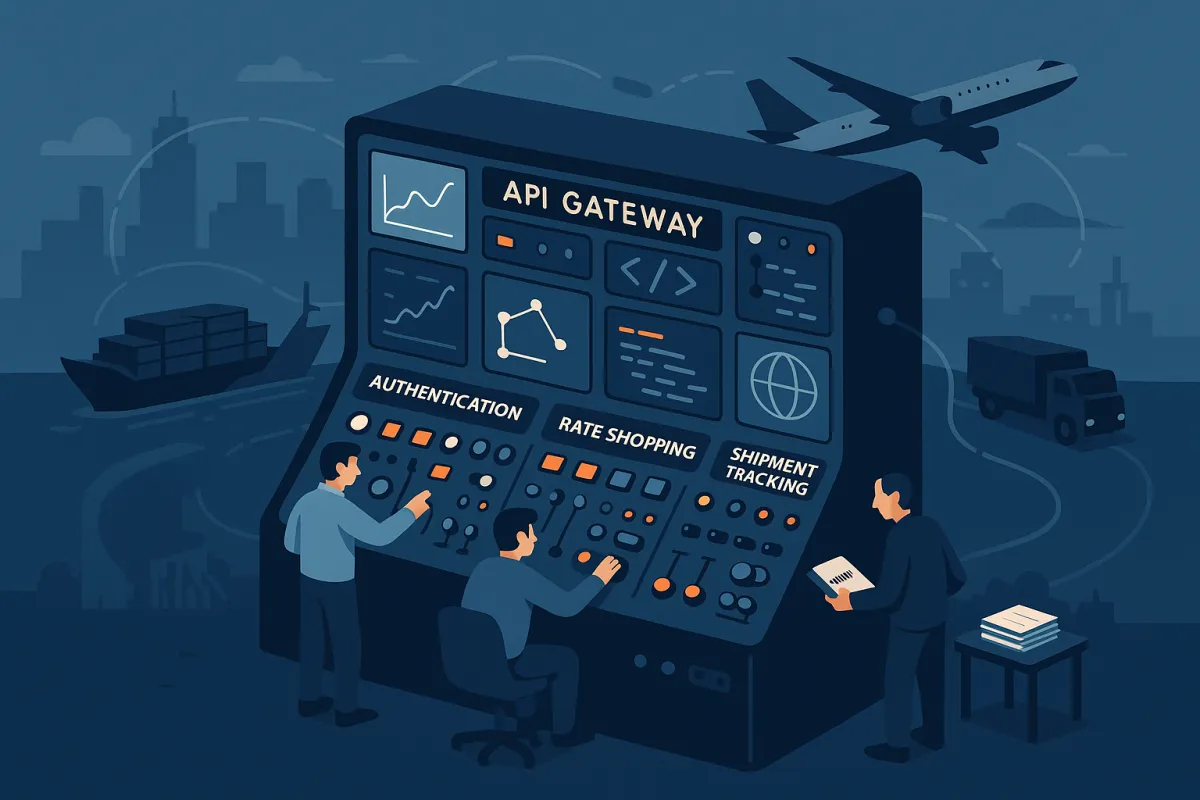
Three years from now, 75% of European shippers will manage multiple API gateways across their carrier connectivity infrastructure. By 2028, more than 75% of corporate organizations will use two or more API gateways due to the adoption of hybrid models, integrations between business units, and merger and acquisition processes. Yet most procurement teams aren't ready for what this means.
The timing couldn't be worse. WiseTech's acquisition of E2open in 2025, Descartes' purchase of 3GTMS for $115 million in March 2025, and Körber's transformation of MercuryGate into Infios following their 2024 acquisition represent just the beginning of a fundamental market restructuring that's turning carrier connectivity management into a high-stakes balancing act. When your TMS vendor gets acquired tomorrow, you'll have days—not months—to understand how your API gateways will interact with entirely new systems.
A German automotive manufacturer discovered this the hard way. Their €800,000 integration disaster started with a simple vendor consolidation notification. Within 90 days, authentication cascades were failing across six different carrier APIs, forcing manual workarounds that delayed shipments and triggered penalty clauses. The problem? They were managing seventeen different API gateways with no unified governance framework when their integration partner was acquired.
Why Multi-Gateway Chaos Is Already Here
Most European shippers think they're dealing with single-gateway scenarios. Check your current setup. You probably have separate gateways for your TMS API connections, carrier-specific portal access tokens, real-time tracking webhooks, and EDI-to-API bridge services. That's four gateways minimum before counting any logistics marketplace connections or freight visibility platform APIs.
While bringing flexibility and scalability, this new dynamic also poses challenges in visibility, security, and governance. The hybrid EDI/API landscape makes this complexity exponential. Hybrid integration strategies combine the reliability of EDI with the speed and agility of APIs, creating a single environment where both technologies work together. This approach allows companies to modernize their supply chain operations without losing compatibility.
Here's what triggers immediate gateway sprawl:
- Legacy carriers still requiring EDI file transfers alongside modern API-first logistics providers
- Different regional carrier preferences (EDIFACT in Germany, ANSI X12 in cross-Atlantic shipments)
- Emergency backup systems when primary API connections fail during carrier system updates
- Separate authentication protocols for rate shopping versus shipment tracking APIs
The M&A wave accelerates this complexity. WiseTech has made 55 acquisitions over the past 10 years, extending its product capability with more than 50 applications across 25 countries. By comparison, with this single acquisition of e2Open, comes five product groups constructed of more than 30 product capabilities, around 5,600 customers, 500,000 connected enterprises across 20 countries. Each acquisition creates integration friction that pushes shippers toward additional gateway solutions.
The Authentication Nightmare That Nobody Talks About
Multi-gateway management fails spectacularly around authentication synchronization. When Carrier A updates their OAuth implementation, your TMS gateway handles the transition smoothly. But your backup visibility platform still uses the old tokens, your freight audit system has different credentials entirely, and your emergency manual portal access relies on completely separate authentication.
One authentication change cascades through four different systems with different update schedules. Result? Three days of delayed shipment updates while IT teams manually coordinate token refreshes across disparate platforms. If a partner's old system can't connect, planners end up re‑keying loads; if a security token expires, trucks can't be booked. Up‑front guardrails keep those surprises off the dock.
This gets worse when carriers switch from EDI to API mid-contract. Maybe one day, but some industries may find it harder than others to make the change. Inventory-centric documents (943, 856, 945, 846) keep riding EDI until your ERP and trading partners are ready for a broader API leap. You're suddenly managing both the old EDI gateway for historical transactions and the new API gateway for real-time updates—to the same carrier.
Strategic Multi-Gateway Governance Framework
Successful multi-gateway management starts with unified policy enforcement, not technical architecture. Companies with robust API governance mechanisms achieve 35% more operational efficiency and reduce the integration time for new services by up to 40%. But governance frameworks designed for single-gateway environments break down when managing hybrid EDI/API complexity.
The governance layer needs four core components:
Authentication Orchestration: Single credential management that automatically distributes updated tokens across all connected gateways. When DHL updates their API keys, your governance layer should refresh credentials in your TMS, visibility platform, and audit systems simultaneously.
Data Transformation Consistency: Unified mapping rules that work regardless of whether data comes through EDI batch files or real-time API calls. Hybrid gateways that accept an API on your side and translate it to X12/EDIFACT only for partners that still need one. Your business logic shouldn't care whether shipment status updates arrive via 214 EDI transactions or JSON webhook payloads.
Fallback Orchestration: Automatic routing when primary gateways fail. If your main API connection to UPS times out, the system should seamlessly switch to EDI file transfer without manual intervention or data loss.
Vendor Consolidation Protection: Policy templates that automatically trigger when integration providers merge or get acquired. This includes data portability requirements, service level continuity clauses, and automatic contract renegotiation triggers.
Leading solutions like Kong, MuleSoft, and increasingly integrated platforms like Cargoson provide multi-gateway orchestration capabilities, though each approaches hybrid EDI/API management differently. Kong excels at API-first governance with EDI gateway plugins, while MuleSoft offers stronger enterprise integration patterns for complex transformation requirements.
Implementation Roadmap: From Chaos to Control in 90 Days
Phase 1 (Days 1-30): Gateway Discovery and Risk Assessment
Start by mapping every API connection, EDI file transfer, and manual portal access your organization currently uses. Include backup systems, development environments, and those "temporary" workarounds that became permanent. Document authentication methods, update frequencies, and which business processes would break if each connection failed.
Identify critical dependency chains. If your TMS relies on rate shopping APIs that connect through a separate gateway from your shipment execution APIs, document what happens when those systems get out of sync.
Phase 2 (Days 31-60): Unified Governance Layer Deployment
Deploy a governance platform that can manage both API and EDI connections. Start with authentication centralization—move your most frequently updated carrier APIs under unified credential management first. Give every partner its own secure token; no shared passwords.
Implement data transformation consistency for your highest-volume lanes. If you're sending 200 shipments daily to DPD via API and 50 weekly LCL shipments via EDI, ensure both connection types feed the same business logic in your internal systems.
Phase 3 (Days 61-90): Automation and Future-Proofing
Enable automatic fallback routing and establish vendor consolidation monitoring. Set up alerts that trigger when your integration providers announce M&A activity, and create automated workflows that begin contract review processes.
Build emergency preparedness protocols. Run a short pilot and keep the old file feed open until loads flow smoothly. Your governance framework should be able to instantly switch all carrier connections to backup gateways without losing data integrity.
Cost-Benefit Analysis: Why Reactive Approaches Cost 4X More
Proactive multi-gateway management requires initial investment—typically €50,000-200,000 for mid-size European shippers depending on carrier connection complexity. But reactive approaches following vendor acquisitions average €200,000-800,000 in emergency integration costs, plus operational disruption that's difficult to quantify.
The break-even calculation depends on your carrier diversity and integration complexity. Companies managing 15+ direct carrier connections typically recover their governance investment within 18 months through reduced integration maintenance costs and avoided emergency expenses.
Hidden reactive costs include:
- Emergency consulting fees when your TMS provider gets acquired (€800-1,500 daily rates become standard)
- Dual-platform licensing during forced migrations (6-12 month overlap periods)
- Data synchronization cleanup after manual workarounds (typically 40-60 hours of technical work per carrier)
- Business disruption costs from delayed shipments during integration failures
This accelerates the onboarding of new partners, reduces the time-to-market for digital products, and strengthens competitive agility. Companies with robust API governance mechanisms achieve 35% more operational efficiency and reduce the integration time for new services by up to 40%.
The ROI calculation changes dramatically when considering vendor consolidation risks. Every month you delay implementing unified governance, you increase the probability that an acquisition announcement will force expensive reactive measures. With current M&A activity, European shippers have roughly 18 months before the next wave of major consolidation impacts their carrier connectivity stack.
Vendor Selection for Multi-Gateway Resilience
Choose integration partners and TMS providers that explicitly support multi-gateway governance. Avoid vendors that bundle API management as an afterthought to their core offering. Choosing a TMS partner that is well-versed in both will be essential for both carriers and brokers. Deep domain expertise in either will best ensure integrating with customers or partners is optimized to securely support data exchange.
Evaluate vendors on specific multi-gateway capabilities: authentication federation across disparate systems, data transformation consistency between EDI and API flows, automatic failover orchestration, and contractual protection against acquisition-driven service changes.
European-built solutions like Cargoson increasingly offer native multi-gateway management designed for European cross-border complexity, while global platforms like nShift and Transporeon provide extensive carrier networks with varying degrees of gateway consolidation capability.
The next 24 months will determine whether your organization controls its carrier connectivity destiny or gets forced into expensive reactive measures by vendor consolidation you didn't see coming. With a consolidated view of all APIs and their dependencies, technology teams gain control, and business areas regain speed. It is a paradigm shift: the multi-gateway becomes a strategic layer, not just an operational one.
Start your gateway inventory this week. The cost of preparation is predictable; the cost of being unprepared is whatever your vendors decide to charge when you have no alternatives.