
Hybrid vs Pure Cloud TMS Architecture: The European Shipper's 2026 Migration Decision Framework for Balancing Regulatory Compliance, Vendor Consolidation, and Operational Continuity Without Joining the 76% Failure Rate
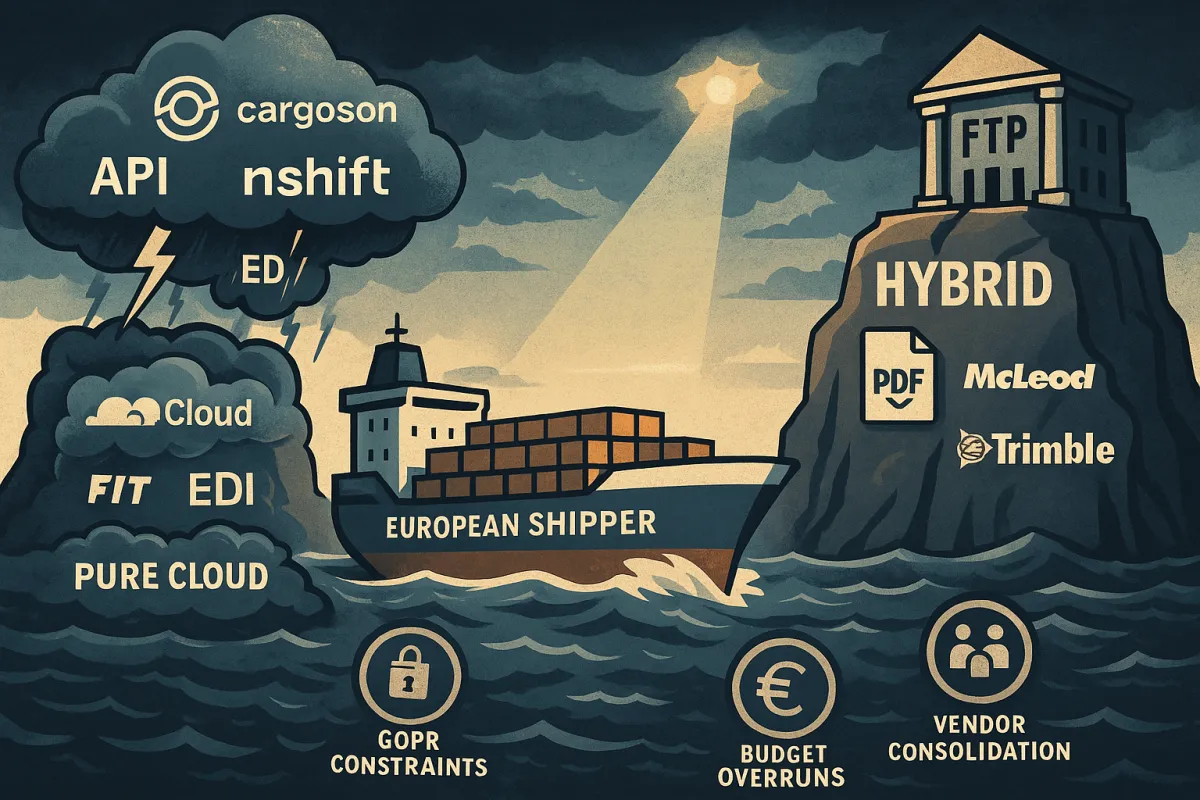
European manufacturers facing regulatory pressure and vendor consolidation in 2026 confront an architectural decision that will determine their operational trajectory for the next decade. With 62% of cloud migration projects experiencing difficulties or failure and 76% of European logistics transformations never meeting their targets, the choice between pure cloud, hybrid cloud, or gradual migration approaches for TMS architecture demands careful analysis beyond traditional vendor comparisons.
The timing creates unprecedented complexity. WiseTech's $2.1 billion acquisition of E2open and Descartes' $115 million purchase of 3GTMS signal the largest vendor consolidation wave in TMS history, while July 2027's eFTI mandate and February 2026's ICS2 v3 requirements create regulatory deadlines that cannot be delayed.
Why European TMS Cloud Migration Architectural Decisions Matter More in 2026
The convergence of regulatory deadlines, vendor consolidation, and technology maturity creates what industry analysts call a "perfect storm" for European transport technology procurement. FedEx SOAP retirement in June 2026, USPS switching off Web Tools APIs Version 3 in January 2026, and the mandatory nature of eFTI compliance by July 2027 force architectural decisions that cannot be reversed without significant cost.
European shippers managing annual transport spends above €10 million face a particularly volatile moment. Budget overruns hit 75% of European TMS implementations while regulatory deadlines approach simultaneously, vendor options disappear through consolidation, and 66% of technology projects end in partial or total failure.
The vendor landscape transformation adds urgency to architectural planning. Companies undergoing integration often experience 12-18 months of reduced innovation while they harmonize platforms and teams. Post-acquisition integration timelines typically span 12-18 months, during which platform development stagnates and support quality deteriorates.
The 76% Failure Rate Problem
Most European shippers underestimate TMS implementation complexity, particularly around integration requirements. The 76% who struggle skip the planning, underestimate the complexity, and treat their TMS like a simple software purchase rather than a strategic transformation. The financial impact proves substantial: the average cost to migrate a mid-market company's workloads to cloud is $280,000, including services, tooling, and first-year costs, while enterprise migrations (5,000+ users) average $1.2–$4.5 million depending on complexity and number of applications.
Implementation scope frequently exceeds initial estimates. A basic domestic shipper needs 10-15 integrations minimum, totaling 1,000-1,500 hours of labor, while most shippers today require an average of 40 integrations. For European cross-border operations, this complexity multiplies through varying carrier protocols and regulatory requirements by country.
Hidden costs emerge throughout the process. Post-migration cloud costs are 23% higher than estimated in the first 12 months, primarily due to right-sizing failures, while data transfer (egress) fees account for 6–12% of total migration costs — a cost many organizations underestimate.
Pure Cloud TMS Architecture: Benefits and European Reality Check
Cloud-native TMS platforms offer compelling advantages for European shippers, particularly in integration velocity and carrier onboarding capabilities. Cloud TMS (Truckbase, Tailwind, Rose Rocket, Alvys, AscendTMS, ITS): 4–10 weeks, $0–$25K implementation, 1–3 office staff committed. Enterprise TMS (McLeod, Trimble): 4–9 months, $50K–$250K+ implementation, dedicated PM and 5–15 office staff committed.
The operational difference between cloud-native and traditional systems becomes apparent in day-to-day operations. Real-time processing capabilities eliminate the 15-60 minute delays common with batch-processing legacy systems, enabling European shippers to respond to disruptions and opportunities within minutes rather than hours.
Modern cloud platforms like Cargoson, alongside established solutions including nShift, Transporeon, and emerging platforms like ShipStation, provide API-first architectures that dramatically reduce integration time. Carriers that previously required weeks or months of EDI setup can now be onboarded in days through standardized APIs.
GDPR and Data Residency Constraints
European data protection requirements significantly influence architectural decisions for cloud TMS implementations. Under the GDPR, transferring personal data to a non-adequate country without specific safeguards is a violation that can cost up to 4% of global turnover. For an AI-first company, the model weights themselves—often containing memorized personal data from training sets—are the most sensitive assets.
Many global cloud providers offer "EU regions" but retain the ability to transfer data for support or analytics. Many global cloud providers offer "EU regions" but retain the ability to transfer data to non-EU jurisdictions for support, debugging, or analytics purposes. This can violate GDPR transfer restrictions without the customer even knowing.
The practical solution requires careful vendor selection. The new sovereign-cloud offerings — AWS European Sovereign Cloud (announced October 2023, first region in Brandenburg expected 2026), Microsoft EU Data Boundary (rolled out through 2024-2025), Google's S3NS partnership with Thales in France, and Bleu (Capgemini/Orange/Microsoft) targeting French SecNumCloud qualification — represent a serious effort to address the Cloud Act gap.
For TMS implementations, this means evaluating vendor certifications carefully. ISO 27001, SOC 2 Type II, and C5 (the BSI Cloud Computing Compliance Criteria Catalogue) are strong indicators of operational maturity. VarnaAI selected Hetzner specifically because it meets all four criteria: German data centers, German legal jurisdiction, transparent subprocessor lists, and ISO 27001 certification.
Hybrid Cloud TMS Architecture: The Pragmatic Middle Path
Hybrid cloud represents a strategic compromise that combines cloud scalability with on-premises control, particularly relevant for European shippers managing sensitive data or legacy ERP constraints. hybrid cloud deployments are expanding at an 18%+ growth rate through 2031, driven by organizations seeking to balance regulatory compliance with operational flexibility.
The architectural approach allows sensitive workloads to remain on-premises while leveraging cloud resources for scalable operations like carrier integration and analytics. European manufacturers with established SAP or Oracle ERP systems often find hybrid approaches enable TMS integration without requiring complete ERP migration.
Leading vendors recognize this demand. Solutions like MercuryGate (now Infios), Descartes, E2open, and modern European platforms including Cargoson offer flexible deployment options that support hybrid configurations. This flexibility becomes particularly valuable when regulatory requirements vary by country or when legacy systems cannot be easily migrated.
Managing Complexity and Operational Overhead
The primary challenge with hybrid cloud TMS implementations centers on observability and operational complexity. The issue of visibility gaps is becoming a limiting factor for the scalability of hybrid clouds. It is estimated that most enterprises today are able to collect metrics, logs, and traces. The issue is, therefore, not the availability of such data, but the fact that there is fragmentation in the signals.
This fragmentation creates practical problems for TMS operations. The issue of system behavior in a hybrid environment is such that it is no longer linear. This means that a single user request can traverse multiple services in the hybrid environment, including the cloud, on-prem, and edge. Failures are, therefore, never isolated. It is in this sense that the issue of observability becomes important.
The operational impact translates to measurable costs. IBM's 2024 Cost of a Data Breach report found that breaches involving data across multiple environments (public cloud, private cloud, on-premise) cost over $5 million on average and took 283 days to identify and contain. Visibility gaps directly translate to slower detection and higher impact.
Implementation requires deliberate architectural decisions to maintain unified control. A unified cloud platform standardizes provisioning, deployment, observability, and governance across AWS, Azure, GCP, and on-prem systems, but achieving this standardization demands investment in platform engineering capabilities that many mid-market European shippers lack.
Vendor Consolidation Impact on Architectural Choices
The 2025-2026 period marks the most significant consolidation wave in TMS vendor history, fundamentally altering procurement dynamics for European shippers. WiseTech's $2.1 billion acquisition of E2open represents the largest in its history, while Descartes' deal for 3GTMS marks the 32nd acquisition by the company since 2016.
Consolidation creates three distinct vendor categories with different risk profiles. The post-consolidation landscape reveals three distinct categories: global mega-vendors (Oracle TM, SAP TM, E2open/WiseTech, Descartes), European specialists (Alpega, nShift, Transporeon), and emerging European-native solutions like Cargoson that maintain development focus specifically on European regulatory requirements.
The implications extend beyond feature sets to fundamental platform stability. When your TMS vendor becomes an acquisition target, you inherit these integration risks without directly managing the project. The technical consequences prove disruptive: platform development typically stagnates during integration periods while engineering resources focus on harmonization rather than innovation.
Pricing impacts follow predictable patterns. Plan for 15-20% budget increases in 2026-2027 if reactive, or 8-12% if proactive with proper contract protection. This difference reflects the procurement leverage available before consolidation eliminates competitive pressure between formerly independent vendors.
Contract Protection for Hybrid Deployments
Standard TMS procurement contracts inadequately address vendor acquisition scenarios, creating particular vulnerability for hybrid deployments where architecture spans multiple environments. Standard TMS procurement contracts don't address vendor acquisition scenarios, leaving European shippers vulnerable to post-acquisition changes without recourse. Acquisition-resistant contracts require specific protections including 12-18 months advance notice for ownership changes, guaranteed functionality preservation for minimum periods, and migration assistance rights.
Hybrid architectures require additional contract protections beyond standard acquisition clauses. Feature deprecation rights become particularly important when vendor consolidation eliminates redundant platforms. Feature deprecation rights protect against post-acquisition platform consolidation that eliminates capabilities European operations require. Include contractual guarantees for feature availability, performance benchmarks, and alternative solution provision if acquired vendors discontinue functionality critical to European regulatory compliance or operational requirements.
Financial protection requires specific attention to hybrid deployment costs. Your contracts should include pricing protection clauses that lock rates for 24 months following any vendor ownership change. For hybrid configurations, this protection should extend to both cloud subscription fees and on-premises licensing costs.
The European Shipper's Architectural Decision Framework
Selecting between pure cloud, hybrid, or gradual migration approaches requires structured evaluation against European-specific criteria. The framework prioritizes regulatory compliance, vendor stability, and implementation risk rather than traditional feature comparisons.
Regulatory Compliance Assessment: Begin by mapping your regulatory requirements across all operational countries. As of January 2026, eFTI platforms and service providers can start preparing for operations while Member States authorities may start accepting data stored on certified eFTI platforms for inspection, creating the first practical deadline for TMS platforms to demonstrate compliance capabilities. By July 2027, all Member States will be required to accept electronic transport data via eFTI-certified platforms, making 2026 the critical preparation year.
Data Residency Requirements: Evaluate your data sensitivity and storage requirements. The most direct response to GDPR's transfer framework is EU-region data storage. Major cloud providers — AWS, Google Cloud, Azure — offer EU-region deployments that keep data physically within the EEA, eliminating the transfer question entirely for data that never leaves EU infrastructure. This is not required by GDPR, but it resolves transfer compliance elegantly and is increasingly favored by enterprise European customers who want contractual certainty that their data remains in EU jurisdiction.
Vendor Acquisition Resistance: Current consolidation creates three distinct vendor categories: global mega-vendors (Oracle TM, SAP TM, E2open/WiseTech), European specialists and emerging solutions. Assess vendor financial stability, product roadmap certainty, and customer service capacity during potential ownership transitions.
Integration Complexity Analysis: Document your current carrier network and integration requirements. Cross-border European operations typically require 40+ carrier integrations, each with varying API maturity and regulatory compliance capabilities. Pure cloud platforms generally offer faster integration through standardized APIs, while hybrid approaches may better support legacy EDI relationships.
The evaluation should include emerging European-native solutions. Look for vendors with local development teams, European data residency compliance, and multi-language support as baseline requirements rather than premium features. Platforms like Cargoson, alongside established European specialists including Alpega and Transporeon, often provide advantages in regulatory compliance and cross-border carrier connectivity.
Implementation Timeline and Risk Mitigation
Successful European TMS implementations follow phased approaches that protect against vendor disruption and regulatory compliance gaps. Phased implementation strategies protect against vendor disruption by establishing core functionality first, then adding compliance modules and specialized features in subsequent phases. This approach allows platform changes or vendor consolidation to be addressed without complete system replacement.
Phase 1 (Months 1-3): Core Platform Establishment Focus on basic transport management functionality and primary carrier integrations. This phase should include data migration, user training, and core workflow implementation. Avoid advanced features until basic operations prove stable.
Phase 2 (Months 4-6): Regulatory Compliance Integration Vendors claiming regulatory readiness should demonstrate functional integration by January 2026, not just promise compliance by the July 2027 mandate. This timeline separation allows you to evaluate actual capabilities rather than marketing promises.
Phase 3 (Months 7-9): Advanced Features and Optimization Add analytics, advanced reporting, and optimization features once core operations prove stable. This timing allows you to address any vendor stability issues before committing to advanced functionality.
The procurement window for optimal terms continues to narrow. The procurement window for securing optimal TMS platforms before vendor consolidation eliminates choices and capacity shortages worsen cost structures runs through Q1 2026. Organizations that delay face reduced vendor options and increased pricing as consolidation eliminates competitive pressure.
Your architectural choice between pure cloud, hybrid, or gradual migration will likely define your operational capabilities for the next 5-7 years. European shippers who act decisively within this compressed timeline—with proper frameworks addressing vendor stability, regulatory compliance, and implementation risk—position themselves to navigate 2026's convergence successfully. Those who delay risk joining the growing statistics of failed implementations and budget overruns that characterize reactive procurement strategies.