
Hybrid EDI/API Integration Strategy for European TMS: How to Modernize Carrier Connectivity Without Breaking Legacy Workflows or Budgets in 2025
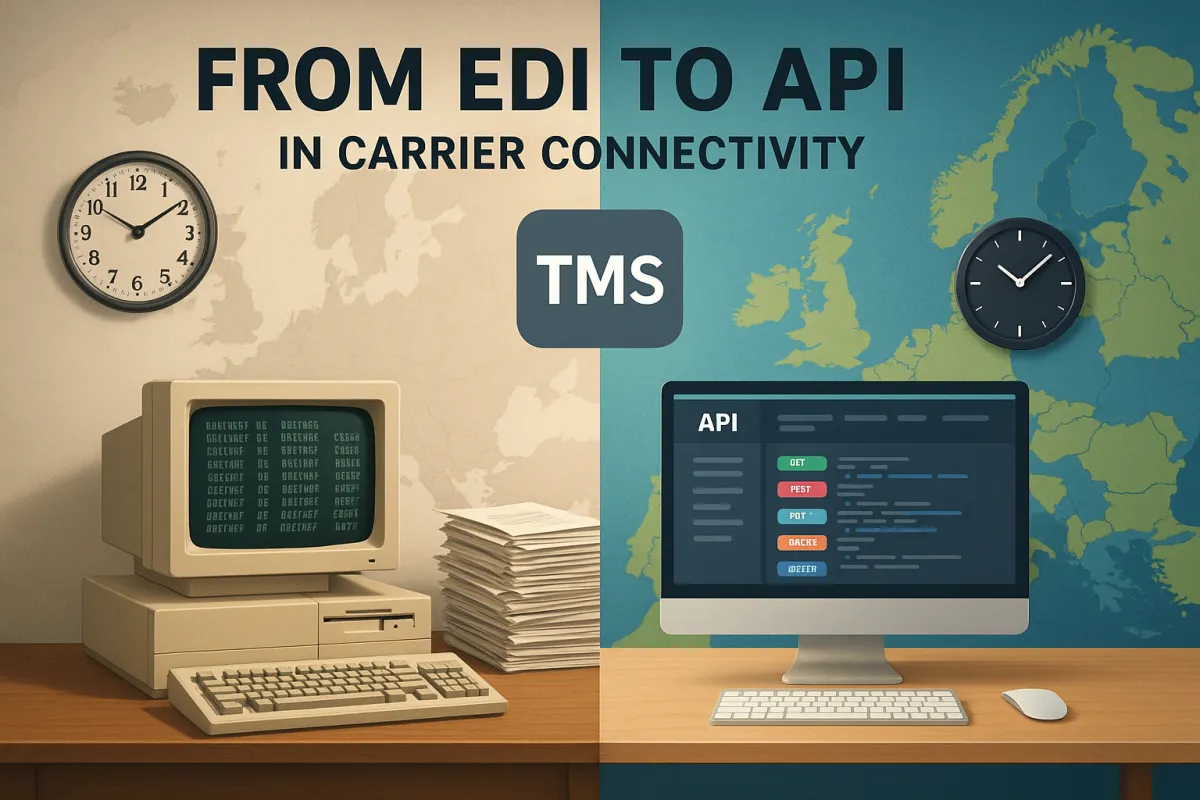
Last month, a mid-sized German automotive parts manufacturer discovered six months into implementing their new TMS that their chosen platform couldn't handle their complex carrier network across 12 countries. They'd already spent €800,000 before realizing their supposedly modern solution required costly custom development for basic European carrier integrations. The culprit? They'd selected a North American-focused platform without understanding the intricate reality of European logistics: the European TMS market reached around €1.2 billion in 2023, growing at a CAGR of 12.1 percent, forecasted to reach €2.1 billion in 2028, but this growth masks a fundamental challenge that's forcing shippers to reconsider their integration approaches entirely.
The European Shipper's Integration Dilemma: Why Pure API or Pure EDI Strategies Fail
Here's what most technology leaders miss: effective August 31, 2024, FedEx disabled key FedEx Web Services WSDLs, including Tracking, Address Validation, and Validate Postal Codes, forcing thousands of European shippers to scramble for API migrations. Meanwhile, EDIFACT messaging still dominates cross-border European transport - creating a mixed environment where your TMS must handle both integration types effectively.
The reality hits harder when you understand the regulatory backdrop. The EU ETS now requires shipping firms to surrender 70% of 2025 emissions (up from 40%), with 100% compliance by 2026. These compliance costs are being passed directly to shippers, making operational efficiency more urgent than ever. Yet most TMS platforms force you to choose between modern APIs or legacy EDI compatibility.
Consider the typical European supply chain complexity: your German automotive supplier uses EDIFACT messaging, your Italian logistics provider requires REST APIs, and your UK fulfillment center still operates on CSV file uploads. A pure API strategy leaves you disconnected from traditional European carriers, while sticking with EDI means missing real-time data that modern operations demand.
The Cost of Getting Integration Strategy Wrong: Real European Case Studies
That German automotive manufacturer's mistake wasn't unique. Their story reflects a broader pattern across European manufacturing: companies invest heavily in TMS platforms without validating carrier compatibility first. They assumed modern meant better, only to discover their primary logistics partners - established European carriers with decades-old EDIFACT systems - couldn't integrate without expensive middleware.
The financial impact compounds quickly. Beyond the initial €800,000 sunk cost, they faced additional expenses: custom integration development (€200,000), staff retraining (€50,000), and six months of operational inefficiency. Most damaging was the opportunity cost - their competitors gained market advantage while they struggled with basic transport coordination.
Similar patterns emerge across European shippers. A Dutch electronics distributor spent nine months trying to force their modern API-only platform to communicate with their network of regional carriers. They eventually needed to maintain parallel systems - the new TMS for reporting and the old EDI setup for actual operations.
These failures share common characteristics: underestimating carrier integration complexity, assuming all European logistics follows modern standards, and missing the hybrid nature of European transport networks. Right now in Europe, almost every country has ratified eCMR, and the remaining countries are expected to ratify by 2026. From 2026, all the countries in the European Union will be accepting the eCMR, yet the transition period requires supporting both digital and paper processes simultaneously.
Understanding Your Current Integration Landscape: EDI vs API Assessment Framework
Before choosing your integration approach, you need visibility into your actual carrier network. Most shippers discover they have three distinct carrier categories: digital-native providers (API-first), traditional European carriers (EDIFACT-based), and hybrid operators supporting both methods.
Start by auditing your top 20 carriers by volume. Document their preferred communication methods, current integration capabilities, and timeline for digital transformation. You'll likely find that 60-70% of your European carriers still primarily use EDIFACT messaging for critical functions like booking confirmations and proof of delivery.
The assessment reveals why pure strategies fail. Your highest-volume carriers may offer APIs for tracking but require EDIFACT for booking modifications. Conversely, newer logistics partners might only support REST APIs but handle smaller shipment volumes. Partner buy-in remains the top challenge - finance teams comfortable with traditional EDI control reports resist moving to API-only digital logs.
System limitations add another layer of complexity. Your existing ERP might generate perfect EDIFACT messages but struggle with OAuth authentication required by modern APIs. Until technical capabilities, partner readiness, and compliance requirements align, compromise becomes necessary.
Solutions like Cargoson recognize this reality with native hybrid capabilities, while platforms like nShift and Transporeon offer similar dual-approach support through different means - though implementation complexity varies significantly.
The Three-Phase Hybrid Migration Strategy: From Legacy to Modern Without Disruption
Smart European shippers use workload splitting as their transition strategy. Live, decision-driving data travels via API while audit-critical records that make more sense as documents stay on EDI. This approach acknowledges that plenty of shippers use both EDI and API, with the simple approach being to split workloads based on data type and business requirements.
Phase 1 focuses on assessment and planning. Map your current carrier landscape, identifying which partners support APIs, which require EDIFACT, and which offer both options. Establish integration priorities based on shipment volume and operational importance. Test API connections with willing partners while maintaining existing EDI flows.
Phase 2 introduces parallel operation. Begin routing real-time queries (rates, tracking, delivery status) through APIs while keeping transactional documents (bookings, invoices, compliance records) on EDIFACT. This reduces integration risk while providing immediate benefits from real-time data.
Phase 3 implements gradual migration. As carriers upgrade their systems and your team gains API expertise, shift additional functions from EDI to API. The timeline depends on your carriers' digital transformation progress - some European logistics providers are actively modernizing, while others plan to support EDIFACT indefinitely.
Platforms like Cargoson, FreightPOP, and Shiptify have built hybrid capabilities from the ground up, though each takes different architectural approaches to solving the same fundamental challenge.
Practical Implementation: API-First for Real-Time, EDI for Compliance-Critical
The most successful hybrid implementations follow a clear division of responsibilities. Many companies today use a hybrid model, combining EDI for high-volume, structured transactions and APIs for dynamic, real-time data access. For example, EDI handles large-scale bookings, invoicing and customs documentation while APIs provide live status updates and container tracking.
Rate shopping exemplifies where APIs excel. Modern logistics requires comparing rates across multiple carriers in real-time during order processing. APIs deliver these results in seconds, while EDIFACT typically requires batch processing with hours-long response cycles. However, once you've selected a carrier and created a shipment, the formal booking document might still flow through EDIFACT to ensure compliance with existing audit processes.
Document compliance remains EDIFACT's strength. European regulatory requirements often specify exact document formats and approval workflows that EDIFACT handles elegantly. Your finance team knows how to audit EDIFACT-based invoices, and your customs broker's systems expect specific EDIFACT message structures.
Tracking integration demonstrates the hybrid approach's power. Use APIs to pull real-time shipment status for customer-facing applications while maintaining EDIFACT milestone notifications for internal ERP systems. This gives customers the instant visibility they expect without disrupting established business processes.
Platforms like Cargoson offer native support for this division, while solutions like ShippyPro and EasyPost typically require additional configuration to achieve similar hybrid functionality.
Managing the Technical Transition: Gateway Solutions and Middleware Strategies
For comprehensive hybrid operations, some shippers implement middleware gateways. This cloud service takes in an API call and quietly converts it to X12 or EDIFACT (and back again) so every partner sees its preferred format. You gain real-time speed without asking carriers to retool immediately, though translation services add operational costs.
Gateway solutions work best for organizations with diverse carrier networks and limited internal development resources. The middleware handles protocol translation, data formatting, and error handling while presenting a unified interface to your TMS. However, this convenience comes with ongoing subscription costs and potential single points of failure.
Translation layers introduce latency - typically 200-500 milliseconds per message - which may impact real-time applications. They also require careful error handling since API timeouts and EDIFACT delivery failures have different characteristics and recovery procedures.
Consider the cost-benefit carefully. Middleware can cost €5,000-15,000 monthly for mid-sized operations, while building direct integrations might require 6-12 months of development time. The calculation depends on your internal technical capabilities, carrier diversity, and timeline requirements.
Cargoson's approach of native hybrid support eliminates middleware needs in many cases, providing direct API and EDIFACT connectivity without translation overhead. This architectural decision reflects the reality that European shippers need both protocols for the foreseeable future.
Future-Proofing Your Integration Investment: 2025-2027 Regulatory and Technology Trends
From 2026, all the countries in the European Union will be accepting the eCMR. Right now in Europe, almost every country has ratified eCMR, and the remaining countries are expected to ratify by 2026. This regulatory push toward digital documentation is forcing carriers to upgrade their integration capabilities, but the transition creates new hybrid requirements.
Even with eCMR mandatory by 2026, many carriers will support both digital and paper processes during the transition period. Your TMS must handle eCMR-compliant digital signatures alongside traditional EDIFACT confirmation messages. The regulatory framework encourages digitization without mandating immediate abandonment of existing processes.
The EU ETS now requires shipping firms to surrender 70% of 2025 emissions, with EUA prices hitting €120/ton. These compliance costs are driving carriers toward more efficient operations, often including API adoption for better visibility and optimization. However, the same cost pressures make carriers hesitant to abandon working EDIFACT systems.
European TMS platforms are preparing differently for these changes. Cargoson builds compliance features directly into their hybrid architecture, while nShift and Transporeon offer specialized modules for regulatory reporting. The key is choosing platforms that can adapt to regulatory changes without requiring complete integration rewrites.
The timeline for pure API adoption remains unclear. While new carriers typically launch with API-first approaches, established European logistics providers are more likely to maintain EDIFACT support indefinitely. Your integration strategy should assume hybrid requirements through at least 2030, making platform choice decisions accordingly.