
Hybrid EDI/API Integration Strategy 2026: How European Shippers Can Modernize Carrier Connectivity Without Breaking Legacy TMS Workflows or Partner Relationships
Most European manufacturers and retailers face the same brutal reality: their transport management systems run on EDI connections built two decades ago, yet Member State authorities must accept information shared electronically by operators via certified eFTI platforms starting July 2027. You can't rip out systems that handle 75% of your transport partnerships overnight, but regulatory deadlines don't negotiate.
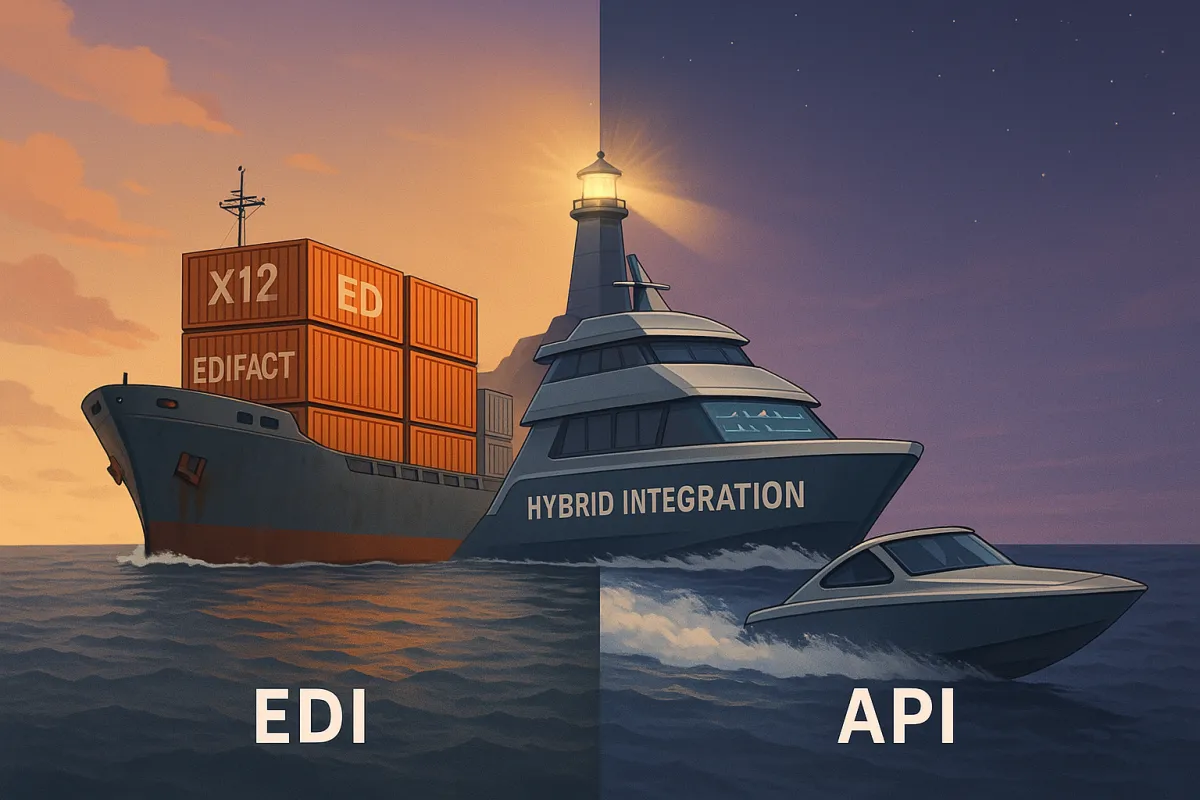
The answer isn't choosing between EDI and API anymore. Instead, hybrid integration strategies combine the reliability of EDI with the speed and agility of APIs, creating a single environment where both technologies work together. This approach keeps existing partnerships intact while preparing your infrastructure for eFTI compliance and next-generation carrier connectivity.
Why Complete EDI Replacement Fails for European Shippers
Every integration consultant promises the same thing: migrate to APIs, modernize your stack, future-proof everything. But here's what they don't mention upfront—Replacing EDI entirely isn't a viable option for most businesses that operate on a supply chain. Partner requirements, industry standards, and legacy systems make a complete transition unrealistic.
The numbers don't lie. Retail and consumer goods accounted for 28.02% of the EDI software market share in 2024, utilizing EDI to synchronize data across physical stores, e-commerce platforms, and third-party logistics. These aren't legacy holdouts clinging to outdated technology—these are strategic decisions based on partner requirements and operational realities.
The €500K+ Hidden Costs of API-Only Migration
Pure API migrations regularly exceed initial budgets by 200-300%. The hidden costs compound quickly: partner resistance, integration complexity, testing requirements, and staff retraining. Modern enterprises require real-time data exchange, flexible integration patterns, and operational agility that legacy EDI systems struggle to provide. But the reverse is equally true—API-only architectures can't handle the standardized document exchange that underpins global supply chains.
Consider what happens when your largest transport partner only accepts EDIFACT purchase orders. You can't force them to rebuild their systems for your API preferences. The carrier relationship matters more than technology preferences, especially when transport capacity gets tight.
Building Your Hybrid Integration Architecture: The Three-Layer Strategy
The future of business data exchange lies in combining technologies rather than choosing between them. Modern integration platforms now blend EDI's standardized reliability with API's real-time capabilities, creating powerful hybrid systems that maximize the strengths of both approaches.
Smart European shippers build hybrid architectures using three distinct layers that work together while serving different operational needs.
Layer 1: Preserving Critical EDI Connections
Your foundational layer maintains existing EDI partnerships without disruption. The challenge isn't choosing one over the other — it's gaining the speed and visibility of APIs without disrupting the EDI connections that partners already depend on. EDI may be older technology, but it's deeply standardized, reliable, and widely trusted across the industry.
Legacy EDI connections handle your highest-value transport partnerships. These relationships took years to establish, involve complex rate negotiations, and often include service-level guarantees you can't replicate elsewhere. Breaking these connections for technology migration would be operationally and financially reckless.
Modern platforms from providers like Cargoson, along with established solutions from nShift, Descartes, and others, preserve these EDI connections while adding hybrid capabilities on top.
Layer 2: The Translation and Transformation Bridge
For deeper visibility, some add a middleware gateway. This cloud service takes in an API call and quietly converts it to X12 or EDIFACT (and back again) so every partner sees its preferred format. This translation layer becomes your hybrid integration's secret weapon.
The bridge layer handles format transformation without requiring partners to change anything. Your internal systems get real-time API responses while transport partners receive familiar EDI documents. Modern platforms now offer pre-built connectors that integrate EDI directly with major ERP systems, including SAP, Oracle, NetSuite, and Microsoft Dynamics. These hybrid connectors enable automated workflows where EDI handles standardized transactions while APIs ensure ERP systems always have the most current data available.
Layer 3: Selective API Implementation for Strategic Partners
Your top layer deploys APIs strategically with partners who support modern connectivity. In 2026, major carriers including UPS, USPS, and FedEx will complete a shift that's been years in the making: retiring legacy carrier APIs in favor of more modern, secure platforms. These carriers become your API integration priorities.
Focus API implementations on high-value use cases: real-time rate shopping, dynamic routing decisions, and exception management. Speed – Messages travel in seconds instead of hours, and trigger pick tickets sooner. Error handling – One bad record can be fixed on the spot. No whole‑file resend. Visibility – APIs refresh dashboards in seconds, giving teams time to adjust labor, inventory, or routing before costs mount.
Implementation Roadmap: 90-Day Hybrid Deployment Strategy
Most hybrid integration projects fail because they try to solve everything simultaneously. Success requires a phased approach that minimizes operational risk while delivering measurable improvements quickly.
Phase 1: Legacy System Audit and Partner Mapping (Days 1-30)
Start with a comprehensive audit of existing EDI connections and partner capabilities. Map data flows, identify bottlenecks, and catalog which partners support both EDI and API connectivity. This assessment reveals quick-win opportunities for hybrid implementation.
Document current EDI transaction volumes, processing times, and error rates. Identify partners who've modernized their connectivity options but still accept your EDI transmissions. These become your hybrid integration candidates.
Phase 2: Pilot Integration with High-Value Carriers (Days 31-60)
Deploy hybrid connectivity with your most important transport partners who support both protocols. June 2026: Remaining SOAP-based endpoints will be fully retired. After this, integrations must use FedEx's REST APIs to access rates, labels, tracking, and future service updates. FedEx becomes a natural pilot partner due to their forced migration timeline.
Run parallel operations during the pilot phase. Send the same transport orders via both EDI and API to validate data consistency and identify integration gaps. This parallel approach proves hybrid reliability before production deployment.
Phase 3: Full Production Deployment with Monitoring (Days 61-90)
Expand hybrid integration to remaining partners while implementing comprehensive monitoring. When data lives in different "languages," it creates a visibility gap. If your API stream is processed in real-time but your EDI batching happens every four hours, your automated workflows are only as fast as your slowest protocol. This lack of synchronization makes true end-to-end automation nearly impossible to scale.
Deploy unified monitoring that tracks performance across both EDI and API connections. Monitor response times, error rates, and data consistency to ensure hybrid architecture delivers promised benefits.
Regulatory Compliance Through Hybrid Integration
Member States authorities may start accepting data stored on certified eFTI platforms for inspection from January 2026. Use this voluntary period for real-world testing and staff training. QR code generation and machine-readable format requirements become mandatory by July 2027. Your TMS must generate these automatically for every shipment across all transport modes.
Hybrid integration architectures handle eFTI compliance more elegantly than pure API or pure EDI systems. The translation layer can generate eFTI-compliant digital documents from existing EDI transaction data while APIs provide real-time access to shipment information for regulatory authorities.
Estimated cost savings of up to €1 billion per year for the EU transport and logistics sector make eFTI compliance economically attractive, not just regulatory necessity. Early adoption through hybrid integration positions you for competitive advantage.
Leading TMS providers like MercuryGate, Descartes, and Cargoson are preparing eFTI-compatible solutions that leverage hybrid architectures. Solutions from providers like Cargoson, nShift, Descartes, and emerging technologies position forward-thinking shippers for sustained competitive advantage.
Cost-Benefit Analysis: Hybrid vs. Pure API Migration
Pure API migration projects typically require 12-18 months and budgets exceeding €500,000 for mid-sized manufacturers. Hybrid approaches deliver similar functionality improvements in 90 days with budgets under €200,000.
The financial advantage stems from preserved EDI investments rather than wholesale replacement. Many organizations maintain EDI for established partner relationships and compliance requirements while adopting APIs for new digital initiatives and real-time integration needs. This hybrid approach, while pragmatic, can increase operational complexity and integration management overhead. But complexity is manageable; complete system replacement is risky.
Risk mitigation alone justifies hybrid approaches. Going "API-only" promises real-time updates and cost savings, but the reality is rarely binary... Partner Readiness - every carrier and customer can send/receive APIs or at least use a self‑service web portal. System Limits - your WMS, TMS, or ERP can send and receive API messages without messy workarounds. Compliance Comfort - finance and quality teams are confident using digital logs in place of traditional EDI control reports. Until all three conditions align, hybrid integration remains the safer path.
Future-Proofing Your Hybrid Architecture for 2027 and Beyond
In 2026, supply chain orchestration closes the execution gap—unifying EDI, APIs, and AI to protect OTIF, speed resolution, boost resilience, and provide real-time data. Hybrid integration architectures provide the foundation for this unified approach.
Your hybrid architecture evolves naturally toward API-first as partners modernize their systems and regulatory requirements shift. Even after these migrations are complete, carriers will continue updating pricing logic, delivery data, security requirements, and services. Hybrid platforms handle these changes without requiring architectural overhauls.
The regulatory landscape is arguably the most powerful catalyst for EDI technology adoption between 2026 and 2030. Governments worldwide are implementing mandatory e-invoicing regimes to reduce the "VAT gap"—the difference between expected and actual tax revenue—and to streamline fiscal administration. The European Union's "VAT in the Digital Age" (ViDA) reform is the most significant change to VAT administration since the inception of the Single Market. Effective July 1, 2030, all intra-EU B2B and B2G (Business-to-Government) invoices must be issued as structured e-invoices using the Peppol standard (EN-16931 format).
Position your hybrid architecture for AI integration, blockchain connectivity, and emerging standards without breaking existing partnerships. The flexibility to adapt becomes your competitive advantage as European logistics digitization accelerates.
Companies implementing hybrid EDI/API strategies now gain operational advantages while competitors struggle with compliance deadlines. The July 2027 eFTI deadline approaches faster than you think, and hybrid integration delivers the benefits of early implementation well beyond regulatory compliance.