
France's ELO Border Mandate Forces Shipper Data Fixes
France's ELO customs envelope is now mandatory for UK-France freight. See what shippers must fix in carrier EDI/API data to avoid boarding refusals.
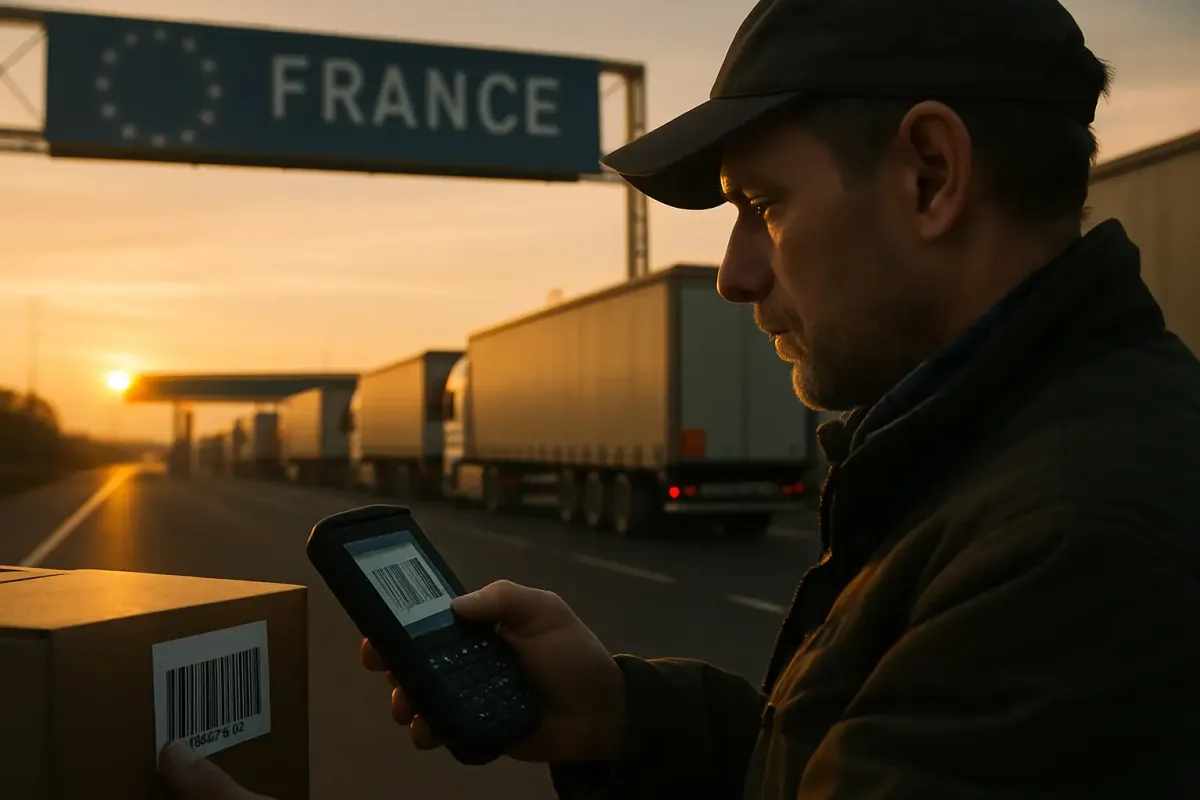
France Turns On the ELO Barcode Mandate: What Changed on 20 April 2026
French customs made the Enveloppe Logistique Obligatoire (ELO) mandatory for every Ro-Ro truck crossing the France-UK Smart Border starting 20 April 2026, according to the Direction Générale des Douanes et Droits Indirects (DGDDI). From that date, France's 'Enveloppe Logistique Obligatoire' requirement came into force on April 20 2026, and from the first sailing after midnight, every truck—loaded or empty—boarding a ferry or shuttle between the ports of Calais, Dunkerque and the Channel Tunnel terminal at Coquelles must present a single ELO barcode at check-in. The requirement covers imports, exports and transits, and applies to all trucks, whether loaded or empty.
This isn't a haulier-side formality you can ignore because "the carrier handles customs." The ELO barcode is only as good as the data feeding it, and a growing share of that data now originates in your ERP or TMS, not in a customs broker's office. If your goods descriptions, HS codes, or party data are wrong when they leave your system, the truck doesn't roll. This marks a significant change for hauliers moving goods between the UK and EU via Ro-Ro routes, with stricter requirements on how customs and transport data is submitted before crossing.
Why This Is a Shipper Problem, Not Just a Haulier Problem
The ELO consolidates ICS2 ENS data your systems generate, so a bad goods description in your outbound EDI feed can block the barcode before a driver ever sees a queue. The ELO integrates directly with ICS2, meaning strict data alignment is required: an authorized party logs into the French customs portal and links vehicle and driver details, customs declaration references, and the ENS to a specific vehicle, since the ELO requires at least one ICS2-compliant ENS filing.
Look at the mechanics closely and the chain becomes obvious. First, the freight forwarder prepares and files the ICS2 Entry Summary Declaration, which forms the ELO's core data payload, then the ELO creator links the ICS2 ENS reference, customs declaration references, and haulier details through the Prodouane interface to generate a unique barcode. Every field in that ENS, HS code, commodity description, consignee name, traces back to what your order management or ERP system pushed into your carrier's or forwarder's booking flow. Get the goods description wrong and you don't just risk an ICS2 stop-words rejection somewhere down the line; you risk the ELO itself never validating.
The Compliance Timeline: These Deadlines Stack
France didn't introduce ELO in isolation. It layered it on top of an EU-wide ICS2 rollout that's been tightening in stages, and shippers fixing one deadline often discover it doesn't cover the next one.
| Date | Milestone |
|---|---|
| 28 April 2025 | ELO teleservice goes live on douane.gouv.fr as a voluntary tool |
| 20 April 2026 | ELO becomes mandatory for all Ro-Ro crossings at Calais, Dunkirk and the Channel Tunnel |
| 4 May 2026 | European Commission's updated ICS2 stop-words list adds nine newly prohibited terms |
| 1 June 2026 | Croatia, Latvia, Poland, Romania and Slovakia lose their ICS1 road-mode derogation |
The stop-words piece deserves attention on its own. Alongside the version 3 transition, the European Commission published an updated stop words list that comes into force on 4 May 2026, and generic descriptions such as 'machine parts', 'clothing', 'electronics', 'goods', 'general cargo', and 'parts' are already rejected, with the May 2026 update adding a further nine terms to the prohibited list. The nine additions target a specific bad habit. The nine newly prohibited terms cover "As loaded," "As received," shipper loading disclaimers, and the abbreviations SLAC and SLSC, reflecting a clear policy direction against carrier-loaded shorthand. If your ERP still auto-populates those placeholder strings for consolidated loads, your ENS filing gets rejected before it ever reaches the ELO stage.
Meanwhile the ICS1-to-ICS2 road-mode transition is closing out elsewhere in Europe. Croatia, Latvia, Poland, Romania, and Slovakia have been operating under a temporary derogation that allowed continued use of ICS1 for road transport, and that ends on 1 June 2026, after which ICS1 will be fully decommissioned for road mode in those countries. If your carrier connectivity stack touches those corridors too, you're not fixing France in isolation, you're fixing the same ENS data pipeline in five places at once.
Two Integration Modes: Ask Your Forwarder Which One They Actually Certified For
French customs built ELO to support both manual portal entry and system-to-system integration, and these are not interchangeable, so you need to confirm which one your provider is certified for, not assume. ELO will be made available in DTI mode and EDI mode, and an EDI certification guide will be published as the deployment of ELO approaches. DTI means someone logs into douane.gouv.fr and manually creates the envelope for each vehicle. EDI means the ELO reference gets generated automatically from your carrier's or forwarder's system via a dedicated web service, authenticated through OAuth2 and requiring French customs' own certification of the connecting operator.
That distinction matters at volume. If you run 200 crossings a day and your forwarder is still on DTI, someone is manually keying vehicle registrations and ENS references into a portal all day, and that's where mismatches creep in. If they claim EDI, ask when they were certified and against which version of the specification, because the certification guide only became relevant as the mandate approached.
What to Fix, and by When
Technology leads running UK-France lanes should treat this as an immediate audit, not a Q3 project. Practically, that means:
- Identify every lane touching Calais, Dunkirk or Coquelles Ro-Ro routes and confirm which carrier or forwarder is creating the ELO for each one.
- Ask each partner directly whether their connection is EDI-certified or still running on manual DTI entry, and get the certification date in writing.
- Re-audit goods description fields in your ERP export templates against the updated stop-words list before 4 May 2026 exposure spreads further, since when a stop word appears in the description field of an ENS, the filing is rejected outright, automatically, without warning, and without any grace period.
- Push ENS submission earlier in your dispatch workflow. For road shipments, the ENS must be filed and accepted at least one hour before the vehicle arrives at the EU customs office of first entry, and the ELO can only be created once that reference exists.
- Document this as a template. If ELO works as intended, other member states have an obvious blueprint to copy for their own borders.
Where This Sits in Your Carrier Connectivity Stack
Most shippers don't build ICS2 or ELO connectivity themselves. They inherit it through whichever forwarder, EDI provider, or TMS platform already maintains the customs link. Platforms like Cargoson, nShift, Transporeon and FreightPOP sit in this layer already for rates, labels and tracking, and several are extending that same connectivity model to customs data pass-through, alongside customs-specialist tools like iCustoms and CustomsLink that build ELO generation directly into their filing platforms.
The practical takeaway is that whoever owns carrier connectivity inside your organization now owns border-clearance risk too. That's not a compliance team problem you can hand off quietly. It belongs on the same roadmap as your API migrations and EDI modernization work, reviewed with the same urgency you'd give a carrier that just changed its rate API without warning.