
FedEx SOAP Retirement June 2026: Emergency Migration Framework for European Shippers to Build Operational Continuity Before Legacy Integration Failures Cost €500K+ in Shipping Disruptions
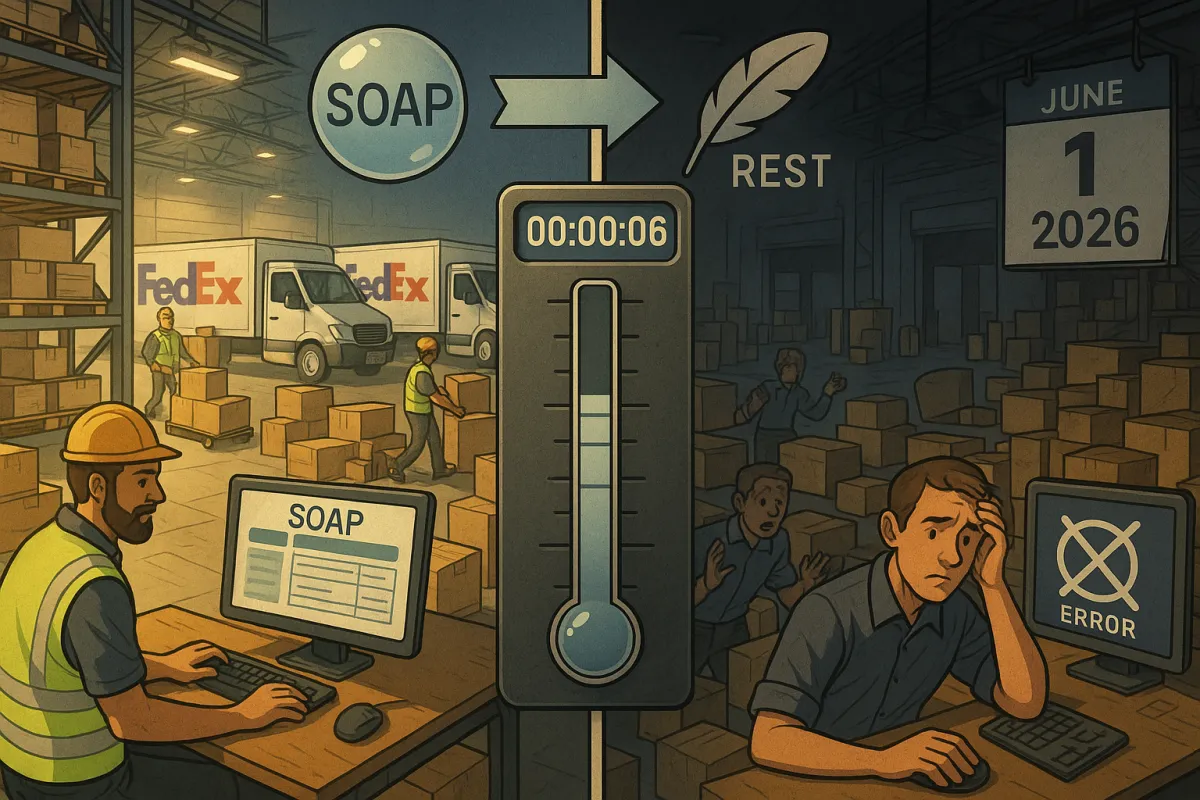
FedEx will retire its legacy Simple Object Access Protocol (SOAP)-based Web Services on June 1, 2026, creating what could become the most expensive operational crisis European manufacturers and retailers have faced since Y2K. Unlike gradual technology transitions, this is a hard cutoff that will instantly disable rate calculations, label generation, and tracking updates for thousands of companies still running legacy integrations.
The scale of this disruption is staggering. For enterprise teams managing thousands of shipments daily, this creates a perfect storm: forced migrations under hard deadlines while dealing with the new reality of aggressive rate limiting across all major carriers. While data migration failure rates drop by 73% with proper planning, most teams are discovering these deadlines months too late.
Here's what makes this particularly dangerous: businesses relying on direct integrations with the legacy service face a hard cutoff for transitioning to the new Representational State Transfer (REST) environment, which could disrupt critical shipping, logistics and fulfillment operations. After the June 1 deadline, systems still using SOAP connections will lose essential functions such as label generation, rate calculation, tracking and address validation, leading to checkout rates disappearing, label generation breaking down, and tracking becoming unavailable.
The FedEx SOAP Retirement Crisis: Why June 2026 is a Non-Negotiable Deadline
Compatible Providers must complete upgrades by March 31, 2026, while direct customers have until June 1, 2026. This timeline creates different pressure points than the abrupt USPS cutoff that already happened in January. Unlike USPS's abrupt cutoff, FedEx provides a longer transition period, but this advantage only matters if you use it correctly.
The operational cost of getting this wrong is brutal. A degraded carrier API during peak season can cost over €100,000 per hour in fulfillment disruption. When your FedEx integration fails on June 2nd, you're not just losing shipping capability, you're facing emergency freight costs, customer service disasters, and potential contract penalties from SLA violations.
Enterprise TMS platforms like Cargoson, Manhattan Associates, and SAP TM have already implemented FedEx REST endpoints and are managing dual-API operations for clients during the transition period. These platforms recognized the migration complexity early and built parallel systems that can route traffic between legacy and modern APIs based on configuration flags.
The harsh reality facing European shippers: the WSDL retirement means every integration touching FedEx services requires a complete rebuild. Your existing SOAP calls don't map one-to-one to REST endpoints. Rate shopping, label generation, and tracking require new endpoint structures, different request formatting, and updated response parsing. The JSON payloads use different field names, nesting structures, and data types than your SOAP XML.
Authentication Architecture Overhaul: From Legacy Keys to OAuth 2.0
Both carriers are moving to a RESTful API using OAuth 2.0 instead of single access key authentication. This isn't just a credential swap. REST API access requires MFA. Every FedEx account connected to a shipping platform must complete an MFA flow (typically address validation plus a PIN sent by SMS, phone call, email, or invoice) before the new credentials are issued.
The authentication failures are already happening. UPS migrated to OAuth 2.0 in August 2025. By February 3rd, 73% of integration teams reported production authentication failures. The pattern is clear: sandbox testing passes, production deployment fails. 72% of implementations face reliability issues within their first month despite passing sandbox testing.
For custom integrations, your development team will need to implement the FedEx MFA flow against the REST API directly: address validation, OAuth credential exchange, and PIN verification. Budget time for testing. Most teams underestimate how many edge cases the new API surfaces compared to SOAP.
Migration Timeline Strategy: Using the Testing Window Before Production Cutoff
Smart organizations are using FedEx's extended timeline differently than the USPS disaster. Run parallel systems where your application calls both SOAP and REST endpoints simultaneously, comparing results to identify discrepancies before the June deadline. This parallel run strategy lets you test production traffic loads against new endpoints while maintaining fallback capability.
The key insight most teams miss: using platforms already operating in FedEx's REST environment can significantly reduce migration time and complexity. Modern TMS systems like Cargoson, nShift, and FreightPOP have already absorbed the integration complexity. FedEx MFA is built into these platforms, with current customers being walked through the credential upgrade with no shipping downtime.
REST introduces stricter validation rules, new authentication protocols and potential workflow changes. Testing across rates, labels, tracking and international shipments is essential to avoid disruptions. The validation requirements are tighter than SOAP, so data that passed before might fail in the REST environment.
Performance gains justify the effort. The REST API offers faster rate calls, cleaner error handling, and access to newer FedEx endpoints that SOAP never supported. The performance gain matters most during peak season, when rate-quote latency compounds across high shipment volumes.
Technical Implementation: SOAP vs REST Endpoint Mapping
The technical complexity runs deeper than most teams realize. Service Mapping Complexity: Your existing SOAP calls don't translate one-to-one. Rate shopping, label generation, and tracking require new endpoint structures, different request formatting, and updated response parsing.
Authentication represents the biggest change. The SOAP API runs on older authentication protocols that no longer meet current standards. The REST API uses authentication, which is significantly more robust. This security improvement comes at the cost of integration complexity, especially for teams managing multiple carrier connections.
Error handling requires complete rewrites. REST APIs return different error codes, use different retry logic, and have different rate limiting behaviors. USPS's new APIs enforce strict rate limits of approximately 60 requests per hour, down from roughly 6,000 requests per minute without throttling in the legacy system. FedEx's rate limiting follows similar patterns, fundamentally changing how your integration must handle high-volume operations.
Multi-Carrier Integration Resilience: Building Future-Proof Architecture
Most enterprise shippers now manage 8–15 active carriers across modes (LTL, FTL, parcel, gig fleet, dedicated). The FedEx migration is just the beginning. Every major carrier is accelerating API retirement schedules through 2026, creating a cascade of forced migrations for enterprises managing complex carrier networks.
The abstraction layer approach separates companies that survive from those that don't. The secret to surviving carrier API migrations isn't perfect planning. It's building systems that can fail gracefully and recover quickly. Build adapter layers that can route requests to either legacy or modern APIs based on configuration flags. This lets you test production traffic loads against new endpoints while maintaining fallback capability.
Modern TMS platforms handle this complexity at scale. Carrier and 3PL platforms: Rate engines, capacity APIs, and shipment status feeds from external carriers must integrate with the TMS for automated carrier selection, tendering, and tracking. Cargoson offers direct API/EDI integrations with carriers across all transport modes (FTL, LTL, parcel, air, and sea freight), allowing you to compare rates, book shipments, and track imports and deliveries from a single platform.
The rate limiting crisis compounds the integration challenge. Carrier scorecards update continuously based on actual execution data, and dynamic allocation routes shipments to the optimal carrier per the shipper's configured policy weights. This real-time carrier selection becomes critical when API rate limits force you to optimize every request.
European Compliance and Regulatory Considerations
European shippers face additional complexity layers that American guidance ignores. Your TMS marketplace integration must handle country-specific carrier protocols, documentation requirements, and regulatory variations across EU member states. From July 1, 2026, vans weighing 2.5-3.5 tons performing international transport of goods will be subject to the obligation to use second-generation smart tachographs (G2V2).
As of 1 January 2026, the transitional phase of the Carbon Border Adjustment Mechanism (CBAM) has ended and the definitive phase has begun with importers now subject to full financial obligations under the scheme. CBAM became financially binding for imports made from January 1, 2026, and companies that delay preparation risk significant operational and financial disruption. From 1 January 2026 importers must purchase and surrender certificates based on verified annual emissions, with a €100 per excess tonne penalty for non-compliance.
eFTI readiness adds another layer. Your carrier API implementations must support electronic freight transport information exchange requirements that become mandatory across EU member states. Vendors demonstrating integrated CBAM compliance and eFTI readiness reveal their commitment to European markets. Solutions from Cargoson, SAP, and Oracle that address these requirements comprehensively indicate vendor stability during the regulatory transition ahead.
Emergency Contingency Planning: When Migration Timelines Compress
The procurement window is closing rapidly. Your enterprise transport procurement window is closing fast. The procurement window for securing optimal TMS platforms before vendor consolidation eliminates choices and capacity shortages worsen cost structures runs through Q1 2026. This gives you approximately 3-4 months of leverage before capacity tightens again. Act quickly to secure favorable implementation terms and ensure your marketplace integration project launches before vendor consolidation further limits your options.
The vendor selection decision becomes more critical under compressed timelines. The companies that survive 2026's migration crisis won't be the ones with perfect technical execution. They'll be the ones who recognized that carrier integrations are infrastructure, not features, and invested accordingly.
Partnership strategies vs in-house development requires careful evaluation. The shipper gets the full benefit of enterprise-grade transportation management technology without the burden of implementing, configuring, maintaining, and staffing the system themselves. In a well-structured managed TMS arrangement, the logistics provider handles the day-to-day operation of the platform, including carrier management, load planning and optimization, shipment execution, tracking, exception management, freight audit, payment, and reporting.
The integration cost reality is sobering. European manufacturers are staring at their Q1 2026 budgets, watching ERP-TMS integration line items spiral beyond recognition. Basic API integrations cost €5,000-€15,000, while complex ERP connections exceed €50,000. These costs multiply when you're handling multiple carrier migrations simultaneously.
Post-Migration Optimization and Monitoring
Performance benchmarking becomes critical for validating migration success. Shippers who've already migrated report better rate-call latency, cleaner error handling, and access to newer endpoints that the SOAP version never supported. That matters most during peak, when every extra second on a rate quote compounds across thousands of shipments.
Integration health monitoring prevents small issues from becoming major failures. Exception management is critical because visibility without resolution doesn't reduce cost or protect SLAs. A delay detected but not resolved still results in expedited freight, missed customer commitments, and accessorial charges. The best TMS platforms in 2026 are measured on time-to-resolution — how quickly an exception is converted into a corrected plan and updated customer promise.
Future API version management requires architectural thinking beyond the immediate migration. New features are locked out: FedEx is building everything new on REST. Staying on SOAP freezes your shipping capabilities while competitors move ahead. The longer you wait, the less time you have to test and resolve issues before the June 2026 deadline arrives.
Your choice: spend the next six months debugging OAuth flows and rate limiting edge cases, or let someone else handle that while you focus on growing your business. The FedEx SOAP retirement deadline is immovable. The question isn't whether to migrate, but whether to build the resilience your enterprise needs, or let carrier API changes control your shipping operations.