
FedEx SOAP API Retirement June 2026: Emergency Migration Guide for European Shippers to Prevent Integration Failures and Shipping Disruptions
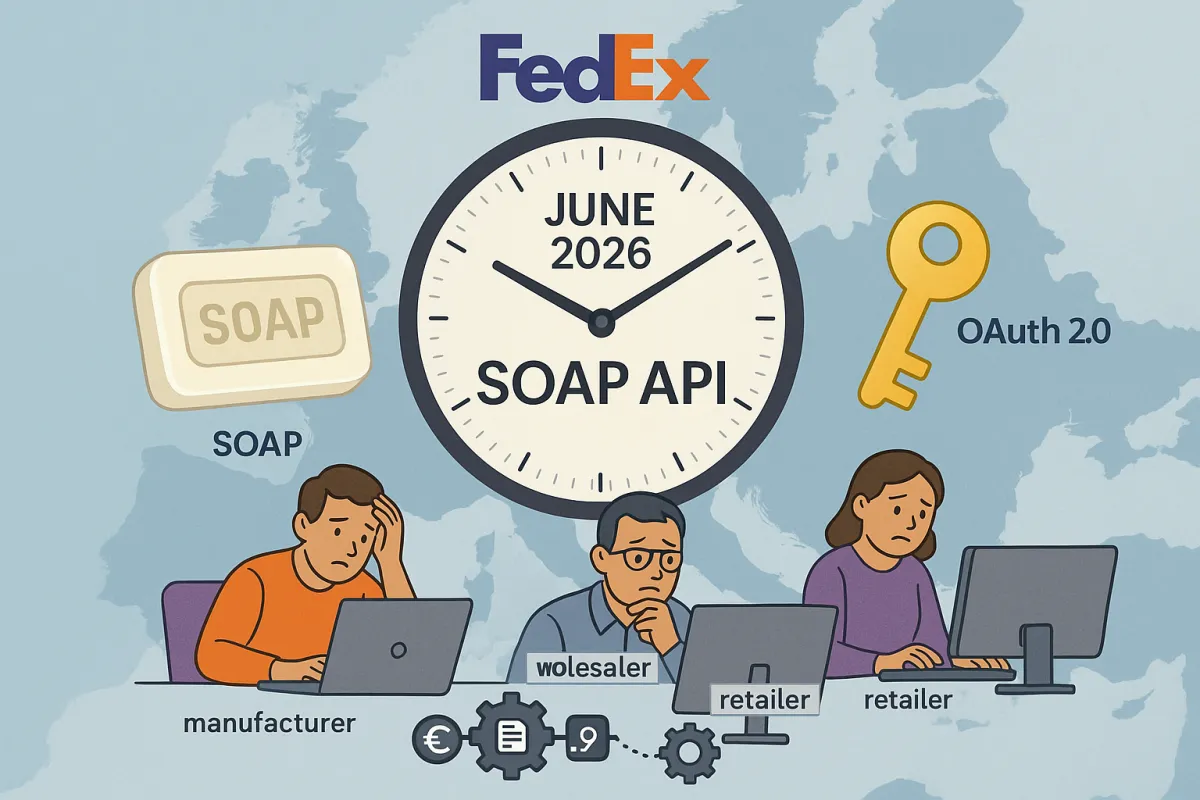
Yes, another API change. FedEx will fully retire its remaining SOAP-based Web Services endpoints on June 1, 2026. If your shipping operations depend on FedEx's legacy SOAP APIs for rates, labels, or tracking, you have approximately 18 months to complete what could be the most complex carrier migration your team has faced.
This isn't just a simple endpoint swap. The changeover to OAuth 2.0 authorization must be completed by March 31, 2026, after which shipping with FedEx SOAP web services is no longer possible worldwide. The technical implications reach far beyond updating a few configuration files.
The FedEx SOAP Retirement Crisis: What European Shippers Must Know
FedEx's SOAP retirement follows a clear industry pattern. UPS, USPS, and FedEx will complete a shift in 2026: retiring legacy carrier APIs in favor of more modern, secure platforms. But FedEx's migration involves more than just switching protocols.
FedEx APIs will have improved security through OAuth token-based authentication, replacing the simpler access key model. OAuth access tokens need to be regenerated after every 60 minutes and provided with each API transaction to authenticate and authorize your access to FedEx resources. Your integration architecture needs to handle token refresh cycles automatically.
The timeline creates pressure points across European shipping operations. While all future features and enhancements will be added to the FedEx RESTful APIs, your current SOAP integrations continue working until June 2026. This creates a false sense of security - you're not broken today, but you will be if you wait.
Notice how TMS platforms handle these transitions differently. Modern solutions like Cargoson, nShift, and FreightPOP typically manage carrier API updates automatically. Their teams monitor deprecation notices and implement changes before deadlines hit. Legacy TMS platforms often push this responsibility to your internal IT teams.
Integration Impact Assessment: Identifying Your SOAP Dependencies
Start with an honest audit of your current FedEx integrations. Check which services you're using - shipping, rating, tracking, address validation, or customs documentation. FedEx Web Services Tracking, Address Validation, and Validate Postal Codes WSDLs were retired on May 15, 2024, with SOAP based FedEx Web Services in development containment and replaced with FedEx RESTful APIs.
If you're still using SOAP for any FedEx functionality, you're operating on borrowed time. FedEx APIs will not affect existing integrations built using FedEx Web Services, however, for future integrations, FedEx Web Services will not support all new features. This means you can ship packages, but you're locked out of service improvements.
Your TMS vendor's approach matters significantly here. Platforms like Alpega, MercuryGate, or Descartes may have different migration timelines and capabilities. Some vendors completed FedEx REST migrations months ago. Others are scrambling to meet the June 2026 deadline. Check your vendor's specific migration plan and test environment availability.
Document your current data flows carefully. FedEx's SOAP services use XML request structures that don't map directly to REST's JSON format. Customer reference fields, phone number validations, and state code requirements all change in the new API structure.
Authentication Overhaul: Moving from Access Keys to OAuth 2.0
OAuth 2.0 represents the most complex part of your migration. Both carriers are moving to a RESTful API using a more advanced security model like OAuth 2.0 instead of single access key authentication. Shippers using older protocols like XML or SOAP for their API integrations will have to make a conversion to something that's RESTful compatible.
Once you have secured API credentials on FedEx Developer portal, the OAuth endpoint is used to get an access token which is used as credentials with each API transaction. This requires implementing token management logic that most SOAP integrations lack.
Here's what changes: Instead of sending static credentials with each request, you'll request temporary tokens from FedEx's OAuth server. The access token typically expires in 1 hour, while refresh tokens expire in 31 days (2682000 seconds). Your application needs to handle token refresh automatically before expiration.
The OAuth implementation varies by customer type. Grant types include client_credentials, csp_credentials, and client_pc_credentials, with FedEx Internal, Compatible, Proprietary Parent Child, and Integrator customers requiring additional child_id and child_secret inputs.
REST API Migration Strategy: Technical Implementation Steps
FedEx has elected to base future integrations on REST APIs to improve reliability and performance, offering better versioning management that ease customer upgrades, as opposed to continuous major versions with SOAP-based WSDLs. The benefits are real, but the migration work is substantial.
Your development team faces several technical challenges. SOAP uses XML schemas with strict validation rules. REST APIs use JSON with different field naming conventions and data structures. Rate shopping requests that worked in SOAP require restructuring for REST endpoints.
Start your migration with FedEx's sandbox environment. First, verify successful authentication with API Key and Secret Key by submitting an OAuth 2.0 request to https://apis-sandbox.fedex.com/oauth/token. Test your OAuth implementation thoroughly before moving to production endpoints.
Modern TMS platforms like Cargoson, ShipStation, or Shiptify typically handle this complexity behind the scenes. Their development teams maintain the OAuth flows and endpoint mappings. If you're building custom integrations, you're responsible for implementing and maintaining all this complexity.
Data Validation and Testing: Preventing Production Failures
FedEx's REST APIs introduce stricter data validation that can break existing workflows. Phone number formats, address validation rules, and service code mappings all change from SOAP to REST implementations.
Customer reference fields face character limits that didn't exist in SOAP. International shipping requires different customs documentation formats. Package dimension validation becomes more stringent in REST implementations.
Test thoroughly with real shipping data before switching production traffic. Create test shipments to all your major destination countries. Verify that tracking numbers generate correctly and that webhook notifications work if you use them for order status updates.
Your testing should include edge cases: oversized packages, hazardous materials declarations, Saturday delivery requests, and signature requirements. SOAP and REST handle these scenarios differently, and production failures during peak shipping periods can cost significant revenue.
TMS Vendor Readiness: Ensuring Your Platform Supports Migration
Not all TMS vendors approach carrier API changes with the same urgency. Some platforms like Cargoson or nShift build and maintain carrier connections as core product features. Others treat API integrations as optional add-ons or push the responsibility to external partners.
TMS platforms typically integrate with FedEx's and UPS's APIs in some form, so it's still a pressing issue, with the same holding true for companies relying on 3PLs or other software providers to handle their parcel carrier interface. Your vendor's migration readiness directly impacts your compliance timeline.
Ask your TMS vendor specific questions about their FedEx REST implementation: When did they complete the migration? Do they support all FedEx services you currently use? How do they handle OAuth token refresh? What's their testing process for API updates?
Some TMS platforms completed FedEx REST migrations in early 2025. Others are still planning implementation. If your vendor hasn't started migration work by now, consider this a red flag for their technical capabilities and carrier relationship management.
Enterprise platforms like Transporeon often partner with carrier connectivity specialists like nShift for API management. Understand your vendor's partnership structure and who actually maintains the FedEx integration code.
Risk Mitigation: Building Fallback Strategies for June 2026
Carrier APIs don't stand still. Even after these migrations are complete, carriers will continue updating pricing logic, delivery data, security requirements, and services. FedEx's SOAP retirement represents just one example of ongoing technical requirements in carrier connectivity.
Build redundancy into your shipping operations. If FedEx integration failures occur during the migration, you need alternative carriers configured and tested. UPS, DHL, GLS, and other European carriers provide similar service options with different API architectures.
Consider the total cost of maintaining carrier integrations. If you manage a custom-built site or a site built on a highly customizable platform like Magento, you may face ongoing development work, testing, and redeployments as carriers make changes to their API integrations. Each carrier change requires development resources, testing time, and potential production fixes.
Monitor your migration progress against the June 2026 deadline. Start testing REST implementations no later than early 2026 to allow time for debugging and fixes. Production cutover should happen well before the final SOAP retirement date to avoid last-minute complications.
Carrier connectivity platforms like nShift, Shiptify, or Cargoson absorb this ongoing maintenance burden. Their teams handle API deprecations, security updates, and service changes automatically. For mid-to-large European shippers, this operational model often proves more cost-effective than maintaining internal carrier integration teams.
The FedEx SOAP retirement forces a strategic decision: invest in internal API development capabilities or delegate carrier connectivity to specialized platforms. Either path works, but the June 2026 deadline doesn't accommodate indecision.