
DCSA API Standards Revolution: How European Shippers Can Cut Carrier Integration Costs by 60% and Future-Proof TMS Connectivity in 2025
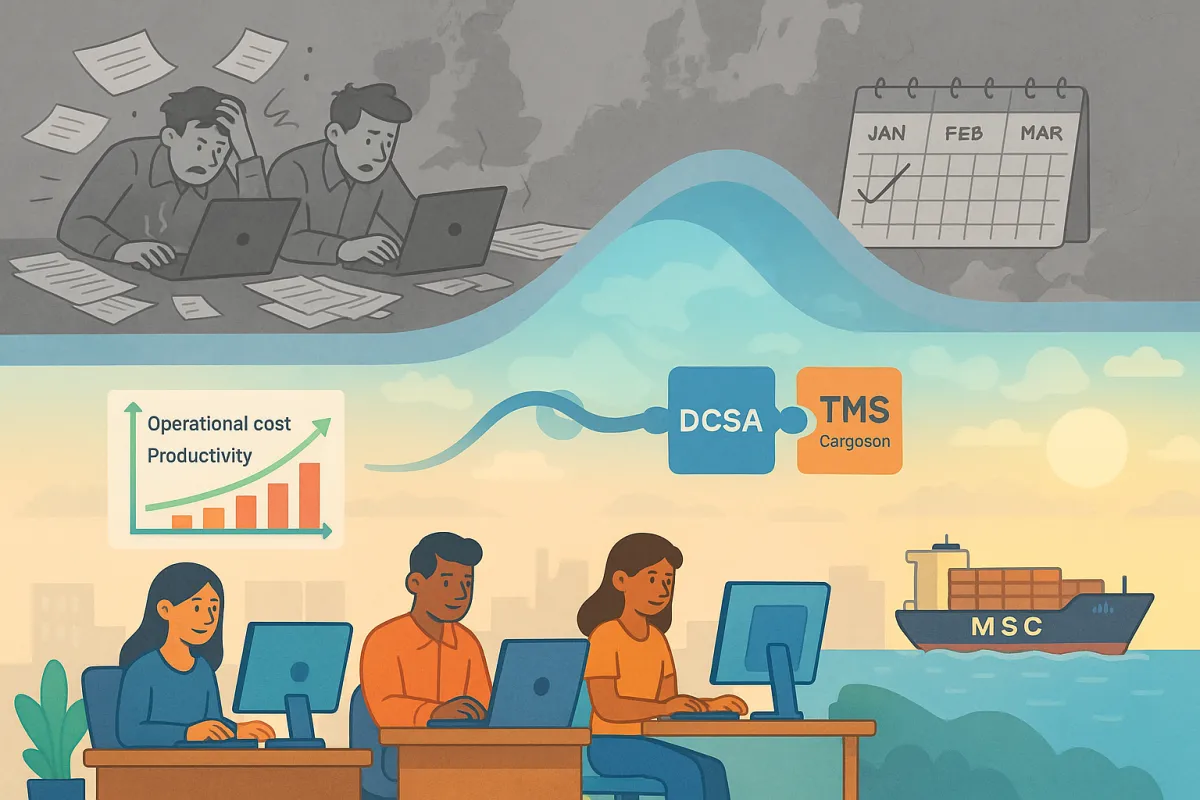
European shippers with transport budgets over €10 million are discovering what industry leaders already know: the ongoing transition to an API ecosystem for container shipping presents the biggest opportunity to reduce carrier integration costs since EDI standards emerged in the 1990s. These standardised data sets are designed to simplify cross-carrier integration for shippers, freight forwarders, and digital platforms, and the numbers prove it works.
When MSC Joins the Standards Revolution, Everyone Wins
The momentum behind DCSA's standards, collaboratively created with ten of the largest container shipping companies, reached a tipping point in June 2025. MSC confirmed its adoption of the Digital Container Shipping Association (DCSA) Commercial Schedules API, providing customers and partners with real-time access to standardised vessel schedule data through direct system integration.
This isn't just another carrier updating their technology. MSC has fully adopted the point-to-point endpoint of the API, with development underway for the vessel schedule and port schedule endpoints. When the world's largest container shipping company by capacity commits to standardized APIs, your integration strategy just shifted from experimental to essential.
What makes this significant? The use of standardised APIs gives beneficial cargo owners and freight forwarders more accurate, actionable information which enhances operational efficiency on a wider scale, helping improve overall supply chain resilience and profitability.
Traditional TMS providers like SAP TM and Oracle TM typically require months-long projects to add new carrier connections. Modern solutions including Cargoson, nShift, and Descartes are already building DCSA-ready architectures that can onboard new standardized carriers in days, not months.
The Complete DCSA Standards Ecosystem Taking Shape
Three major standards releases in November 2025 alone signal how rapidly this ecosystem is expanding. The new VGM standard provides a single API for real-time submission, validation and exchange of container weight data, aligned with SOLAS requirements and consistent with other DCSA standards covering Booking, Track & Trace and electronic bills of lading.
Then came the arrival notices breakthrough. DCSA's new standard defines arrival notices as structured data that can be exchanged machine-to-machine via API. Today these notices are often sent as PDF attachments via email — a practice that leads to delays, inaccuracies and frequent disputes, while carriers face heavy administrative workloads and limited visibility, while shippers and consignees must navigate inconsistent formats and labor-intensive processing.
The arrival notice standard matters because it simplifies system integration, improves timeliness and accuracy, and helps reduce financial disputes on storage, detention and demurrage charges caused by late or missing Arrival Notices.
Here's the complete DCSA toolkit now available:
- Commercial Schedules API for real-time vessel schedule data
- Verified Gross Mass (VGM) API for container weight compliance
- Arrival Notice API for structured import notifications
- Booking API for standardized container reservations
- Track & Trace API for shipment visibility
- Electronic Bill of Lading (eBL) API for digital documentation
TMS platforms that integrate these standards — like Cargoson, FreightPOP, and nShift — can now offer genuinely interchangeable carrier connections rather than custom point-to-point integrations.
The Real Cost Analysis: Why Custom Integrations Are Bleeding Money
The financial case for DCSA standards becomes clear when you examine actual integration costs. According to a recent Gartner study, companies that have adopted an API-connected TMS have seen their productivity increase by 27% and their operational costs decrease by 23% on average. But the savings from standardized APIs go much deeper.
A German automotive parts manufacturer recently discovered their €800,000 TMS implementation included carrier integrations that required costly custom development, forcing a complete re-implementation. Sound familiar?
Consider the hidden costs of custom carrier integrations:
- Development time: Each carrier API requires 2-6 months of development work
- Maintenance overhead: Carrier API changes force recurring development cycles
- Testing complexity: Every carrier connection needs separate test environments
- Documentation burden: Custom integrations require extensive internal documentation
- Knowledge risks: Developer departures can make integrations unmaintainable
DCSA standards eliminate most of these costs. Once your TMS supports DCSA APIs, onboarding new carriers becomes configuration rather than development. Cloud TMS implementations often conclude within eight weeks, compared to 6-18 months for traditional systems, and standardized APIs accelerate this further.
Modern TMS platforms like Cargoson, Descartes, and nShift already build DCSA compatibility into their core architecture, meaning you get future carrier connections for free rather than paying for each new integration.
Your 90-Day Implementation Roadmap
The successful DCSA adoptions we've observed follow predictable patterns. Here's the proven implementation sequence:
Phase 1: Foundation (Weeks 1-4)
Audit your current carrier integrations. Identify which carriers already support DCSA standards — MSC leads the way, but others are following rapidly. Document integration maintenance costs and development time for each existing carrier connection.
Evaluate TMS platforms with native DCSA support. Solutions like Cargoson build true API/EDI connections with carriers, not just accounts in software or standardized EDI messages that carriers must implement themselves. Compare this with legacy systems requiring custom development for each carrier.
Phase 2: Pilot Implementation (Weeks 5-8)
Start with one high-volume lane using a DCSA-enabled carrier. The DCSA Commercial Schedules API offers access to data including point-to-point routings, vessel schedules, and port schedules designed to simplify cross-carrier integration. Measure the reduction in manual processes and data inconsistencies.
Configure your TMS to consume standardized APIs. Modern platforms like nShift, Cargoson, and FreightPOP make this a configuration task rather than a development project.
Phase 3: Expansion (Weeks 9-12)
Roll out additional DCSA-compatible carriers systematically. By replacing PDFs with structured data, the standard enables automatic confirmation of receipt, reduces manual rework and monitoring, and removes inconsistencies across carriers and geographies.
Document cost savings, time reductions, and error decreases. Use this data to justify expanding to additional trade lanes and carriers.
Regulatory Alignment: Why DCSA Standards Support European Compliance
European freight regulations increasingly demand structured, machine-readable data exchanges. DCSA provides open, vendor neutral frameworks compliant with regulatory requirements (e.g. customs and dangerous goods). The eFTI regulation and DCSA's API models are pushing freight data into structured formats that support automated compliance monitoring.
This regulatory alignment matters for procurement decisions. TMS platforms that support DCSA standards — including Cargoson, nShift, and Descartes — position your organization ahead of regulatory requirements rather than scrambling to achieve compliance after mandates take effect.
The ongoing digitalization of shipping processes enables the industry to move toward faster, more accurate, and fully traceable information exchange. European shippers adopting DCSA standards now benefit from both cost reductions and regulatory readiness.
Avoiding the Vendor Lock-in Trap Through Open Standards
One of the biggest risks in carrier connectivity comes from proprietary APIs that create vendor dependency. When carriers change their custom APIs, you're locked into expensive redevelopment cycles. DCSA standards provide insurance against this risk.
These standards promote interoperability and efficiency, facilitating seamless communication and collaboration among various stakeholders, enhancing operational transparency, reducing complexities, and driving innovation. This means switching between DCSA-compatible carriers becomes a business decision, not a technical project.
The electronic bill of lading experience demonstrates why open standards matter. Proprietary eBL platforms create silos where all participants must use the same solution provider. DCSA standards avoid this trap by enabling interoperability across different technology providers.
When evaluating TMS platforms, prioritize those with DCSA-first architectures. Solutions like Cargoson build standardized API support into their core platform, while enterprise vendors often treat standards compliance as an add-on feature.
Building Your 2025 DCSA Integration Strategy
The window for competitive advantage through DCSA standards adoption is narrowing. Each new standard strengthens the digital foundation for global trade, taking the industry another clear step towards a digital and automated documentation framework end to end.
Your action plan starts with platform selection. Cloud-native systems are architected for API-first integration, enabling seamless connections with electronic logging devices, accounting software, fuel card systems, and shipper portals, eliminating costly middleware requirements that traditional systems demand.
Modern TMS providers handle this differently. Platforms like Cargoson, nShift, and FreightPOP build DCSA compatibility into their standard offerings. Traditional enterprise systems often require custom development work to achieve the same functionality.
Begin by identifying your highest-cost carrier integrations. Target these for DCSA migration first to maximize early returns. These new-generation systems create an intelligent, responsive logistics ecosystem that is perfectly integrated with your entire value chain, giving companies a decisive competitive advantage.
The organizations implementing DCSA standards in 2025 will establish sustainable competitive advantages in carrier connectivity costs, implementation speed, and regulatory compliance. The question isn't whether to adopt DCSA standards — it's how quickly you can begin the migration.