
Carrier Connectivity Middleware Architecture: How European Shippers Can Build Scalable API Orchestration That Cuts Integration Costs 60% While Surviving 2026's FedEx, USPS, and DHL Migration Deadlines
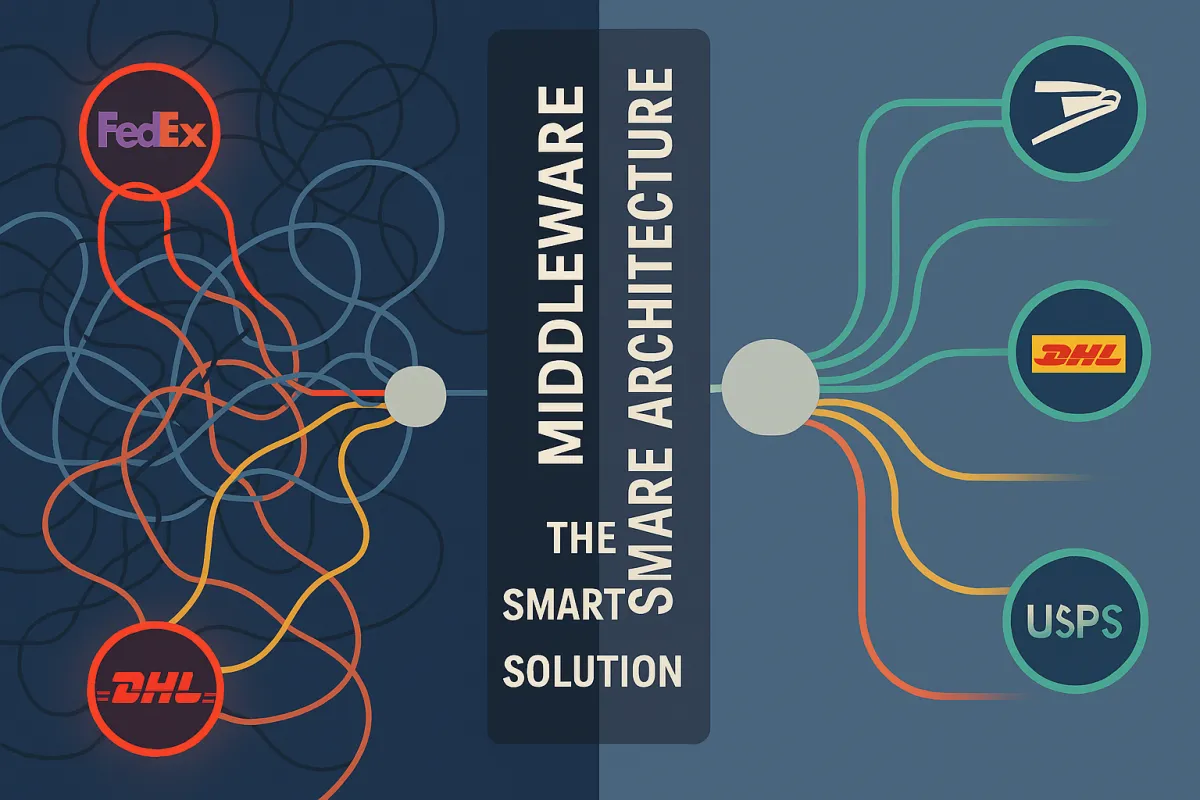
European shippers are facing the perfect storm: FedEx SOAP retirement hits June 1, 2026, USPS Web Tools already shut down January 25, 2026, and your existing carrier connectivity middleware is about to become a €200,000 problem instead of a solution.
The scale of this crisis isn't theoretical. By February 2026, 73% of integration teams reported production authentication failures after similar UPS OAuth migrations, and 72% of implementations face reliability issues within their first month despite passing sandbox testing. For European manufacturers and wholesalers managing dozens of carrier relationships, this represents an existential threat to daily operations.
Here's what most people miss: while everyone scrambles to patch individual API connections, smart companies are using 2026's forced migration to architect scalable carrier connectivity middleware that cuts integration costs by 60% while future-proofing against the next wave of carrier changes.
The €50K+ Integration Crisis: Why Point-to-Point Carrier APIs Don't Scale
Direct carrier integrations create exponential cost growth that becomes unsustainable faster than most finance teams realize. Basic cloud solution implementation for small fleets ranges from €1,000 to €5,000, while enterprise implementations exceed €100,000. But that's just the beginning.
Consider the mathematics: if you're managing 20 carriers and each direct integration costs €15,000 to build plus €5,000 annually to maintain, you're looking at €400,000 in development costs alone. With FedEx SOAP deprecation beginning May 1, 2026, and Compatible Providers required to complete upgrades by March 31, 2026, that timeline just compressed into an impossible sprint.
The authentication complexity alone is staggering. FedEx's move to OAuth 2.0 aligns with modern API security standards but requires completely different credential issuance and token refresh logic. Both USPS and FedEx are moving to RESTful APIs using OAuth 2.0 instead of single access key authentication. Each carrier implements OAuth differently, meaning your team needs to master dozens of unique authentication flows.
Then there's the rate limiting nightmare. USPS's new APIs enforce strict rate limits of approximately 60 requests per hour, down from roughly 6,000 requests per minute in the legacy system. For businesses with large customer bases or frequent data imports, the limitations quickly become apparent.
Modern TMS platforms like Cargoson, nShift, and MercuryGate solve this by building abstraction layers that handle the complexity once, then sharing those benefits across all customers. But if you're building direct integrations, you're rebuilding the same OAuth, rate limiting, and error handling logic 20+ times.
Three Middleware Architecture Patterns for Multi-Carrier Connectivity
The right carrier connectivity middleware architecture depends on your scale, but the pattern you choose today determines your flexibility for the next five years. Each pattern serves different operational scales and has distinct cost implications.
Hub-and-Spoke: The SME Starting Point
Hub-and-spoke architecture works well for 5-15 carriers where you can afford some manual configuration but need better reliability than direct integrations. Your middleware acts as a central orchestrator that normalizes carrier APIs into a standard format for your TMS or ERP.
The implementation costs run €25,000-€75,000 compared to €200,000+ for equivalent direct integrations. You build one authentication module that handles OAuth flows, one rate limiting queue that manages carrier quotas, and one error handling system that provides consistent retry logic across all carriers.
This pattern shines when carrier APIs change. Instead of updating 15 different integration points in your warehouse management system, you update the middleware once. When platforms like Cargoson, MercuryGate and BluJay built abstraction layers that handle OAuth complexity and implement intelligent rate limiting queues, they essentially industrialized the hub-and-spoke pattern.
API Gateway Pattern: Enterprise-Grade Orchestration
API gateway architecture becomes necessary at 15-50 carriers where you need advanced routing, circuit breaker patterns, and sophisticated monitoring. Your gateway acts as a proxy that can route requests based on carrier performance, automatically fail over when APIs are down, and provide detailed analytics on carrier reliability.
Circuit breaker patterns are crucial here. When FedEx's rate API starts returning errors, your circuit breaker opens automatically, routing rate requests to UPS while logging the failure for investigation. This prevents cascade failures that can take down your entire shipping operation.
The integration with enterprise TMS platforms like SAP Transportation Management, Oracle TM, or Cargoson requires careful planning. Your gateway needs to present a consistent API that these platforms can consume, while handling the complexity of dozens of different carrier authentication methods, data formats, and error responses behind the scenes.
Event-Driven Architecture: Future-Proof at Scale
Event-driven architecture becomes essential beyond 50 carriers or when you need real-time processing across multiple business units. Instead of synchronous API calls, your system publishes events (shipment created, carrier selected, label generated) that trigger downstream processing.
This pattern excels at webhook orchestration. When UPS sends a tracking update webhook, your event processor can simultaneously update your warehouse system, trigger customer notifications, and log analytics data without blocking the webhook response. Enterprise teams managing thousands of shipments daily face this complexity when dealing with aggressive rate limiting across all major carriers.
The real question becomes whether building custom event-driven middleware makes sense when platforms like Cargoson provide native connectivity that already handles this complexity. The break-even point typically occurs around €500,000 in annual carrier integration costs.
Cost Analysis: Build vs Buy vs Hybrid Middleware Strategies
API spend for carrier connectivity is a major cost driver, consuming 40% of total revenue in 2026 for TMS platforms, with costs dropping to 20% by 2030 as volume leverage improves. For enterprise shippers, this translates to specific ROI calculations that determine optimal middleware strategies.
Middleware as a Service pricing typically ranges from €499/month for SME solutions to €4,999+ monthly for enterprise platforms. TMS platforms start with approximately €29,000 monthly fixed running costs, requiring minimum cash reserves of €849,000 to reach profitability within four months. But these numbers mask the true total cost of ownership.
Building custom carrier connectivity middleware requires serious upfront investment. A complete middleware platform development costs approximately €2.1 million over 18 months, based on current European development rates. This includes the authentication layer (€400,000), rate limiting and queue management (€300,000), monitoring and observability (€500,000), error handling and retry logic (€350,000), and carrier onboarding automation (€550,000).
The alternative is leveraging platforms that have already solved these problems. Multi-carrier shipping platforms like Cargoson, MercuryGate, and BluJay built abstraction layers that handle OAuth complexity, implement intelligent rate limiting queues, and provide fallback mechanisms when USPS quotas are exceeded.
The 41-month payback calculation becomes clear: €2.1M upfront investment versus €60,000 annually for enterprise middleware licensing. Custom development breaks even after 35 months, but only if you factor zero maintenance costs and perfect execution. Add ongoing development (€200,000 annually), security updates, and the reality that carrier APIs change constantly, and the math rarely works unless you're processing over 1 million shipments annually.
MuleSoft enterprise middleware costs start around €150,000 annually but can reach €500,000+ once you factor in development, connectors, and support. Comparing this to Cargoson's built-in connectivity reveals why many European shippers choose TMS platforms with native carrier support rather than building custom middleware layers.
Production-Ready Implementation: Managing the 2026 Migration Timeline
Parallel migration strategies prevent operational disruption during the carrier API transition. Unlike USPS's abrupt cutoff, FedEx provides a longer transition period where you can run parallel systems calling both SOAP and REST endpoints simultaneously, comparing results to identify discrepancies before the June deadline.
Your sandbox testing protocols need to account for authentication complexity that doesn't appear in development environments. Test scenarios use a handful of requests, with webhook endpoints passing every sandbox test and authentication flows working flawlessly, but 72% of implementations face reliability issues within their first month despite passing sandbox testing.
The gradual carrier switchover process requires careful orchestration. Start with low-volume carriers to test your middleware under real load conditions. The migration process involves minimal work: verify the address on your carrier accounts, choose a verification method, enter the PIN, and your connection moves to the REST API with no downtime and no labels going dark.
Rollback procedures become critical when production authentication fails. While data migration failure rates drop by 73% with proper planning, most teams discover these deadlines months too late, facing mounting pressure from complexity increases and legacy system strain. Your middleware needs to handle authentication failures gracefully, automatically falling back to working carriers while alerting operations teams.
Modern TMS platforms like Cargoson handle these migrations transparently by maintaining both legacy and modern API connections during transition periods. This eliminates the risk of shipment disruption while giving your team time to validate the new endpoints work correctly with your existing business processes.
Regulatory Compliance Through Middleware: ICS2, CBAM, and eFTI Readiness
Your middleware layer should handle European regulatory complexity at the infrastructure level, not force compliance logic into every application that needs shipping data. ICS2 Entry Summary Declarations, CBAM carbon reporting, and eFTI document flows all require automated data transformation that happens transparently during normal shipping operations.
ICS2 compliance requires automated generation of Entry Summary Declarations for shipments entering the EU. Your middleware needs to collect the required data fields from carrier APIs, transform them into the correct ENS format, and submit them to customs authorities automatically. This can't be an afterthought bolted onto existing integrations.
CBAM carbon reporting adds another complexity layer where your middleware must calculate carbon emissions based on transport mode, distance, and carrier efficiency ratings. The data collection happens during rate shopping, but the compliance reporting occurs quarterly through automated regulatory API submissions.
eFTI document flows require your middleware to generate, digitally sign, and exchange transport documents with carriers and customs authorities. This involves PKI certificate management, digital signature validation, and secure document exchange protocols that most shipping applications shouldn't need to understand.
Cargoson, SAP, and Oracle handle these European regulatory requirements at the platform level, automatically generating compliance data and submitting required reports. Custom middleware approaches need to budget €300,000+ annually for regulatory compliance development and maintenance to match this functionality.
Monitoring and Observability: Preventing the 73% Production Failure Rate
Sophisticated monitoring prevents cascade failures in production middleware environments. 73% of integration teams reported production authentication failures, and data migration failure rates drop by 73% with proper planning. Your monitoring strategy needs to catch problems before they affect shipment processing.
Circuit breaker patterns require health check orchestration across all carrier endpoints. When FedEx's tracking API starts returning 503 errors, your circuit breaker needs to open automatically while maintaining service availability through alternative carriers. This requires monitoring response times, error rates, and authentication token refresh failures across dozens of endpoints simultaneously.
OAuth token refresh failures create subtle but critical problems. Your monitoring needs to track token expiration times and trigger renewal processes before tokens expire. When token refresh fails, your system needs to alert operations teams immediately while falling back to alternative authentication methods or carriers.
Webhook authentication cascades can take down your entire system when carriers change their signing keys without notice. Your monitoring should validate webhook signatures, track authentication failures, and automatically disable problematic webhooks while alerting development teams about signature validation problems.
Rate limiting detection requires sophisticated analytics to identify when carriers throttle your requests. Your monitoring needs to track request volumes, response times, and HTTP 429 responses to automatically adjust request patterns before hitting carrier limits. This becomes especially critical when managing USPS's strict rate limits of approximately 60 requests per hour compared to the legacy system's 6,000 requests per minute.
Production monitoring strategies complement TMS platforms like Cargoson that provide built-in observability dashboards and automated alerting. The question becomes whether building custom monitoring infrastructure makes sense when established platforms already provide enterprise-grade monitoring for carrier connectivity.
Vendor Independence Strategy: Future-Proofing Your Middleware Investment
Architecture decisions today determine flexibility during the inevitable vendor consolidation wave. Your middleware needs to avoid lock-in while leveraging existing platforms' connectivity advantages. This requires careful API abstraction layer design and strategic technology choices.
Open standards adoption becomes crucial for future flexibility. Your middleware should use OpenTelemetry for observability, OAuth 2.0 for authentication, and REST APIs for all internal communications. This ensures compatibility with future platforms while avoiding proprietary protocols that create vendor dependencies.
Containerization strategies enable deployment flexibility across cloud providers and on-premises environments. Your middleware should run in Docker containers with Kubernetes orchestration, allowing migration between AWS, Azure, Google Cloud, or private data centers based on regulatory requirements or cost optimization.
API abstraction layers let you leverage platforms like Cargoson's connectivity while maintaining the option to migrate to alternative solutions. Your applications should integrate with your middleware through standardized APIs, not directly with TMS platforms. This architectural separation provides vendor independence while still benefiting from mature carrier integrations.
The strategic balance involves positioning established platforms as integration-friendly services rather than locked dependencies. Cargoson provides comprehensive carrier connectivity through APIs that your middleware can consume, reducing development costs while maintaining architectural independence. This hybrid approach combines the benefits of proven carrier integrations with the flexibility to evolve your technology stack independently.
European shippers face a choice: spend the next six months rebuilding individual carrier integrations under impossible deadlines, or architect middleware that survives the next decade of carrier API changes. The companies that survive 2026's migration crisis won't be the ones with perfect technical execution. They'll be the ones who recognized that carrier integrations are infrastructure, not features, and invested accordingly.
Your middleware architecture decision determines whether carrier API changes control your shipping operations or become transparent infrastructure updates. Plan accordingly while the migration window remains open.