
Carrier API Rate Limiting Solutions: How European Shippers Can Prevent Integration Throttling During Peak Seasons Without Breaking TMS Performance in 2025
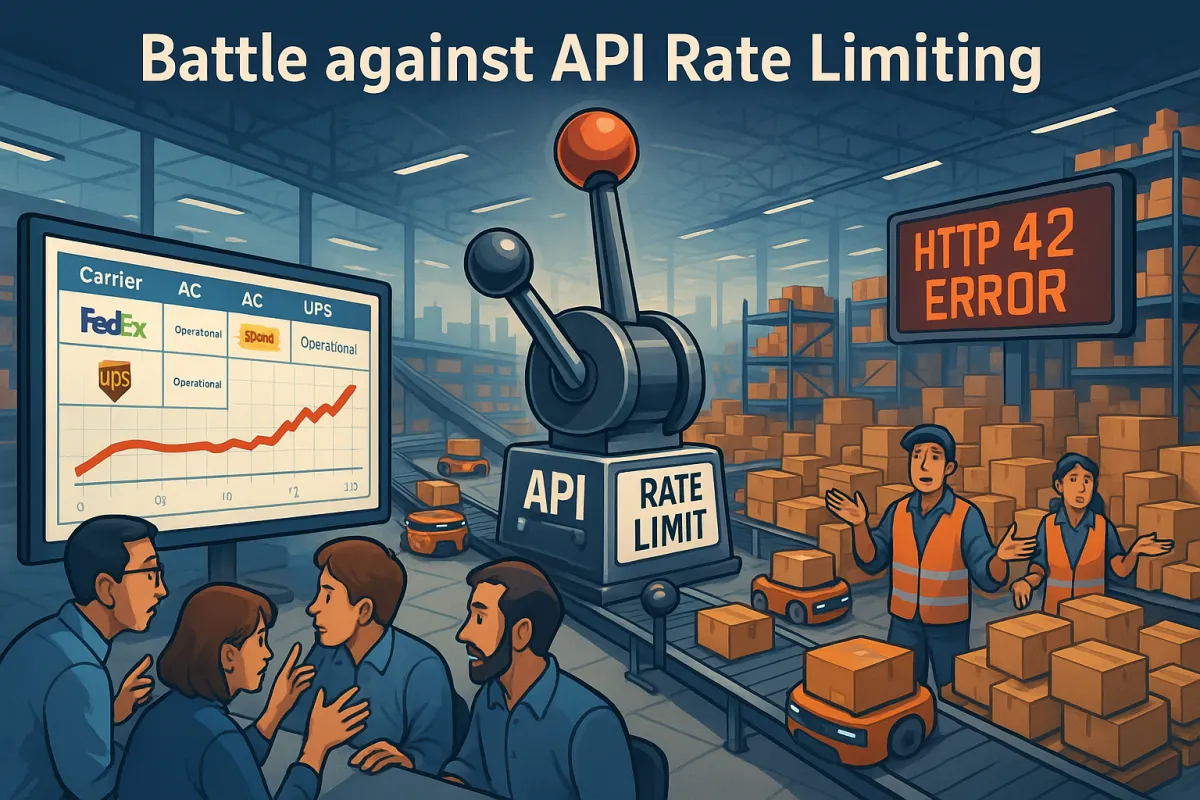
European shippers hit by carrier API rate limiting lose an average of €15,000 per month when throttling disrupts their shipping operations. Your label generation stops. Your tracking updates fail. Your customers start calling. Yet most companies only discover the extent of their rate limit exposure during peak season, when FedEx, DHL, and UPS APIs all throttle simultaneously during Black Friday volume.
This isn't theoretical. Between Q1 2024 and Q1 2025, average API uptime fell from 99.66% to 99.46%, resulting in 60% more downtime year-over-year. For shippers managing multiple carrier integrations, 47% of those who experienced an incident in the past 12 months reported remediation costs of more than $100,000. When your TMS system depends on real-time carrier connectivity, those numbers hurt.
The Hidden Cost of Carrier API Rate Limiting for European Shippers
Rate limiting hits hardest during Q4 when shipping volumes peak. Your system requests 300 labels from DHL in two minutes, not knowing that the throttling limit is set to 250 transaction over 10 seconds. The result? HTTP 429 errors cascade through your order fulfillment pipeline while your warehouse team scrambles to process shipments manually.
Consider a mid-sized retailer processing 2,000 daily orders across five carriers. When peak season volume doubles to 4,000 orders, your label generation API calls increase proportionally. But carrier rate limits don't scale with your business growth. The default Per Capability Per Project (PCPP) quota limit for the Track capability is 100K requests per day. That means when traffic from any of the projects within an organization to any of the 6 endpoints under Track capability exceeds this limit, then we will send you a "429 'Too many requests'" error until the end of the day.
The actual cost breakdown looks like this: manual order processing during throttling incidents costs approximately €8 per order in additional labor. System downtime leads to shipping delays that trigger service credits averaging €12 per affected shipment. Customer service overhead for explaining delays adds another €5 per incident. When you're processing 4,000 orders during peak season and hit rate limits across multiple carriers, those numbers compound quickly.
Understanding Carrier API Rate Limit Architectures
Every carrier implements throttling differently, creating a complex landscape for TMS integrations. FedEx uses three throttling mechanisms to manage that large volume. Quotas, rate limits, and thresholds are in place to allocate FedEx resources effectively and efficiently. Their approach includes daily transaction quotas at the organization level, per-minute rate limits at the project level, and burst thresholds monitored by IP address.
FedEx's approach—burst-based limiting with 10-second windows differs significantly from UPS's implementation. By default, ShipStation API allows you to send up to 200 requests per minute, but this applies to the platform layer, not necessarily the underlying carrier APIs.
Modern TMS systems handle these variations with varying degrees of sophistication. Cargoson goes further by maintaining different retry strategies for different types of carrier responses, understanding that a FedEx 429 response requires different handling than a DHL timeout. MercuryGate and Blue Yonder typically implement exponential backoff with maximum retry limits. Manhattan Active and SAP TM include more sophisticated queueing mechanisms.
Rate Limiting Patterns by Major European Carriers
DHL Express implements sliding window rate limiting with burst allowance for European traffic. Their API typically allows 300 requests per minute during normal operations, with burst capacity up to 500 requests in a 30-second window. DPD uses a different approach, implementing daily quotas with soft throttling that gradually increases response times before hard limiting at 1000 requests per hour.
GLS and Hermes operate regional variants where rate limits adjust based on geographic distribution. A shipper sending primarily to Germany might receive higher rate allowances than one distributing across all EU markets. PostNL and Colissimo maintain separate rate pools for domestic versus international shipping APIs.
Smart Rate Management Implementation Strategies
Queue-based processing with intelligent prioritization prevents the rate limit cascade that destroys shipping operations. Instead of sending API requests as they arrive, implement a request queue that respects each carrier's specific throttling parameters. We documented specific cascade patterns: FedEx rate limits trigger failover to UPS, which then hits its limits and fails over to DHL, creating a "carrier domino effect" that exhausts all available options within 90 seconds.
Smart queuing means understanding priority levels. Outbound shipment labels take precedence over tracking status updates. Same-day delivery requests get higher priority than standard ground shipments. Your queue processor should maintain separate buckets for each carrier, each with its own rate limiting logic.
Burst credit management becomes critical during peak periods. When your normal traffic runs at 60% of carrier rate limits, you maintain a 40% buffer for sudden volume spikes. But EasyPost's API dynamically adjusts user's rate limits based on system load, action taken, and other variables. As such, it's important to implement retry and backoff logic to handle rate limiting as the exact limit could change day-to-day and is not guaranteed to be a single hard limit.
Building Rate-Aware Integration Logic
Circuit breaker patterns prevent your integration from hammering carrier APIs when they're already under stress. When FedEx returns three consecutive 429 responses, your circuit breaker opens for 30 seconds before allowing another request attempt. This prevents the thundering herd effect where multiple retry attempts make throttling worse.
Exponential backoff with jitter prevents synchronized retry patterns. Instead of retrying every 30 seconds (which creates traffic spikes), add randomization. Your first retry waits 2-8 seconds, the second waits 4-16 seconds, and so on. This distributes retry load more evenly across time.
Request batching leverages carriers' bulk operation endpoints where available. Instead of making 100 individual tracking requests, batch them into 10 requests with 10 tracking numbers each. It would be helpful in minimizing the number of calls per customer order if the '/shipments/getrates' API method supported accepting multiple carrier codes. I am building an application that is attempting to find the minimum shipping cost, and if you want to find all FedEx, UPS, and USPS options for each order, it requires 3 API calls. This basically reduces the orders / minute that can be handled by a factor of 3.
TMS Selection Criteria for Rate Management
When evaluating TMS vendors, rate management capabilities often get overlooked until production problems emerge. Then you deploy to production and 72% of implementations face reliability issues within their first month. Sound familiar?
Ask specific questions during vendor evaluations. Does the system maintain separate rate limit pools for each carrier? Can it automatically failover to alternative carriers when primary options hit limits? How does it handle burst traffic during flash sales or promotional campaigns?
Cargoson, nShift, and Transporeon each take different approaches to rate management. Some platforms like FreightPOP focus on simplicity with basic throttling protection. Others like EasyPost, nShift, ShipEngine, LetMeShip, and Cargoson, plus direct integrations with DHL Express, FedEx Ground, and UPS offer more sophisticated controls.
Advanced Rate Management Features to Look For
Real-time rate monitoring dashboards should show current consumption against limits for each carrier integration. You want visibility into trends, not just current status. If you're consuming 80% of your DHL daily quota by noon, you need alerts before hitting the wall.
Automatic failover to alternative carriers requires more than just technical capability. Your TMS needs to understand service level requirements, cost parameters, and geographic coverage. If your primary carrier for Germany-to-Poland shipments hits rate limits, the system should route to your secondary carrier while maintaining delivery commitments.
Predictive rate usage analytics help you anticipate problems before they occur. Machine learning models can analyze historical patterns to predict when you'll hit rate limits during promotional campaigns or seasonal peaks.
Monitoring and Alerting Systems for API Rate Health
Success rates, response times, and rate utilization provide the foundation for rate limit monitoring. But your monitoring needs to track more than just HTTP response codes. In Q1 2024, APIs saw around 34 minutes of weekly downtime. In Q1 2025, that rose to 55 minutes.
Track rate limit consumption as a percentage of available capacity across different time windows. Your monitoring should alert when you hit 70% of hourly limits, 80% of daily quotas, or when response times exceed baseline by more than 200ms. Response time: Adjusts concurrent requests if latency crosses 500ms. That 500ms threshold appears across multiple implementations, but here's what vendors don't tell you: when managing five carriers simultaneously, hitting that threshold means your entire shipping workflow grinds to a halt.
Set up proactive alerts before hitting limits. Getting close to daily quotas requires different responses than hitting burst limits. Daily quota alerts trigger carrier switching decisions. Burst limit alerts require immediate request throttling.
Emergency Response Procedures
Rapid carrier switching protocols need predetermined decision trees. When DHL hits daily limits at 3 PM, which alternative carrier handles Germany-bound shipments? What's the cost impact? How do you communicate service level changes to customers?
Manual override procedures become necessary when automated systems fail. Your operations team needs documented steps for bypassing rate limiting during critical periods, even if it means higher costs. Emergency carrier support contacts should be readily available.
Cost-Benefit Analysis: Smart Rate Management vs Manual Workarounds
ROI calculations for automated rate management show clear benefits. Manual intervention during throttling incidents costs approximately €45 per hour in operations overhead. A typical mid-sized shipper experiences 2-4 throttling incidents per month during normal periods, increasing to 8-12 during peak season.
Smart rate management systems typically cost €5,000-€15,000 for implementation plus €2,000-€5,000 annually for maintenance. Compare this against throttling incident costs: 12 incidents per peak month × €8 average cost per delayed order × 50 affected orders per incident = €4,800 monthly during peak periods alone.
Hidden costs of manual workarounds extend beyond immediate labor. Shipping delays damage customer relationships. Service level agreement violations trigger financial penalties. Warehouse efficiency drops when staff switch between automated and manual processes.
Future-Proofing Rate Management Systems
Carrier API evolution continues accelerating. FedEx is introducing transaction quotas and rate limits for FedEx API. FedEx is introducing transaction quotas and rate limits to help manage these requests to ensure an equitable distribution of system resources and prevent abuse, overloading, and unauthorized access. Your rate management system must adapt to changing carrier policies without manual reconfiguration.
GraphQL adoption among carriers will impact rate limiting models. Instead of REST endpoint limits, GraphQL implements query complexity scoring. AI-powered rate optimization trends suggest dynamic limit adjustment based on real-time system performance rather than fixed quotas.
Start by auditing your current rate limit exposure across all carrier integrations. Document failure patterns from your last peak season. Implement monitoring before optimization—you need visibility into current performance before building smarter controls. Test failover logic during low-impact periods rather than discovering gaps when every minute of downtime costs revenue.