
Carrier API Health Monitoring: How European Shippers Can Build Early Warning Systems to Prevent €100,000+ Integration Failures in 2025
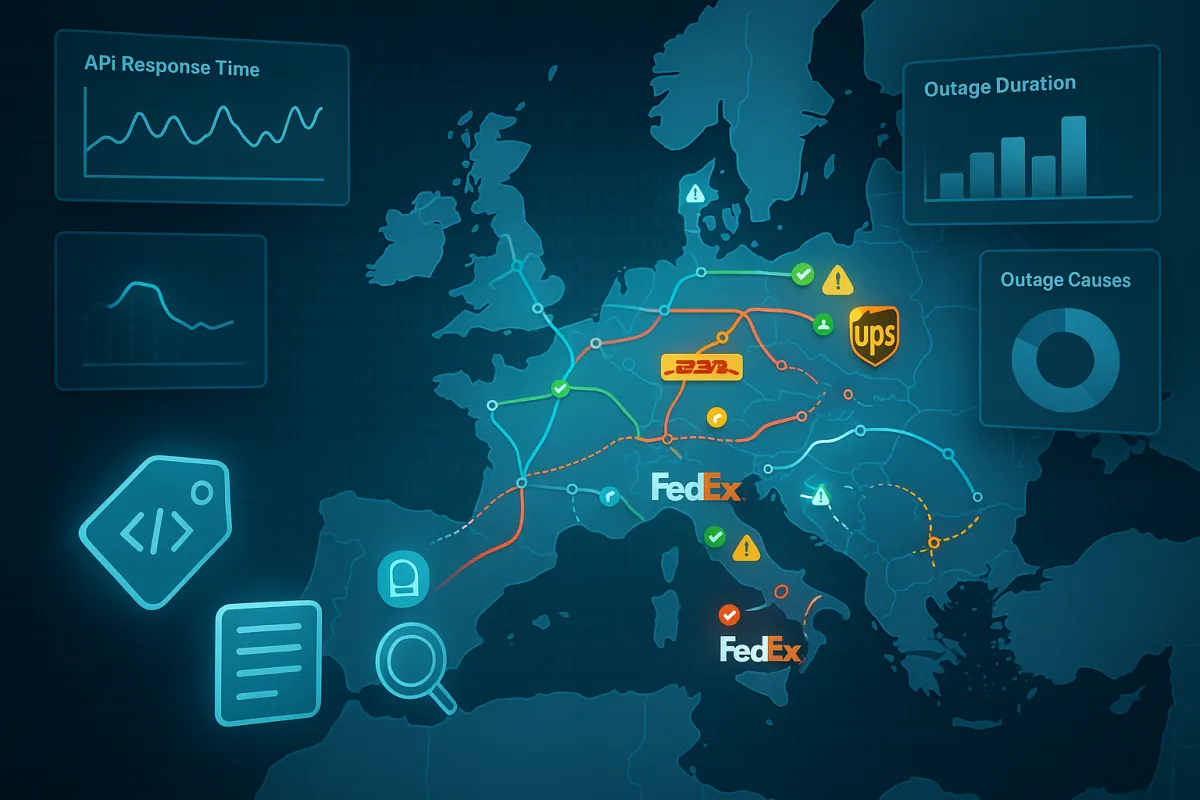
DHL Express dropped its tracking API for 90 minutes during peak Black Friday traffic, leaving major European retailers unable to update customers about €43 million worth of shipments. The silent failure only triggered alerts when customer complaints flooded support desks.
Sound familiar? Average weekly API downtime rose from 34 minutes in Q1 2024 to 55 minutes in Q1 2025, and logistics saw the sharpest decline in API uptime as providers expanded their digital ecosystems to meet rising demand. For European shippers handling millions of packages annually, these seemingly small disruptions cascade into operational chaos.
The numbers tell the story. 100% of technology executives reported experiencing outage-related revenue losses in the past year, with per-outage losses ranging from at least $10,000 to over $1,000,000. When your DHL rate shopping API returns error 500 while UPS tracking goes silent and FedEx authentication suddenly requires new fields, you need more than basic monitoring.
Why Standard Monitoring Tools Miss Carrier-Specific Problems
Standard monitoring tools miss the critical patterns unique to carrier APIs. While Datadog might catch your server metrics and New Relic monitors your application performance, neither understands why UPS suddenly started returning 500 errors for rate requests during peak shipping season, or why FedEx's API latency spiked precisely when your Black Friday labels needed processing.
Here's what makes carrier API monitoring different: Generic monitoring treats all APIs the same. That assumption breaks quickly with carriers. Rate shopping might work perfectly while label creation fails silently. Authentication succeeds but tracking webhooks never arrive. These patterns require specialized detection that understands carrier-specific failure modes.
Consider this scenario: Your monitoring dashboard shows green across all services. Response times look normal. Error rates stay within acceptable ranges. Yet customers can't track their DHL shipments because the carrier switched field validation rules without notice. Your multi-carrier integration just silently started rejecting label requests from DHL Express. No error alerts fired, no circuit breakers tripped, and your monitoring dashboards show everything as green.
Understanding Carrier API Failure Patterns
Each carrier develops distinct failure signatures. FedEx schedules regular maintenance windows that can block API access for several hours, while UPS rate limits spike unpredictably during peak shipping periods. DHL's XML validation has become increasingly strict, rejecting requests that worked fine last month.
Peak demand creates unique challenges. Some APIs can spike above 1.2 seconds during peak periods. When even a single second of latency per package can create backups cascading down the conveyor, leading to operational delays, overtime, and SLA failures, you need predictive alerting that spots performance degradation before it impacts operations.
Business context matters more than raw metrics. Tag requests with tenant ID, shipping service level, and package characteristics. When diagnosing a performance issue, you need to know if slow responses affect only international shipments or if the problem spans all service types. Context-rich data accelerates troubleshooting and enables more precise alerting.
Building Proactive API Health Monitoring Architecture
Smart monitoring architecture separates concerns by function rather than by carrier. This architecture separates concerns by function (rate shopping, labelling, tracking) rather than by carrier. Each monitor understands the specific response patterns and failure modes for its function across all carriers. The Carrier Health Engine maintains baseline performance profiles for each carrier and can detect when UPS response times suddenly jump or when DHL starts returning malformed XML.
Your rate shopping monitor needs different thresholds than your tracking system. Rate requests during checkout require sub-second responses, while tracking updates can tolerate higher latency. Label generation sits between the two - fast enough for automated processing but resilient to temporary spikes.
Multi-tenant environments add complexity. Most carrier integration platforms serve multiple shippers. Your monitoring architecture must isolate performance data and alerting per tenant while efficiently sharing carrier connections. Large retailers might have negotiated SLAs requiring 99.9% uptime, while smaller shippers accept 99.5%.
Multi-Carrier Monitoring Strategy
Rate limits from different carriers interact unpredictably. FedEx might throttle your entire account when one service hits limits, while UPS applies granular limits per API endpoint. DHL's European datacenters have different capacity than their US systems.
Traditional TMS platforms handle this differently. Solutions like Cargoson build carrier-aware rate limiting that automatically distributes load across available carriers when one approaches limits. This contrasts with platforms like FreightPOP or 3Gtms that rely on basic retry mechanisms, often making rate limit situations worse by hammering already overloaded endpoints.
Cargoson's approach includes intelligent backoff strategies that respect each carrier's specific retry-after headers and implements circuit breakers that don't block all traffic when detecting partial outages. Blue Yonder and Manhattan Active offer similar enterprise-grade features but require significantly more configuration overhead.
Essential Metrics and Alert Configuration
Response time monitoring needs carrier-specific baselines. UPS APIs typically respond within 200-400ms under normal load, while DHL's European endpoints can take 800ms during business hours. Your alerts should trigger when UPS exceeds 600ms but only warn about DHL at 1200ms.
Error rate thresholds vary by function and carrier. FedEx rate shopping can handle 2-3% error rates during peak periods, but label generation should never exceed 0.5% failures. Tracking APIs can tolerate higher error rates since failed tracking requests don't block shipments.
Quota consumption tracking prevents surprise cutoffs. API monitoring systems allow these organisations to track where the APIs perform as expected. The monitoring needs to track these negotiated SLAs per carrier, not generic uptime metrics. Monitor your FedEx rate quota consumption hourly, especially during promotional periods when volumes spike unpredictably.
Setting Up Predictive Alerting
Predictive alerting catches problems before customers notice. Track response time trends over rolling windows - if UPS response times increase 40% over two hours, that signals capacity issues before errors start appearing.
Baseline performance profiling adapts to carrier patterns. DHL Express performs differently on European business hours than weekends. FedEx Ground has different characteristics than FedEx Express. Your baselines should reflect these operational realities.
Seasonal adjustment strategies matter for European shippers. Black Friday, Christmas shipping cutoffs, and summer holiday periods all create distinct traffic patterns. Historical data from previous years helps set realistic thresholds during peak periods.
Automated Failover and Recovery Systems
Smart circuit breakers don't block all carrier traffic during issues. When DHL's rate shopping API fails, you can failover to UPS for time-sensitive requests while keeping DHL available for bulk label generation that isn't rate-dependent.
Retry logic requires exponential backoff with jitter. Even a 500ms call can back up flow, reroute packages to manual processing (the dreaded "jackpot lane"), and cause SLA failures or overtime costs. Naive retry attempts during carrier outages can overwhelm already stressed systems.
Multi-carrier redundancy implementation varies by platform capabilities. Oracle TM and SAP TM offer sophisticated rules engines for carrier selection during outages, but require months of configuration. Cargoson provides intelligent failover rules out-of-the-box, automatically routing to backup carriers based on service requirements and real-time availability.
Cost Optimization Through Monitoring
API call volume tracking reveals hidden costs. Some TMS platforms charge per API transaction, making high-frequency tracking updates expensive. Others use fixed licensing that makes monitoring essentially free beyond the setup cost.
True cost per API call calculations should include the overhead of maintaining integrations, not just the direct charges. Building carrier connections internally might seem cheaper than using platforms like nShift or Descartes, but the long-term maintenance burden often exceeds platform fees.
Cargoson's transparent pricing model lets you predict costs based on shipment volume rather than API calls, avoiding surprise bills when carriers change their tracking webhook behavior. Traditional enterprise solutions often hide API usage costs within complex licensing structures.
Implementation Roadmap for European Shippers
Phase 1: Assessment and baseline establishment (Weeks 1-2)
Document your current carrier connections and their failure modes. Which APIs fail most frequently? What time patterns do you see? How long does recovery typically take? Structure your observability data for both real-time alerting and historical analysis. Use consistent field naming across carriers - normalize UPS's "ResponseTime" and FedEx's "ProcessingDuration" into a standard "api_duration_ms" field. This consistency enables cross-carrier performance comparisons and simplifies alerting logic.
Phase 2: Monitoring infrastructure setup (Weeks 3-4)
Implement comprehensive telemetry that captures business context. Tag requests with tenant ID, shipping service level, and package characteristics. When diagnosing a performance issue, you need to know if slow responses affect only international shipments or if the problem spans all service types. Context-rich data accelerates troubleshooting and enables more precise alerting.
Phase 3: Alert configuration and testing (Weeks 5-6)
Configure alerts that distinguish between different types of issues. Authentication failures need immediate response, while gradual response time increases might indicate capacity planning needs rather than emergencies.
European shippers who master smart monitoring gain significant competitive advantages. While competitors struggle with carrier outages, your systems automatically failover to backup options. When peak shipping periods strain carrier capacity, your predictive alerts let you proactively adjust operations before customers experience delays.
Vendor selection depends on your scale and requirements. Enterprise shippers with complex European networks might need the full capabilities of Oracle TM or SAP TM despite the implementation overhead. Mid-market companies often find better value in specialized platforms like Cargoson that provide carrier connectivity and monitoring as integrated solutions rather than separate projects.