
Carrier API Deprecation Detection: How European TMS Teams Can Build Early Warning Systems to Prevent €500,000+ Integration Failures in 2026
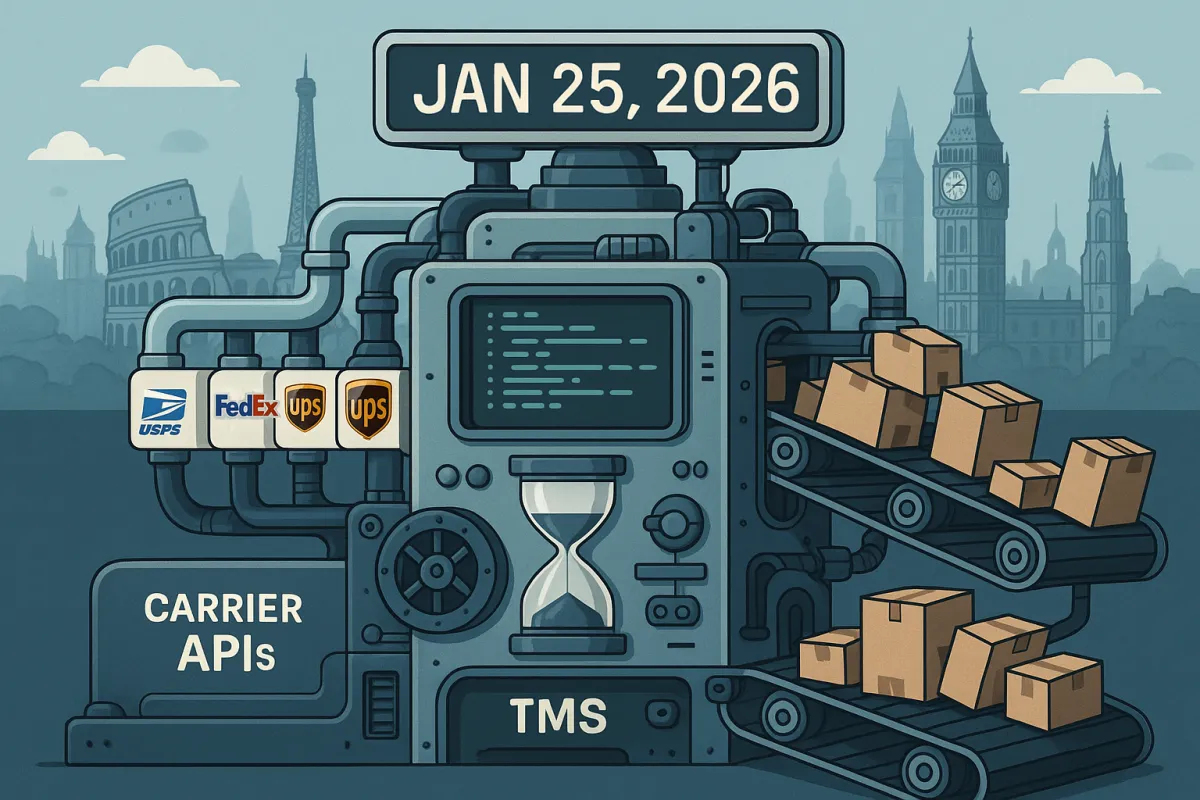
The USPS Web Tools API platform shuts down on Monday, January 25, 2026, forcing millions of European TMS platforms and their customers to scramble for emergency migration solutions. Yet this deadline represents just the tip of the iceberg for carrier API deprecation challenges facing transport management teams across Europe.
While procurement teams negotiate TMS contracts focusing on subscription fees, the hidden reality lurks in integration failures that 72% of implementations face reliability issues within their first month of production deployment. When you combine forced API migrations with this failure rate, European shippers are looking at potential disruption costs that dwarf their original software investments.
The Hidden Crisis: Why 2026 Will Be the Year of Mass Carrier API Failures
January 25th marks more than just another API retirement. The USPS Web Tools API platform will be fully retired on January 25, 2026, but this specific deadline creates a domino effect across European shipping platforms that rely on USPS for transatlantic shipments. The technical complexity goes beyond simple migration work.
API Version 3 uses OAuth 2.0 for API authentication, replacing legacy authentication methods while introducing changes to endpoint structures and request/response formats. This isn't a simple configuration update. Your integration teams need to rebuild authentication flows, update error handling protocols, and test new response structures across multiple carrier connections.
The scope of required changes becomes clear when you examine the new rate limiting landscape. Beginning January 25, 2026, the United States Postal Service will retire its legacy Web Tools APIs and replace them with a new platform that enforces a strict API rate limit of 60 requests per hour. For European TMS teams managing bulk address validation or high-volume shipment processing, this represents a fundamental operational constraint.
Consider how this impacts your multi-carrier strategy. A process that once handled 6,000 address lookups per minute is now limited to one. When you're managing shipments across UPS, FedEx, DHL, and USPS simultaneously, hitting rate limits on one carrier creates cascading delays across your entire shipping workflow.
The authentication migration complexity extends beyond individual carrier changes. Version 3 will require the generation and management of new tokens for secure access, but OAuth 2.0 implementation under production load reveals challenges that sandbox testing misses. Token refresh logic breaks when handling concurrent requests, and OAuth implementations struggle with the request volumes that European shipping operations require during peak periods.
The €500,000 Cost of Reactive API Management
Emergency API rebuilds cost between 10-15 times more than proactive migration planning. A German automotive parts manufacturer discovered their €800,000 TMS implementation mistake the hard way. Six months into deployment, they found their European carriers couldn't integrate without costly custom development work, forcing a complete platform re-implementation.
The financial impact spreads beyond direct development costs. Adding new carrier integrations costs approximately $3,000 per carrier under normal circumstances, but emergency rebuilds during API deprecation windows multiply these expenses. When carriers deprecate APIs without adequate notice, you're negotiating integration costs from a position of desperation rather than planning.
Failed implementations waste budget and time, but they also damage relationships with carriers and customers who experience service disruptions. Customer service teams field complaints about delayed tracking updates, shipping labels that won't generate, and orders stuck in processing while your technical teams scramble to restore carrier connectivity.
The opportunity costs compound when you consider lost efficiency gains. Over 90% of organizations report downtime costs exceeding $300,000 per hour when carrier integrations fail. For European shippers managing time-sensitive deliveries across multiple countries, each hour of API downtime translates to missed delivery windows, penalty fees, and customer satisfaction degradation.
Authentication Migration Complexity
OAuth 2.0 implementation creates production challenges that traditional testing environments can't replicate. The issue manifested as intermittent 401 responses during peak traffic periods, particularly affecting OAuth token refresh operations. When you're processing hundreds of shipments simultaneously, token management becomes a critical bottleneck.
Modern TMS platforms like Cargoson, nShift, and FreightPOP handle OAuth differently, but all face the same core challenge: maintaining authentication state across distributed systems under load. The authentication logic that works flawlessly in development fails when managing concurrent carrier connections during peak shipping periods.
Building Proactive API Health Monitoring Systems
Effective carrier API monitoring requires health scoring beyond simple uptime checks. You need systems that track response times, error rates, and business logic validation success for each carrier endpoint. This data enables dynamic routing decisions that keep shipments flowing when individual carrier APIs start degrading.
Carrier-specific thresholds become crucial because each API behaves differently under stress. FedEx uses proprietary headers, UPS implements rate limiting through error codes, and DHL varies by service endpoint. UPS might handle 100 requests per minute reliably while FedEx starts rate-limiting at 75 requests per minute.
Circuit breaker patterns prevent cascade failures when one carrier API starts returning errors. Your monitoring system should automatically route traffic away from degraded carriers while maintaining service for unaffected integrations. This requires vendor-agnostic monitoring that understands carrier-specific failure patterns.
Successful multi-carrier strategies require normalization layers that translate different throttling signals into consistent internal metrics. When DHL returns a 429 status code, FedEx might signal rate limiting through a different error response structure. Your health monitoring needs to understand these differences and react appropriately.
Platform-specific approaches vary significantly. Cargoson approaches this differently by maintaining separate rate limit contexts for each carrier integration, preventing one carrier's limits from affecting another's performance. Compare this against platforms like Transporeon and Manhattan Active typically implement basic retry logic, which can amplify problems during multi-carrier failures.
Early Warning Indicators: What to Monitor Before APIs Break
Predictive monitoring identifies patterns that precede complete API failures. Between Q1 2024 and Q1 2025, average API uptime fell from 99.66% to 99.46%, resulting in 60% more downtime year-over-year. This degradation doesn't happen suddenly - response time increases and authentication error rates rise before complete outages occur.
Response time degradation serves as an early warning signal. When managing five carriers simultaneously, hitting that threshold means your entire shipping workflow grinds to a halt. Monitor latency trends across your carrier mix and establish thresholds that trigger failover before response times impact user experience.
Regulatory compliance issues create API behavior changes without proper deprecation warnings. European carriers experienced regulatory compliance issues that created API behavior changes without proper deprecation warnings. Six-digit HS codes now required for international shipments might cause API validation failures that weren't announced through normal deprecation channels.
Rate limiting trend analysis reveals capacity problems before they impact operations. Track your usage patterns against carrier limits and identify when you're approaching dangerous thresholds. In Q1 2024, APIs saw around 34 minutes of weekly downtime. In Q1 2025, that rose to 55 minutes.
Authentication error increases often signal upcoming authorization system changes. Monitor 401 responses and token refresh failures across your carrier integrations. These patterns frequently precede announced API updates or undocumented security enhancements that break existing authentication flows.
The Deprecation Detection Framework for European TMS Teams
Automated monitoring setup should track both technical metrics and vendor communication channels. Many deprecation announcements arrive through carrier newsletters, developer portal updates, or industry alerts rather than automated API responses. Your monitoring framework needs to capture these human communication channels alongside technical metrics.
Vendor communication protocols require systematic tracking of carrier announcements. Royal Mail services to Canada will be suspended and will hold items destined for Canada until the CUPW national disruption is over. These aren't API failures in the traditional sense, but they disrupt shipping workflows just as effectively.
Change log automation becomes critical when managing multiple carrier relationships. Set up alerts for API documentation updates, new version announcements, and deprecation warnings. Many carriers announce changes months in advance, but only through specific communication channels that your technical teams might not monitor regularly.
Emergency response procedures should include failover logic that understands business impact. If DHL's label generation experiences 10% error rates but rate quotes work fine, route label creation to FedEx or UPS while continuing to use DHL for rate estimates. This requires business logic that goes beyond simple uptime monitoring.
Consider the carrier connectivity approach differences. Platforms like Cargoson offer unlimited carrier integrations through their European focus, while Manhattan's total cost of ownership ranks as relatively high, while cloud-native solutions like Cargoson focus on reducing implementation complexity through pre-built integrations.
Emergency Response Protocols: When API Changes Hit Production
Incident response requires faster reaction times than human monitoring can provide. A 5% error rate on Sunday evening requires different responses than the same error rate during Monday morning order processing. Your automated systems need context awareness about business patterns and customer impact.
Carrier selection logic should understand failure patterns and route accordingly. When one carrier API starts showing elevated error rates, your TMS should automatically shift traffic to backup carriers while maintaining service level commitments. This goes beyond simple failover - it requires understanding each carrier's strengths and current operational status.
Customer communication protocols become critical during API failures. Your emergency procedures should include automated customer notifications when carrier API issues might impact delivery times. This proactive communication prevents customer service teams from fielding surprised inquiries about delayed shipments.
Different TMS platforms handle emergency scenarios with varying sophistication. For integration platforms, solutions like Cargoson build monitoring into their carrier abstraction layer. This means you get carrier-specific health metrics without building custom monitoring for each API. Compare this approach against managing individual carrier monitoring with platforms like ShipEngine or EasyPost.
Future-Proofing Your TMS Against 2026's API Evolution
Strategic planning requires understanding that APIs will not fully replace EDI as the standard means for connection in the next several years. European market dynamics suggest continued coexistence between API and EDI connections, requiring hybrid integration strategies rather than all-or-nothing approaches.
Investment priorities should focus on platforms that support both integration methods. While EDI is leading in terms of connecting technologies used in TMS deployment, API connectivity is increasing, especially among parcel and LTL freight carriers. Your TMS selection needs to accommodate this transition period without forcing premature technology adoption.
Vendor relationship management becomes more important as carrier connectivity landscapes shift. Carrier integration costs blindside most procurement teams because vendors present API availability as "included" functionality. The reality proves more expensive. While many TMS solutions offer published APIs, carriers are often unwilling or unable to create connections themselves.
Compliance preparation for regulatory changes requires monitoring beyond technical API updates. European shipping regulations evolve independently of carrier API development cycles, creating situations where compliance requirements drive API behavior changes without standard deprecation processes.
Consider Cargoson's European-focused approach versus global platforms when evaluating long-term carrier connectivity strategies. Carrier network: Connected to 80,000+ transport professionals across Europe. In 2025, they launched Alpega MultiParcel which also connects to over 1,000 parcel carriers. While carriers can easily join the platform through their portal, requesting completely new carrier API/EDI integrations is more complex and costly.
The difference between surviving and thriving through 2026's API evolution lies in proactive monitoring, emergency response planning, and vendor relationships that support rapid adaptation. Start building your deprecation detection framework now, before the next wave of carrier API changes creates another €500,000 emergency rebuild project.