
Beyond Uptime: How European TMS Teams Can Build Carrier API Monitoring That Detects Authentication Cascades and Webhook Failures Before They Kill Shipments
October's cascade of carrier API failures exposed what many of us already suspected: uptime monitoring isn't enough anymore. When ShipStation API is currently experiencing performance issues due to an ongoing AWS service issue. We are actively monitoring their status and its impact on our platform. We will provide updates as they become available. That status page message has been stale for weeks now.
European TMS teams managing major carriers including UPS, USPS, and FedEx completing a shift in 2026 by retiring legacy carrier APIs in favor of modern, secure platforms face a stark reality about monitoring. Roughly 20% of webhook events failing in production according to Hookdeck research, yet most teams still rely on basic ping checks that miss the sophisticated failure patterns now dominating production environments.
The False Security of Traditional Uptime Monitoring
Real carrier API monitoring requires understanding what specific failure patterns look like in production. You need systems that detect authentication cascade failures before they knock out your entire order flow. This month's outages taught us that the old "ping and pray" approach falls apart when modern APIs fail in sophisticated ways.
Your traditional monitoring catches server downtime but misses the authentication token that expired at 3 AM on Saturday, silently breaking webhook registrations with PostNord while keeping UPS connections alive. We saw authentication-specific failures that traditional monitoring missed entirely. The difference? A generic monitoring tool sees HTTP 200 responses and declares victory. A business-aware system notices that your rate shopping requests return stale data or your tracking webhooks stopped arriving six hours ago.
Standard monitoring tools miss the critical patterns unique to carrier APIs. While Datadog might catch your server metrics and New Relic monitors your application performance, neither understands why UPS suddenly started returning 500 errors for rate requests during peak shipping season, or why FedEx's API latency spiked precisely when your Black Friday labels needed processing.
The Three Critical Failure Modes Missing from Standard Monitoring
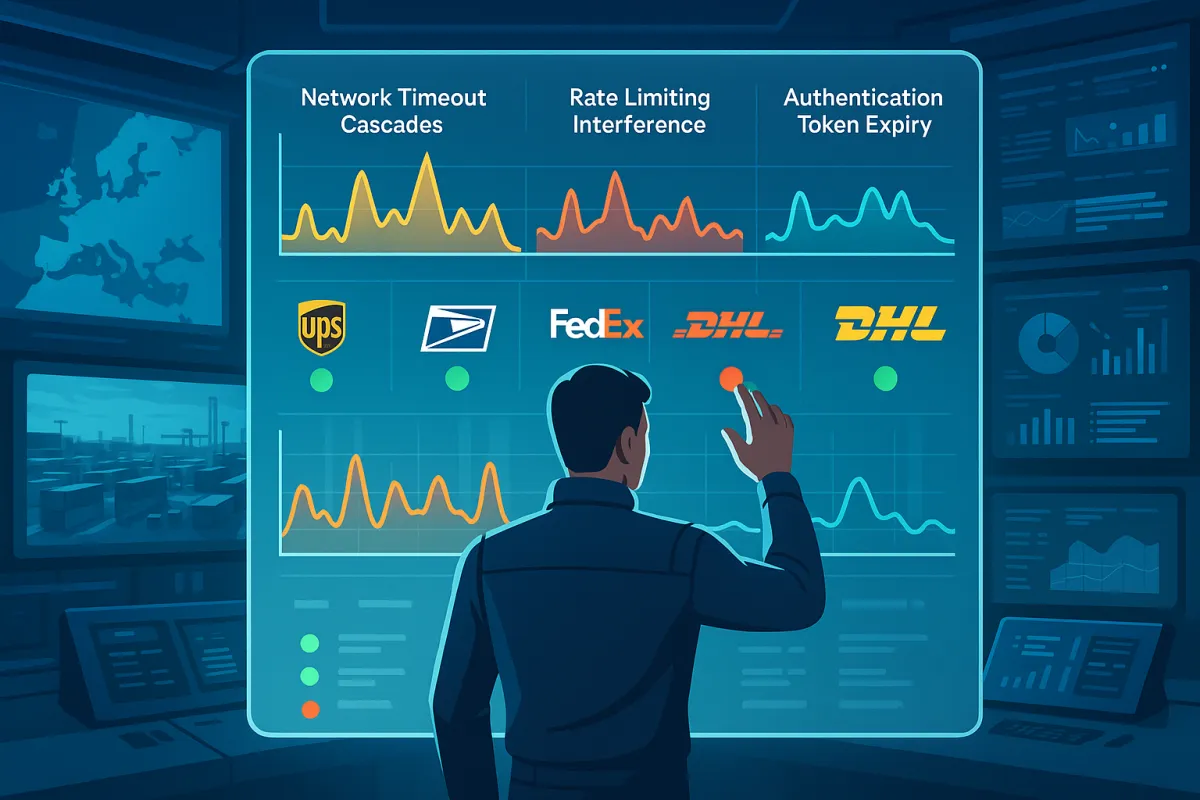
Three failure modes only surface in production: network timeout cascades (where one slow webhook endpoint causes others to timeout), rate limiting interference (webhooks competing with API calls for the same rate limit pool), and authentication token expiry during weekend periods when renewal processes don't run.
Network timeout cascades hit during peak shipping periods when your monitoring system can't distinguish between "DHL's API is slow" and "your connection to DHL is about to fail completely." ThousandEyes reports that "over 30% of API delivery failures trace back to transient connectivity faults rather than server-side issues". These network hiccups are invisible in controlled sandbox environments but common in production multi-datacenter deployments.
Authentication handling varies dramatically between carriers. USPS webhooks survived authentication token renewal seamlessly, while European carriers like PostNord required webhook re-registration after credential updates. DHL Express fell somewhere between - webhooks continued working but with degraded reliability for 4-6 hours post-renewal.
The retry storm problem compounds these issues. When webhook endpoints go down, platforms attempt rapid retries that overwhelm recovering systems. Your monitoring needs to detect when modern TMS platforms like Cargoson handle these storms gracefully versus when ShipEngine's retry logic creates additional load during recovery periods.
Building Business-Aware Authentication Monitoring
Three key metrics emerged as differentiators: initial delivery success rate (webhook received within 30 seconds), retry storm resistance (handling multiple rapid retries without auto-deactivation), and authentication token persistence (webhooks continuing to work after credential refresh cycles).
Real authentication monitoring tracks more than login success rates. You need systems that detect when OAuth token refresh operations start failing during peak traffic periods. This means monitoring token lifespan patterns, refresh success rates, and the cascade effects when authentication fails across multiple carrier connections simultaneously.
Set up monitoring that understands carrier-specific authentication quirks. UPS tokens refresh smoothly but DHL requires complete re-authentication for certain API endpoints after credential updates. European platforms like nShift and Cargoson handled webhook storms better, likely due to their regional focus and deeper carrier relationships. Cargoson's webhook implementation showed the smallest sandbox-to-production reliability gap in our testing, particularly for DHL and DPD integrations.
Your authentication monitoring should trigger alerts before token expiry, not after. Track authentication success rates by carrier, time of day, and token age. When authentication starts degrading 4-6 hours after token renewal with DHL Express, your system should automatically switch to polling mode for tracking updates while investigating the webhook reliability issues.
Webhook Resilience Patterns for European Carriers
European carriers present unique webhook challenges that generic platforms miss. Platforms like Cargoson, nShift, and Descartes build compliance monitoring into their carrier integration layers, but if you're managing direct carrier connections, you need to track these changes manually. This includes monitoring service restrictions, regulatory changes, and maintenance windows that affect webhook reliability differently across countries.
Build webhook monitoring that accounts for European-specific failure patterns. Create alerting for service restrictions that affect your shipping regions. When PostNL announces service suspensions to specific postal codes, your system should automatically adjust carrier selection for affected shipments.
Implement production-tested retry patterns with immediate retry, then exponential backoff with jitter at 1-5 minute intervals. Companies like Slack publicly discussed switching "from fixed-interval retries to adaptive algorithms, which lowered lost event rates by 30%". Your webhook monitoring needs to detect when carriers like DHL or DPD enter maintenance windows so retry logic doesn't overwhelm systems during planned downtime.
European platforms handle these complexities better because they understand regional carrier behaviors. The carriers were tested through multiple integration platforms: ShipEngine, Shippo, EasyPost, nShift, and newer European platforms including Cargoson. The platforms built for European operations show consistently better webhook reliability because they account for carrier maintenance schedules, cross-border documentation delays, and the authentication patterns specific to European logistics providers.
From Reactive to Predictive: Monitoring That Prevents Disruption
Set monthly error budgets for each carrier based on your business requirements. A high-volume shipper might need 99.95% successful rate shopping, while occasional shippers can accept 99.5%. But more importantly, align these budgets with business impact. A 2-second response time for rate quotes during checkout matters more than 500ms tracking updates that customers check once daily.
Establish monitoring thresholds that reflect customer experience priorities. Track burn rate, not just absolute errors. If your monthly error budget allows 100 failed requests, but 50 failures happen in the first week, you're burning budget too quickly. Alert on these trends before you exhaust your error budget and breach customer SLAs.
When UPS tracking webhooks fail, teams need automated customer notification scripts rather than waiting for support tickets. Build monitoring that triggers proactive communication based on failure patterns. If La Poste's authentication fails, your system should know whether to implement carrier failover or wait for recovery based on historical patterns and current capacity constraints.
Strategic API usage monitoring can reduce costs 30-40% by identifying inefficient polling patterns and optimizing webhook vs. API call ratios. Monitor which integration patterns consume the most API credits and adjust accordingly. Your TMS monitoring should track both technical performance and integration costs across your carrier network.
Implementation Roadmap for European TMS Operations
Start with carrier-specific monitoring for your highest-volume providers. Focus on address and service validation first for your highest-volume carriers—typically this means FedEx, UPS, and DHL for most European shippers. Focus on address and service validation first, then expand to rate and tracking validation. European shippers need additional monitoring for carriers like DPD, GLS, and Hermes that handle significant domestic volumes.
Document incident response procedures with specific carrier failure scenarios. When La Poste's authentication fails, teams should know immediately whether this affects only tracking webhooks or also rate shopping APIs. Create runbooks that specify whether to wait for carrier recovery or implement immediate failover based on the failure type and historical recovery times.
Phase 1 (Week 1-2): Deploy basic webhook delivery monitoring with carrier-specific failure detection. Platforms like MercuryGate and Cargoson include built-in real-time validation, but each handles error scenarios differently based on their carrier relationships. Configure alerts for authentication cascade failures and webhook registration issues.
Phase 2 (Week 3-4): Add authentication monitoring with token lifecycle tracking and carrier-specific renewal patterns. Set up automated failover procedures for common failure scenarios like weekend token expiry or maintenance window conflicts.
Phase 3 (Week 5-6): Implement predictive monitoring based on error budget tracking and business impact scoring. Cargoson provides real-time monitoring dashboards that track validation metrics across all connected carriers without additional setup costs. Configure monitoring to trigger proactive customer communication before failures impact shipments.
Cost-Effective Monitoring Architecture That Scales
European mid-market shippers need monitoring solutions that don't require enterprise budgets. Shipping API monitors are beneficial for enterprise-grade organisations as these organisations have independently negotiated SLA terms with their logistics partners regarding the downtime of the API. API monitoring systems allow these organisations to track where the APIs perform as expected. The monitoring needs to track these negotiated SLAs per carrier, not generic uptime metrics.
Build monitoring architecture using tools you already have. The tools exist: platforms like Splunk, QRadar, and Datadog can handle the monitoring infrastructure. The key is configuring them to understand carrier API failure patterns rather than treating all APIs identically.
Choose monitoring tools based on your integration approach. If you're using a European-focused platform like Cargoson or nShift, leverage their built-in monitoring capabilities. Transporeon and nShift require carriers to implement standard EDI interfaces themselves, while Cargoson builds true API/EDI connections with carriers rather than requiring standardized EDI messages that carriers must implement. For direct carrier integrations, implement custom monitoring that tracks the specific authentication and webhook patterns of your carrier mix.
The European shippers succeeding with carrier API monitoring are those who understand that modern APIs fail in sophisticated ways that traditional uptime monitoring can't detect. Focus on business logic validation, implement carrier-aware alerting, and build automation that understands shipping domain failures. Your customers will notice the difference.