
Backend-for-Frontend API Patterns for TMS: How European Shippers Can Simplify Multi-Carrier Integration Complexity and Cut Partner Onboarding Time 60% in 2026
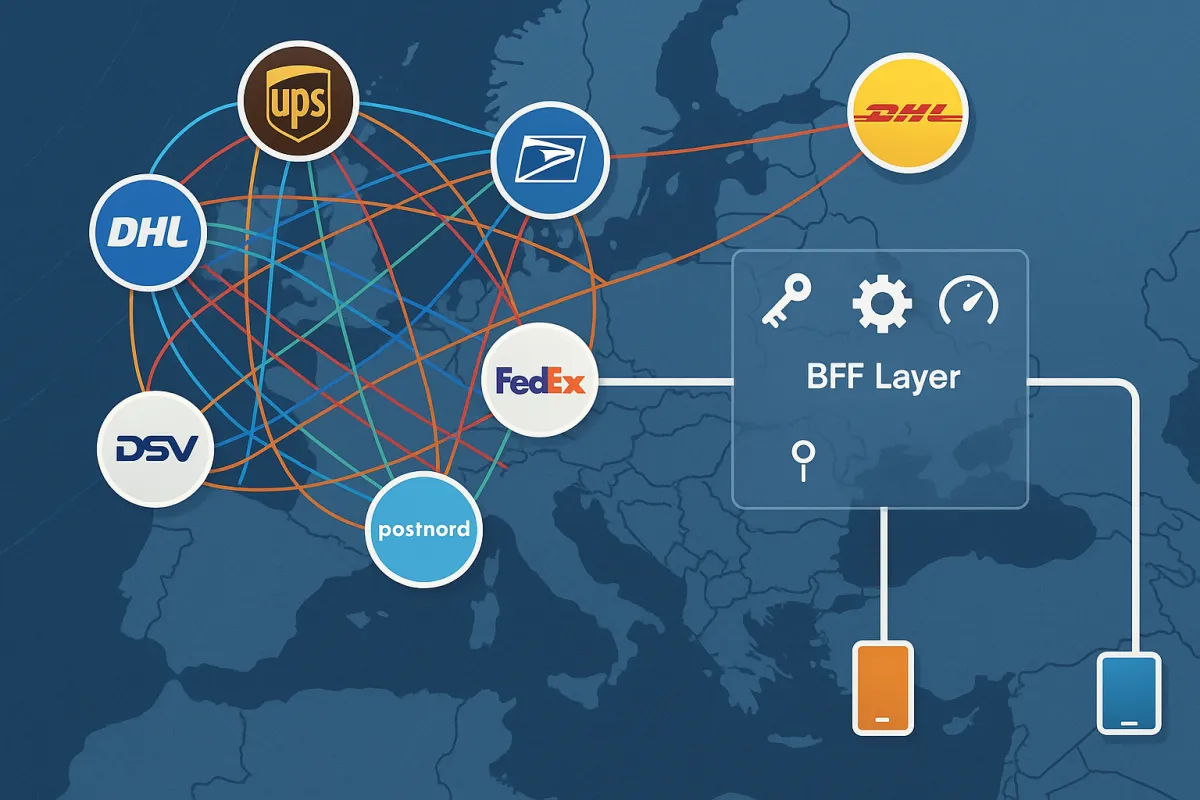
Managing 20+ carrier integrations has become a complex puzzle for European shippers in 2026. UPS completed its OAuth 2.0 migration, USPS Web Tools APIs shut down January 25, 2026, and FedEx is retiring SOAP-based endpoints by June 2026. Each carrier migration brings its own authentication requirements, data schemas, and rate limiting patterns.
This growing API integration pattern complexity is pushing logistics teams toward Backend-for-Frontend (BFF) architectures. BFF services can be smaller and less complex than shared backend services, while frontend teams independently manage their own BFF service, giving them control over language selection, release cadence, and feature integration. For European shippers, this translates to measurable improvements in partner onboarding speed and system reliability.
What Are Backend-for-Frontend Patterns in TMS Architecture
Backend-for-Frontend creates separate backend services for specific frontend applications or interfaces, tailoring APIs for different clients such as web, mobile, or other platforms. Rather than forcing your warehouse management system, customer portal, and mobile app to share the same carrier API endpoints, BFF lets you optimize each connection.
Think of your current carrier connectivity setup. Your TMS likely makes direct calls to DHL Express for rates, then DSV for booking, then PostNord for tracking. Each call has different authentication, timeout requirements, and response formats. A single call to a BFF often results in multiple downstream calls to microservices - like pulling wishlist items that require calls to wishlist, catalog, and inventory services.
Modern TMS platforms like Cargoson, nShift, and Shiptify already implement aspects of this pattern natively. They aggregate carrier responses behind unified interfaces, but most implementations still lack the flexibility European shippers need for complex multi-carrier scenarios.
Technical Architecture Components
BFF patterns optimize data aggregation, transformation, and caching, resulting in reduced latency, smaller payload sizes, and better overall performance. Your BFF layer sits between your TMS and carrier APIs, handling:
- Schema standardization across different carrier response formats
- Rate limiting aggregation when carriers have different throttling rules
- Circuit breaker implementation for automatic failover between carriers
- Authentication token management across OAuth 2.0, API keys, and legacy SOAP credentials
The integration layer manages communication between your systems, handles data transformation from carrier-specific formats to your internal schemas, and validates responses before passing them to your TMS.
Implementation Strategy: Building Your BFF Layer
European shippers typically need 4-8 weeks for simple integrations, extending to 12-20 weeks for complex enterprise implementations involving multiple legacy systems. The key is starting with high-volume carriers and expanding gradually.
Your implementation works with existing TMS platforms - whether you're using cloud solutions like Cargoson, hybrid systems like nShift, or enterprise platforms like Manhattan Active. The BFF layer acts as middleware, not a replacement.
Step 1: Carrier API Audit and Classification
Start by categorizing your current integrations. UPS transitioned from access keys to OAuth 2.0 in 2023, while USPS gradually replaced older APIs with OAuth-secured RESTful APIs since 2024. Document each carrier's authentication method, rate limits, and response schemas.
Different carriers follow different patterns. DHL Express uses OAuth 2.0 with specific scoping requirements. DSV offers multiple connection methods through their Developer Portal. GLS still relies on SOAP for some services while offering REST alternatives. This variation is exactly why standardization helps.
Step 2: Schema Standardization Layer
Create uniform data models that handle carrier-specific variations internally. Your TMS sees consistent response formats while the BFF handles translation between carrier schemas.
Instead of having a single API for all clients, BFFs provide customized APIs that cater to unique needs and requirements of each client, ensuring efficient communication and optimized user experience. Your planning team gets fast rate responses, while your customer service interface receives detailed tracking updates, all from the same underlying carrier connections.
Common BFF Patterns for European Carriers
European carriers present specific integration challenges. DSV offers multiple access methods through their Developer Portal, including Quote, Booking, and Tracking APIs alongside traditional EDI. DHL Express requires OAuth 2.0 with specific scoping for different services. PostNord uses hybrid authentication depending on service type.
Rather than building point-to-point integrations with each carrier, your BFF aggregates these connections. Your TMS makes one call to get rates from five carriers, while the BFF handles the complexity of different authentication methods, timeout requirements, and response parsing.
This approach works particularly well with modern TMS solutions. Systems like Cargoson, FreightPOP, and MercuryGate can integrate with your BFF through standard REST APIs, while the BFF manages carrier-specific complexity behind the scenes.
Rate Limiting Aggregation Pattern
Different carriers impose different rate limits. UPS allows 1000 requests per minute for rating APIs. DHL Express limits to 250 requests per minute for production environments. FedEx applies both per-minute and daily limits depending on service type.
Your BFF implements intelligent queuing and adaptive algorithms that adjust to traffic patterns. When one carrier reaches its limit, requests automatically route to alternative carriers with similar coverage. Rate limiting tools like Kong help manage this complexity.
Circuit Breaker Implementation
Carrier APIs experience downtime during maintenance windows and unexpected outages. USPS schedules regular 8-hour maintenance windows, while other carriers have shorter but more frequent updates. Circuit breakers protect your TMS from cascading failures by redirecting requests to available carriers.
When DHL Express goes offline during a maintenance window, your BFF automatically routes European shipments to DSV or GLS, maintaining service continuity without manual intervention.
EDI-to-API Bridge Pattern
Many European manufacturers and retailers still maintain EDI connections with key partners while adopting API-based integrations for newer relationships. The BFF pattern simplifies API evolution management, allowing developers to introduce new features or make changes without impacting other platforms.
Your hybrid architecture handles both worlds efficiently. Time-sensitive events like shipment tracking benefit from API speed, while traditional processes like invoicing continue working through established EDI connections. This approach is particularly valuable for European manufacturers using enterprise systems like SAP TM or Oracle TM alongside modern solutions like Cargoson.
Practical Hybrid Architecture
Your BFF receives standardized requests from your TMS and routes them appropriately. Rate requests go through fast API connections, returning results in under two seconds. Invoice generation uses existing EDI workflows that trading partners expect, maintaining compliance with established business processes.
This hybrid approach gives you API benefits without disrupting EDI connections that partners depend on. Your procurement team gets faster rate comparisons while maintaining established invoicing workflows.
Performance Optimization and Monitoring
Track API response times, error rates, and integration reliability across all carrier connections. European shippers typically see 40-50% reduction in planning time when implementing properly optimized BFF patterns.
Your monitoring should capture carrier-specific metrics. DHL Express averaging 1.2 seconds for rate responses. DSV occasionally spiking during peak hours. GLS maintaining consistent performance but with geographic variations. These insights help optimize routing decisions and identify issues before they impact operations.
This performance advantage positions your integration strategy competitively against expensive solutions like Blue Yonder or E2open, which often require significant customization for European carrier requirements.
Real-time Health Checks
AI and machine learning capabilities automate monitoring by detecting anomalies in carrier response patterns and maintaining API health proactively. Your system learns normal response patterns and alerts when carriers deviate from expected performance.
Automated health checks run continuously, testing carrier endpoints and authentication status. When issues arise, your BFF can automatically switch to backup carriers while alerting operations teams.
Cost-Benefit Analysis and ROI Calculations
Calculate developer time savings from reduced integration complexity. Each new carrier integration typically requires 160-240 developer hours using traditional point-to-point methods. BFF patterns reduce this to 40-80 hours per carrier after initial setup.
Faster partner onboarding means shorter time-to-value when negotiating new carrier relationships. Your procurement team can evaluate new partners quickly without waiting for lengthy technical integrations.
Compare these savings against subscription costs from providers like Transporeon, nShift, or Cargoson. Many European shippers find that building BFF capabilities internally provides better long-term value while maintaining control over integration priorities.
Future-Proofing Your BFF Implementation
Carrier APIs don't stand still, and your integration architecture needs to evolve accordingly. While many BFF services traditionally relied on REST APIs, GraphQL implementations are emerging as an alternative, allowing clients to request specific data without relying on predefined endpoints.
API management, microservices, and event-driven architecture enhanced by AI define the integration future. Your BFF layer should incorporate these capabilities gradually, starting with basic aggregation and expanding to include predictive routing, automated partner evaluation, and intelligent load balancing.
The next phase involves preparing for API evolution across European carriers. As more carriers adopt real-time pricing, dynamic routing, and enhanced tracking capabilities, your BFF architecture provides the foundation for incorporating these improvements without disrupting existing operations.
Start with your highest-volume carriers and most critical integrations. Build your BFF layer incrementally, proving value with initial implementations before expanding to comprehensive multi-carrier coverage. Your European shipper operations will benefit from reduced complexity, faster partner onboarding, and improved system reliability - exactly what competitive logistics operations need in 2026.