
Automated TMS Testing Framework: How European Shippers Can Build Quality Assurance Systems That Prevent 66% Implementation Failures While Ensuring ICS2 v3 Compliance Before February 2026
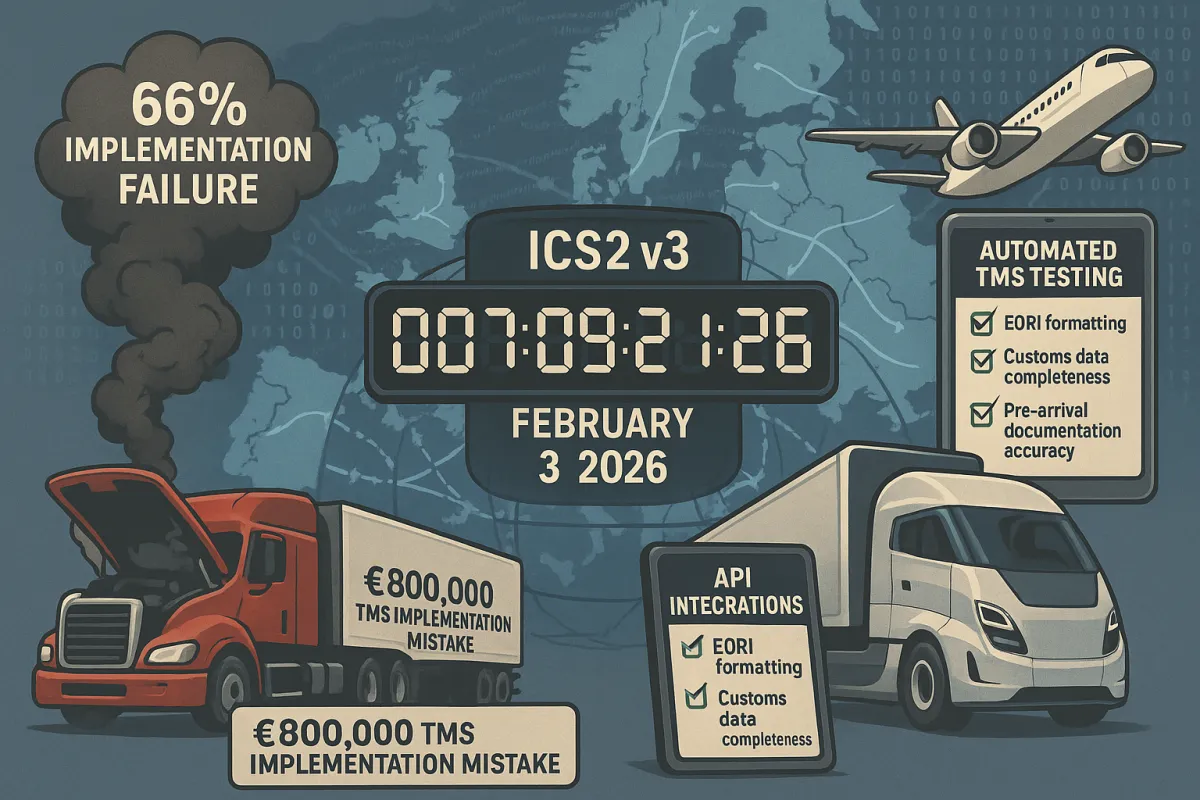
The most pressing compliance deadline for traders operating across European Union borders arrives on February 3, 2026, when Import Control System 2 (ICS2) version 3 messaging becomes mandatory and version 2 is permanently decommissioned. At the same time, European shippers face a sobering reality: 66% of technology projects end in partial or total failure, while transport management system implementations typically cost between €5,000-€15,000 for basic API integrations and exceed €50,000 for complex ERP connections.
This combination creates a perfect storm. While European manufacturers race to implement automated TMS testing and validation frameworks before the February 2026 compliance deadline, they're simultaneously navigating WiseTech Global's $2.1 billion acquisition of E2open and Descartes' purchase of 3GTMS for $115 million - changes that represent the most significant vendor consolidation wave in TMS market history.
The Hidden Crisis: Why 66% of European TMS Implementations Fail
When a major automotive parts manufacturer in Leipzig watched their transport monitoring dashboard flash red across 17 routes simultaneously in February 2026, they realized reactive manual testing was no longer enough. The cost? A German automotive parts manufacturer discovered their €800,000 TMS implementation mistake the hard way, joining the majority of European logistics transformations that never meet their objectives.
A staggering 76% of logistics transformations never meet their budget, timeline, or performance targets, while up to 40 percent of implementations fail by some estimates, and most of those failures trace back to integration issues that surface after launch. The problem isn't just technical complexity - it's that European shippers consistently underestimate the testing infrastructure required for modern carrier integration environments.
Consider the regulatory pressure alone. On February 3, 2026, the EU permanently switched off the old message formats. Every freight forwarder, carrier, and importer must now use ICS2 version 3 messaging, no exceptions. Meanwhile, platforms like Cargoson and Manhattan Active handle this validation automatically, while legacy TMS implementations struggle with manual compliance verification.
The skills gap multiplies these challenges. The skills gap means many European logistics teams lack the technical background to properly evaluate or implement modern TMS platforms. When a company selects Transporeon, nShift, or Alpega without adequate technical resources, implementation becomes a blind leading the blind scenario.
ICS2 v3 Compliance: The February 2026 Testing Mandate That Changes Everything
On 3rd February 2026, the EU's Import Control System 2 (ICS2) transitioned exclusively to version 3 messaging, with the older v2 system now decommissioned. This isn't a soft deadline or a gradual phaseout—it's a technical hard stop that affects every road and rail shipment entering EU territory.
The technical implications go far beyond message format changes. The data standards under ICS2 are significantly more rigorous than many businesses are accustomed to. Generic descriptions like "machine parts" or "clothing" will be rejected. Your automated testing framework must validate these enhanced data quality requirements before they reach customs systems.
ICS2 requires the accurate and timely submission of large volumes of structured shipment data for every movement into or through the EU. For hauliers and courier companies managing high shipment volumes, relying on manual or fragmented processes significantly increases the risk of errors, delays, and rejected filings. To operate effectively under ICS2, businesses involved in transport and customs operations increasingly depend on reliable IT systems that can automate data capture, validation, and submission while ensuring data security, system availability, and traceability.
Critical Testing Checkpoints for Cross-Border Compliance
Your testing automation must validate specific European cross-border requirements that manual processes can't handle at scale. In any case, an EORI number is immediately required to be able to initiate these connection activities. Your automated validation framework should verify EORI formatting, customs data completeness, and pre-arrival documentation accuracy.
ENS filings are automatically validated by ICS2. If errors are detected, the system will return error messages. Operators must review, correct, and re-submit the declaration. Monitoring these messages is essential to maintain compliance and avoid shipment delays. This creates a compliance testing requirement that human teams simply cannot execute consistently across hundreds of daily shipments.
The fragmented enforcement landscape adds complexity. Temporary derogations until June 1, 2026 apply in Spain, Finland, France, Greece, Hungary, Ireland, Italy, Lithuania, Northern Ireland, Croatia, Latvia, Poland, Romania, and Slovakia. These derogations permit continued use of legacy ENS filing methods or provide grace periods during which non-compliance will not result in immediate penalties. Your testing framework must account for these country-specific variations.
Building Production-Ready TMS Testing Automation Frameworks
This protocol compresses comprehensive TMS integration testing into a focused three-day cycle that catches 90% of the issues that typically surface post-launch. Unlike traditional testing approaches that drag on for weeks, this framework prioritizes the critical paths that actually break in production.
Start with API endpoint validation that mirrors real-world usage patterns. Rate Shopping Validation: Test rate comparison across carriers using packages that represent 80% of your shipping volume. Validate that residential delivery surcharges, fuel adjustments, and dimensional weight calculations match carrier invoices. Your automated framework should execute these validations continuously, not just during implementation.
Modern automated testing requires integration with existing TMS platforms. Effective Test Management Software integration with popular API testing tools like Postman, RestAssured, and JMeter is fundamental for automating API test execution and streamlining the testing process. This integration should support importing API test collections and test scripts from these tools into the Test Management Software, enabling centralized management of all API test artefacts. The TMS should provide seamless execution of API tests directly from its interface, triggering test runs and collecting test results automatically.
When API tests are integrated into CI/CD tools, like GitHub Actions, new code is automatically validated as it rolls out. This prevents bad and breaking changes from slipping into production and keeps projects on schedule. European operations require this level of automation due to regulatory complexity and multi-carrier integration requirements.
Multi-Carrier Integration Testing Strategies
European shippers typically manage 40+ carrier integrations simultaneously. A basic domestic shipper needs 10-15 integrations minimum, totaling 1,000-1,500 hours of labor, while most shippers today require an average of 40 integrations. Cross-border operations multiply this complexity through varying carrier protocols and regulatory requirements by country.
Your testing strategy must validate carrier failover scenarios automatically. Test carrier failover scenarios by temporarily blocking API calls to your primary carrier. Does your TMS automatically route shipments to backup carriers? Can your team manually override carrier selection when primary options fail? This type of resilience testing prevents the customer service disasters that plague reactive approaches.
Label Generation Testing: Generate shipping labels for your top product SKUs using real customer addresses. Test international shipments with customs documentation if you ship globally. Automated label generation testing should include ICS2 v3 compliance validation for every European destination.
Automated Compliance Validation: Preventing €50,000+ Integration Failures
The financial impact of manual testing approaches becomes clear when examining real-world failures. The financial impact extends far beyond the advertised device costs, with logistics professionals in Poland reporting that installation costs can reach 3,500-4,700 EUR per vehicle, which, combined with other costs such as purchasing software and employee training, can seriously threaten the profitability of small enterprises.
European shippers implementing automated testing frameworks achieve measurable cost advantages. One logistics director at a German automotive supplier told me they reduced tender cycle time from 72 hours to 8 hours by implementing marketplace connectivity for their spot freight - roughly 89% time reduction. The automated rate comparison alone saved 15 hours per week across their transport team.
Plan for 15-20% budget increases in 2026-2027 if reactive, or 8-12% if proactive with proper contract protection. European shippers who build comprehensive TCO frameworks before vendor selection avoid the budget disasters that plague reactive procurement approaches. Automated compliance validation represents the difference between these two outcomes.
The vendor consolidation happening now directly impacts your testing infrastructure decisions. Platforms like Cargoson provide European-focused automated compliance validation, while larger global vendors like BluJay and Transporeon offer broader but potentially less specialized testing capabilities.
Pre-Production Testing Environments and Sandbox Management
Successful automated testing depends on proper sandbox environment management. Begin with a single API endpoint that represents a critical user journey—authentication, data retrieval, or a core transaction. Choose the simplest tool in your stack to avoid configuration overhead; if your team uses Postman, start there with a collection. For code-first teams, RestAssured or Airborne integrate directly into existing test suites without additional infrastructure.
Structure your first test to check response status codes, response time thresholds, and payload structure. A basic authentication test might verify a 200 status on valid credentials, a 401 on invalid ones, and ensure the response includes an expected token field. Store test configurations using environment variables for base URLs, credentials, and timeouts.
Environment synchronization becomes critical when testing ICS2 compliance across multiple European destinations. Environment-specific discrepancies. APIs can behave differently across dev, staging, and production due to configuration variances. Account for these differences before they surface as post-deployment bugs.
Continuous Integration for TMS: Moving Beyond One-Time Implementation
Integration with CI/CD pipelines is critical for enabling continuous testing and allowing for automated execution of API tests as part of the build and deployment process. The Test Management Software should support integration with version control systems (e.g., Git) to manage API test scripts and configurations.
European regulatory requirements demand continuous validation, not just implementation testing. From January 2026, eFTI platforms can start preparing for operations, while July 2027 brings full mandatory compliance. From July 1, 2026, vans weighing 2.5-3.5 tons performing international transport will be subject to second-generation smart tachographs (G2V2). Simultaneously, as of 1 January 2026, the transitional phase of the Carbon Border Adjustment Mechanism (CBAM) has ended with importers now subject to full financial obligations.
While UI tests are slower and often implemented during the later stages of development, API testing is faster and can be integrated much earlier in the DevOps pipeline. For example, running unit and integration tests during the coding stage helps software teams identify and resolve API issues before they even push code. API load testing typically is implemented later in the development process since it requires environments that as closely as possible resemble the production environment. However, teams have been evaluating changes in performance as early as the coding phase - by ensuring that earlier environments are consistent and setting a baseline measurement as a guide to detecting deviations. This approach can catch performance issues early when they're easiest (and cheapest) to resolve.
Emergency Response Protocols: When Automated Tests Fail
Even sophisticated automated testing frameworks require backup procedures. Your customer service team fielded 2,800 "Where's My Order" calls last week. Half came from shipments where tracking updates failed to arrive because a webhook delivery went silent. The carrier API returned a perfect 200 status code, but your system never received the update.
Emergency protocols must account for the rapid pace of European regulatory changes. The updated list of the Stop words that will come into force on 4 May 2026 has been published in the CIRCABC library. Your contingency planning should include procedures for rapid compliance validation updates when regulatory requirements change mid-implementation.
Any shipments still using v2 messaging simply won't be processed. If you need to amend a v2 ENS lodged before 3rd February, you'll need to invalidate it completely and re-lodge in v3 format. These hard technical deadlines require emergency response capabilities that manual testing simply cannot provide.
2026 Implementation Timeline: Racing Against Regulatory and Vendor Deadlines
Phase your implementation to balance risk with operational requirements. Start with core functionality in Q2-Q3 2025, activate AI features in Q4 2025, and ensure eFTI compliance by Q1 2026. Vendor selection requires evaluating both capabilities and European market commitment.
The procurement window is closing rapidly. The procurement window for securing optimal TMS platforms before vendor consolidation eliminates choices and capacity shortages worsen cost structures runs through Q1 2026, while Europe could lack over two million drivers by 2026, impacting half of all freight movements. Against this backdrop, CBAM became financially binding for imports made from January 1, 2026, and companies that delay preparation risk significant operational and financial disruption.
TMS implementation usually takes 1-2 months for smaller shippers and 3-6 months for larger, more complex networks. As of January 2026, eFTI platforms and service providers can start preparing for operations while Member States authorities may start accepting data stored on certified eFTI platforms for inspection. From 9 July 2027, all national authorities will be obliged to accept freight documentation in electronic form via certified eFTI platforms.
Your testing framework implementation should account for vendor acquisition dynamics. Platforms demonstrating native eFTI integration, automated tachograph data processing, and integrated CBAM compliance show commitment to European operations. Consider European specialists like Cargoson alongside global solutions, evaluating implementation methodology, regulatory expertise, and acquisition resistance as core procurement criteria.
Success requires treating automated testing as strategic infrastructure rather than a technical project. European operations often see 15-25% improvements in transport administrative efficiency within the first year of successful TMS data integration. Without action to make the driver profession more accessible and attractive, Europe could lack over two million drivers by 2026, impacting half of all freight movements, while analysts predict a 3% year-on-year increase in contracted prices.
The companies that implement comprehensive automated testing and validation frameworks before the February 2026 deadline won't just achieve compliance - they'll establish the operational foundation required to navigate European logistics' most challenging transformation period in decades.