
Automated HS Code API Integration: The Complete Implementation Guide for European Shippers After USPS September 2025 Mandate
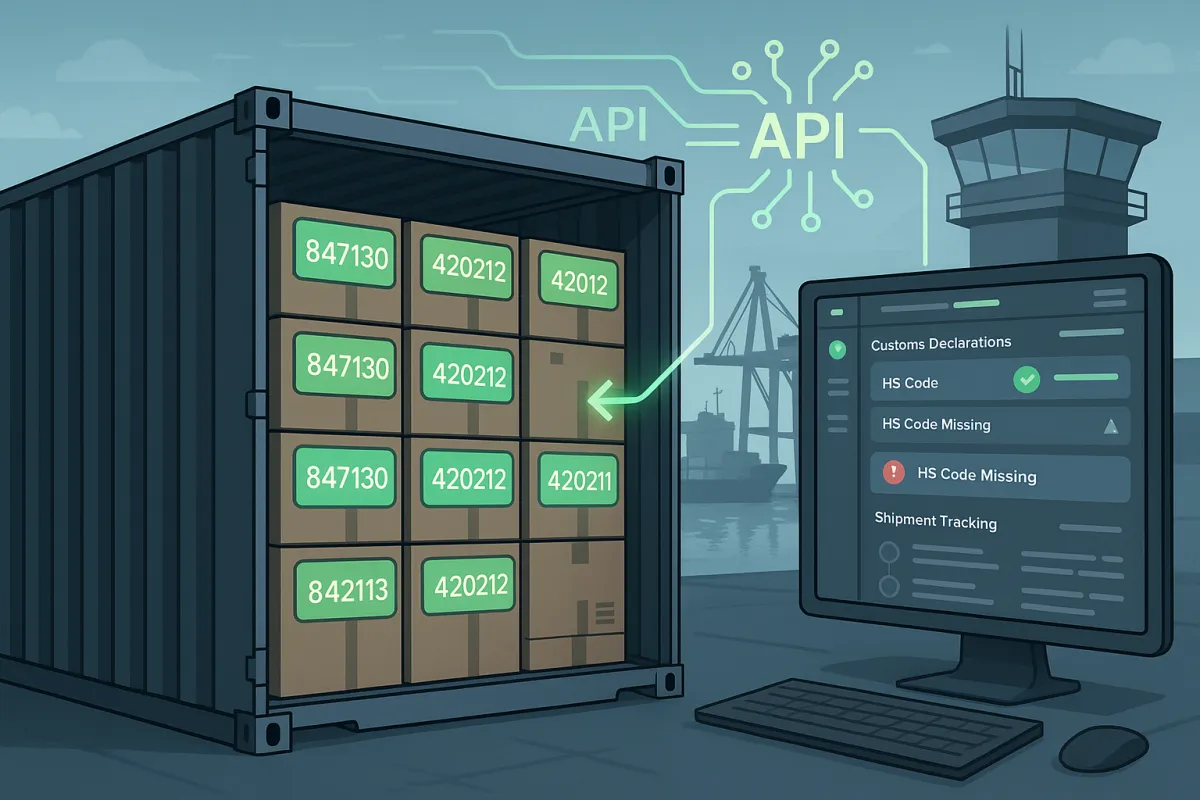
Beginning September 1, 2025, the U.S. Postal Service will require all international commercial shipments to include a six-digit Harmonized System (HS) code on customs declarations. For European manufacturers and retailers shipping to the US, this means your existing TMS workflows need immediate updates. The clock is ticking, but you don't need to tear down your entire system. While USPS is one of the first to set a deadline, this change reflects a broader push from destination countries to enforce HS code requirements across all carriers. To avoid delays or rejected shipments, it's best to include HS codes on all international shipments, regardless of carrier.
Your automation strategy needs to handle this change without disrupting current operations. Companies already struggling with carrier API management now face another layer of complexity. Here's how to implement automated HS code assignment through API integrations while keeping your existing workflows running smoothly.
Understanding the USPS HS Code Mandate and Its Impact on European Shippers
This update aligns USPS mailing standards with new regulations from the Universal Postal Union (UPU) and the World Customs Organization (WCO). But this isn't just about postal services. Requiring a six-digit HS code ensures standardised classification of goods but raises the risk of customs clearance delays if codes are missing or incorrect. Inaccurate codes may lead to shipments being held, rejected, or assessed at higher duty rates.
The timing compounds the challenge. Beginning Aug. 29, U.S.-bound postal packages must face either a duty equal to International Emergency Economic Powers Act tariffs or an $80-to-$200 duty based on the IEEPA rate. European shippers now face both mandatory HS codes and higher duty rates simultaneously.
Major carriers like FedEx and DHL already required HS codes for their express services. USPS will not block label creation if the HS code is missing, but customs agencies in destination countries may hold or return your shipments. Bottom line: Failing to include the HS code risks delivery delays, frustrated customers, and more manual work.
Modern TMS platforms like Cargoson, nShift, and FreightPOP have already integrated HS code functionality. But mid-market European shippers often run legacy systems or work with TMS providers that handle compliance as an afterthought.
Why Manual HS Code Assignment Won't Scale for Mid-to-Large European Operations
Accurate HS code assignment adds administrative costs, especially for businesses managing large catalogues. High-volume e-commerce sellers must now ensure every SKU has a correct HS code, increasing complexity. Smaller businesses without digital tools may face higher rejection rates or added costs to stay compliant.
The numbers don't lie. A typical European manufacturer might have 15,000+ SKUs across different product lines. Manual classification at 5-10 minutes per product means 1,250 hours of work. Even with experienced staff, you're looking at 6-8 months for initial classification, assuming no errors or rework.
But it gets worse. Classify is not static. Our AI continuously learns from customs agency feedback, global regulatory updates, and real-world data sampling. That means your results get smarter, faster, and more accurate over time—so your product catalog stays compliant and ready to scale across borders. HS codes change every five years during major revisions, with smaller updates happening continuously.
Manual processes break down under scale and regulatory complexity. You need systems that can classify 50,000+ products per hour to accellerate market entry and global growth. That's not possible with spreadsheets and human review cycles.
API-First Approach: Integrating HS Code Classification Services with Your TMS
Three main API providers dominate the HS code classification market: FedEx's Harmonized Code Lookup API, Zonos Classify, and several specialized trade compliance platforms. Each has different integration patterns and accuracy rates.
This API provides Harmonized System(HS) information like HS code estimate, description, incoterms and units of measure required for international shipments. Get duties and taxes estimates by using proper harmonized code based on the commodity information. FedEx's API works well if you're already integrated with their shipping services, but requires existing FedEx developer credentials.
Zonos Classify offers the most comprehensive solution. Within milliseconds, you receive HS codes with confidence scores and suggested alternatives—perfect for identifying edge cases or low-confidence matches. You can download classification reports, export results, or send data directly into your systems via API for seamless integration with your ecommerce, ERP, or logistics platform.
The API workflow is straightforward: Easily upload your product details into Classify or integrate through our API. Our AI instantly generates accurate HS codes based on text, categories, or images—no manual work required. Classify automatically supplements missing product details through AI-powered web searches, improving classification accuracy even with minimal input. Most classifications are completed in under 100 milliseconds.
TMS platforms handle these integrations differently. Cargoson builds direct API connections in-house, while some systems like Transporeon partner with external providers. Both platforms offer integration with carriers, but Cargoson provides more flexibility in how carriers are connected. Cargoson integrates with carriers via API or EDI, as well as with those who operate through email - a tailormade approach. This makes it easier for cargo owners to automate processes without requiring carriers to change their existing workflows.
Step-by-Step API Integration Implementation
Start with authentication and rate limiting. Most HS code APIs use OAuth 2.0 or API keys. Zonos requires an API key in the request header, while FedEx uses OAuth with token refresh cycles. Plan for 100-500 requests per minute rate limits during initial catalog uploads.
The classification request structure varies by provider. Zonos accepts product name, description, material, category, and even images. FedEx focuses on detailed product descriptions and destination countries. Classify uses the World Customs Organization (WCO) Harmonized Schedule (HS) codes to match product input fields with the appropriate HS codes. By default, Classify returns a 6-digit universal HS code recognized by all WCO member countries. If a destination country is provided, Classify will return a country-specific HS code, including WCO tariff schedule descriptions for each HS code level.
Error handling becomes critical at scale. APIs fail, return low confidence scores, or provide multiple code suggestions. Your integration needs fallback strategies: cached results, manual review queues for low-confidence matches, and backup API providers. If a shipment has the wrong or missing HS code, customs delays, rejections, and additional duty charges are likely. Customs authorities often assign a higher duty rate to cover extra work.
Modern TMS platforms like Cargoson, MercuryGate, and nShift handle these integrations through their existing API frameworks. But legacy systems need custom development work to connect external classification services with existing product catalogs.
Fallback Strategies and Error Handling for HS Code API Failures
APIs go down. Rate limits hit unexpectedly. Classification confidence scores drop below usable thresholds. Your HS code automation needs to handle these scenarios without breaking shipment processing.
Build a three-tier fallback system. First, cache previous results for repeat products. Most European manufacturers ship the same SKUs repeatedly, so 60-80% of classifications can come from cache. Second, implement confidence score thresholds - anything below 85% gets queued for human review. Third, maintain manual override capabilities for urgent shipments.
Confidence scoring varies between providers. Humans and other classification programs only get HS codes right 7/10 times. Zonos is changing the industry with our machine learning classification tool that generates instant, accurate results. But even AI-powered systems struggle with edge cases or new product categories.
Your error handling workflow should route low-confidence matches to experienced staff who understand trade compliance. Don't just flag them as "needs review" - provide the AI's reasoning, alternative suggestions, and links to relevant tariff schedules.
Enterprise TMS systems like SAP TM and Oracle TM handle API resilience through their existing integration frameworks. But smaller platforms require custom development. Cargoson builds these failover mechanisms directly into their carrier connectivity platform, treating HS code APIs as another integration layer.
Cost Optimization: Balancing API Calls vs. Manual Classification
Accurate HS code assignment adds administrative costs, especially for businesses managing large catalogues. Non-compliance could result in higher duties, fines, or returns. Combined with the Aug. 29 IEEPA duty requirement ($80–$200 per shipment or tariff-based duty), landed costs will rise significantly.
The math matters. Manual classification costs €15-25 per product when you factor in staff time, review cycles, and error correction. API calls run €0.10-0.50 per classification depending on provider and volume. But you need to factor in implementation costs, integration maintenance, and manual review of low-confidence results.
Use bulk classification for initial catalog setup. With bulk upload, you can process up to 50,000 items per hour. Bulk upload your product data via CSV or connect through our API to classify thousands of items in minutes—not weeks. Classify processes up to 50,000 items per hour using as little as a product name, ensuring enterprise-grade accuracy at scale.
Switch to real-time lookup for new products and order processing. This hybrid approach minimizes API costs while maintaining automated workflows. Most European manufacturers see 80% bulk classification, 20% real-time lookup as the optimal split.
Different TMS vendors handle cost optimization differently. Cargoson includes HS code functionality in their standard pricing, while platforms like Descartes and Blue Yonder charge separately for trade compliance modules. nShift (a 2021 merger of Consignor, Unifaun, Transsmart, Webshipper) specializes in parcel/LTL shipping and e-commerce fulfillment, with particularly strong presence in Nordic countries, the UK, and Benelux regions. Adding new carrier API integrations can cost €5,000-€10,000 each and take months to implement. Rate management: Relies on a third-party partner called Libello for storing and calculating from custom tariffs.
Monitoring and Compliance: Ensuring Long-Term HS Code Accuracy
HS codes aren't set-and-forget. The World Customs Organization updates the classification system every five years, with individual countries making changes more frequently. The newest Harmonized System (HS) amendments are taking effect January 1, 2022. Your monitoring system needs to catch these changes before they affect shipments.
Set up audit trails for every classification decision. Track which API provided the code, confidence scores, manual overrides, and customs clearance results. This data helps improve your classification accuracy over time and provides documentation for customs audits.
Monitor clearance performance by HS code. If specific codes consistently cause delays or rejections, your classifications need review. Some TMS platforms automatically flag underperforming codes, while others require manual analysis of shipping data.
Build compliance reporting into your workflow. Customs authorities expect documentation showing how you assigned HS codes, especially during audits. Your system should generate reports showing API sources, human review processes, and accuracy rates.
Modern TMS solutions like Cargoson alongside established platforms like Alpega and 3Gtms include compliance monitoring in their core functionality. When it comes to documentation, Cargoson again has a wider scope. In addition to standard shipping labels, it generates various documents such as CMR (international waybills), e-Waybills, Dangerous Goods Declarations (DGD), and the possibility to create customs declarations. For businesses handling international freight or specific types of goods, these additional documents are crucial for smooth logistics operations.
The September 1st deadline is here. But with proper API integration and fallback strategies, you can automate HS code assignment without disrupting your current shipping operations. Start with bulk classification of your existing catalog, implement real-time lookup for new products, and build monitoring systems to maintain accuracy. Your TMS vendor should handle the technical integration - but you need to drive the implementation timeline.