
API Gateway Architecture Crisis 2026: How European Shippers Can Build Resilient Multi-Carrier Integration Platforms Before Rate Limiting Failures Cost €500,000+ in Remediation
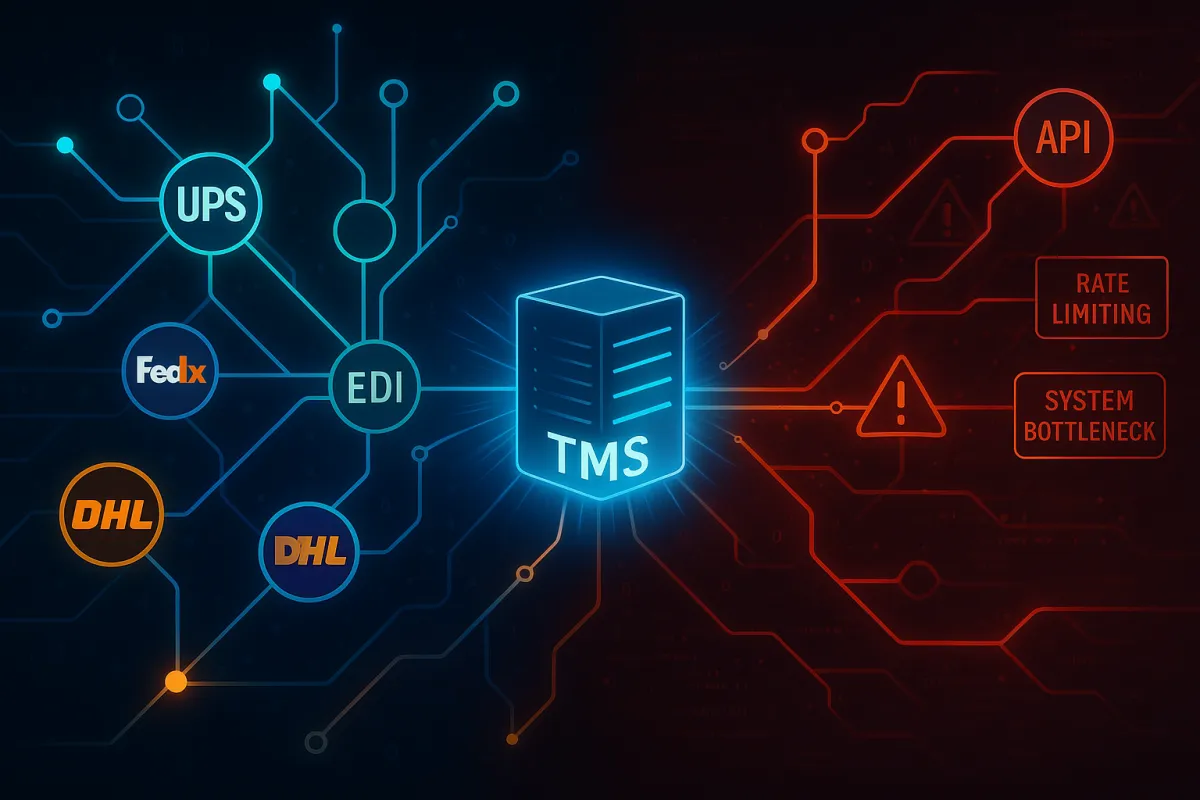
German automotive manufacturer's €800,000 integration disaster exposed a harsh truth about European carrier connectivity. Their enterprise TMS couldn't handle complex multi-carrier environments, forcing a complete platform re-implementation. Meanwhile, API downtime surged by 60% between Q1 2024 and Q1 2025, with average uptime dropping from 99.66% to 99.46%. While seemingly modest, this drop translates to an additional 90 minutes of downtime every month — during which e-commerce sites can't process purchases, mobile apps won't load, and critical business applications grind to a halt.
For European shippers managing 200+ transport partners across 12 countries, those extra minutes become critical failures. Rate limiting cascades now trigger authentication failures that knock out entire order processing systems. Traditional point-to-point integrations collapse when UPS, DHL, and FedEx APIs throttle simultaneously during peak periods. Yet most API gateway architectures still follow 2019 playbooks that can't handle these modern failure modes.
The Hidden Crisis: Why 60% More API Downtime is Crushing European Shipper Operations
72% of implementations face reliability issues within their first month of production deployment, and the root causes aren't technical mysteries. UPS is replacing its entire existing API infrastructure, while FedEx isn't just updating its API; it's championing a digital transformation. Both carriers had migration deadlines that got pushed back multiple times as companies struggled to adapt.
Enterprise TMS teams managing carrier integrations for UPS, FedEx, DHL and other major carriers face a stark reality: over 90% of organizations report downtime costs exceeding $300,000 per hour. When your rate shopping API fails during peak season, customers can't see delivery windows or compare shipping methods. Without the ability to clearly understand what shipping methods are available at what cost, and when packages will be delivered, customers are more likely to abandon their carts.
The cascading failures follow predictable patterns. Authentication issues manifest as intermittent 401 responses during peak traffic periods, particularly affecting OAuth token refresh operations. We saw authentication-specific failures that traditional monitoring missed entirely. The issue manifested as intermittent 401 responses during peak traffic periods, particularly affecting OAuth token refresh operations. Rate limiting hits simultaneously across carriers when everyone processes Black Friday volumes, creating systematic bottlenecks that traditional retry logic can't solve.
Consider the financial impact. Basic API integrations cost €5,000-€15,000, while complex ERP connections exceed €50,000. A basic domestic shipper requires 10-15 integrations minimum, potentially totaling 1,000-1,500 hours of labor. When those integrations fail during revenue-critical periods, remediation costs escalate quickly. The German manufacturer's €800,000 mistake represents just one example of how architectural decisions made in 2022 create expensive problems in 2026.
API Gateway Patterns That Actually Work for Multi-Carrier Environments
Centralized gateway architectures provide better control but create single points of failure. Distributed approaches offer resilience but complicate rate limiting across carrier APIs with different throttling behaviors. The Backend-for-Frontend (BFF) pattern works particularly well for TMS environments where different client applications need different data aggregation patterns.
Modern platforms like Cargoson, nShift, and enterprise solutions such as MercuryGate handle multiple carriers through specialized gateway layers that understand carrier-specific behaviors. For integration platforms, solutions like Cargoson build monitoring into their carrier abstraction layer. This means you get carrier-specific health metrics without building custom monitoring for each API. Blue Yonder and Manhattan Active TMS implement similar patterns at enterprise scale.
Rate limiting strategies must adapt to carrier variations. UPS might allow 1,000 requests per minute while DHL restricts to 300 requests per 5-minute window. Token bucket algorithms work well for burst capacity, but sliding window approaches provide more predictable behavior when managing multiple carrier quotas simultaneously. Adaptive algorithms that learn from carrier response patterns deliver the most reliable performance, automatically backing off when carriers signal stress through increased latency rather than explicit rate limit responses.
Circuit breaker patterns prevent cascade failures when individual carriers experience outages. The Carrier Health Engine maintains baseline performance profiles for each carrier and can detect when UPS response times suddenly jump or when DHL starts returning malformed XML. When FedEx's API returns errors above threshold percentages, the circuit breaker routes those requests to backup carriers or cached rate tables, maintaining user experience while the primary service recovers.
Rate Limiting Architecture: Preventing the 429 Error Cascade
FedEx enforces strict OAuth token limits, UPS throttles based on shipment volume tiers, while DHL uses sliding window algorithms that reset every 5 minutes. Your gateway must translate these different approaches into consistent internal behavior that prevents upstream applications from overwhelming any single carrier.
Queue management becomes critical when managing multiple carrier rate limits simultaneously. Priority-based routing ensures express shipments get processed even when standard shipping requests are being throttled. Implement separate queues for rate shopping, label generation, and tracking requests, as carriers often apply different limits to each operation type.
Monitoring requires carrier-aware alerting that distinguishes between legitimate rate limiting and actual service failures. Generic 429 responses don't tell you whether UPS is performing scheduled maintenance or experiencing capacity issues. While Datadog might catch your server metrics and New Relic monitors your application performance, neither understands why UPS suddenly started returning 500 errors for rate requests during peak shipping season, or why FedEx's API latency spiked precisely when your Black Friday labels needed processing.
Consider implementing intelligent retry logic that respects each carrier's specific retry headers and backoff preferences. Some carriers prefer exponential backoff while others respond better to fixed delays. Your gateway should learn these patterns automatically and adjust retry behavior per carrier, preventing the authentication cascade failures that knock out your entire order flow.
Implementation Cost Control: Avoiding the €50,000+ Integration Trap
Implementation costs range from €30,000 to €900,000, and for shippers with freight spend exceeding $250M annually, implementation can cost 2-3 times the subscription fee. The hidden costs emerge in carrier connectivity, where vendors present API availability as "included" functionality.
Carrier integration costs blindside most procurement teams because vendors present API availability as "included" functionality. While many TMS solutions offer published APIs, carriers are often unwilling or unable to create connections themselves, and even when they can, they typically charge integration costs back to the shipper.
Build versus buy decisions require careful TCO analysis over 5-7 years. Custom API gateway development might cost €200,000 upfront but provides complete control over rate limiting logic and carrier-specific optimizations. Managed solutions reduce initial costs but create ongoing vendor dependencies that compound during market consolidation periods.
Modern European platforms reduce integration costs through pre-built connections. Transporeon and nShift require carriers to implement standard EDI interfaces themselves, while Cargoson builds true API/EDI connections with carriers rather than requiring standardized EDI messages that carriers must implement. This architectural difference significantly impacts total implementation costs and time-to-value.
Factor in maintenance costs that vendors rarely discuss upfront. Annual maintenance fees present another budget trap. Licensed TMS models include annual maintenance charges ranging from 15-20% of license costs, while traditional software maintenance fees often run around 20% of the license fee annually for support and minor upgrades. API gateways require similar ongoing investment for security updates, carrier API changes, and performance optimization.
Performance Optimization: Maintaining Sub-500ms Response Times
If a single carrier API call takes 550ms or more (check out Carrier API Monitor for live data), it consumes a dangerous chunk of that window. And that's a best-case scenario…some APIs can spike above 1.2 seconds during peak periods. For high-volume operations processing 10+ packages per minute, these delays create operational bottlenecks that cascade through entire fulfillment workflows.
P95 performance requirements matter more than average response times when managing carrier APIs. Even a 500ms call can back up flow, reroute packages to manual processing (the dreaded "jackpot lane"), and cause SLA failures or overtime costs. Your gateway architecture must optimize for consistent performance rather than peak throughput.
Caching strategies require carrier-specific logic. Rate tables can be cached for 15-30 minutes depending on carrier update frequencies, but tracking data needs near real-time refresh. Label generation responses should never be cached due to unique reference numbers, while address validation results can be cached for hours or days.
Async processing patterns work well for non-critical operations like tracking updates and delivery confirmations. Rate shopping and label generation must remain synchronous to support user workflows, but tracking polling can be decoupled and processed in background queues without impacting user experience.
Implement comprehensive observability that goes beyond uptime monitoring. The monitoring needs to track these negotiated SLAs per carrier, not generic uptime metrics. Track latency distribution per carrier, error rates by operation type, and authentication success rates during different traffic patterns. This data enables proactive optimization before performance degrades to user-visible levels.
Future-Proofing Your Gateway: 2026 Regulatory and Technology Changes
eFTI compliance becomes mandatory across EU member states by July 2027, requiring electronic transport information exchange through certified platforms. By July 2027, all Member States will be required to accept electronic transport data via eFTI-certified platforms, marking a significant milestone in EU logistics and supply chain digitalisation. Vendors without clear eFTI roadmaps face competitive disadvantages that make them attractive acquisition targets.
Smart tachograph G2V2 requirements took effect August 2025 for cross-border heavy-duty vehicles, creating immediate integration demands. Your API gateway must handle telematics data flows alongside traditional carrier APIs, requiring different security protocols and data retention policies.
AI integration requirements are emerging as carriers implement predictive analytics and automated decision-making. GraphQL adoption accelerates as carriers move beyond REST APIs to support more flexible data queries. Webhook reliability becomes more critical as carriers shift from polling to push-based updates for tracking and exception management.
Vendor consolidation risks affect long-term architectural decisions. The most significant TMS vendor consolidation wave in over a decade is reshaping European procurement decisions right now. WiseTech's acquisition of E2open in 2025, Descartes' purchase of 3GTMS for $115 million in March 2025, and Körber's transformation of MercuryGate into Infios following their 2024 acquisition represent just the beginning of a fundamental market restructuring. Design your gateway architecture to remain carrier-agnostic and avoid dependencies on single vendor ecosystems that might disappear through acquisition.
Implementation Roadmap: 90-Day Deployment Framework
Phase 1: Assessment and Architecture Design (Days 1-30)
Document existing carrier integration patterns, API usage volumes, and failure modes. Establish baseline performance metrics and identify critical rate limiting bottlenecks. Design gateway architecture that separates carrier-specific logic from business logic, enabling easier maintenance and carrier additions.
Phase 2: Core Gateway Implementation and Testing (Days 31-60)
Deploy gateway infrastructure with basic rate limiting and circuit breaker patterns. Implement monitoring and alerting specific to carrier API behaviors. Test failure scenarios including carrier outages, rate limit exhaustion, and authentication issues.
Phase 3: Carrier Integration and Performance Optimization (Days 61-90)
Migrate production traffic through gateway in controlled rollouts. Optimize caching strategies and async processing patterns based on real traffic patterns. Implement advanced features like intelligent retry logic and predictive rate limiting.
Success metrics include sub-500ms P95 response times, 99.9% uptime during peak periods, and zero carrier integration failures due to rate limiting cascades. Follow a proven phased approach that reflects European transport reality. Deploy core TMS functionality first with limited telematics integration, focusing on data quality and user training. Only after achieving operational stability should you enable advanced telematics features like predictive analytics and automated exception management.
European shippers who invest in resilient API gateway architectures now avoid the expensive remediation costs hitting 47% of organizations. The 90-day framework provides a proven path to 99.9% uptime while controlling implementation costs below €100,000. Your carrier integrations don't have to become another €500,000+ budget disaster.