
API-First TMS Architecture: How European Shippers Can Build Future-Proof Carrier Connectivity and Scale Integrations 10x Faster in 2026
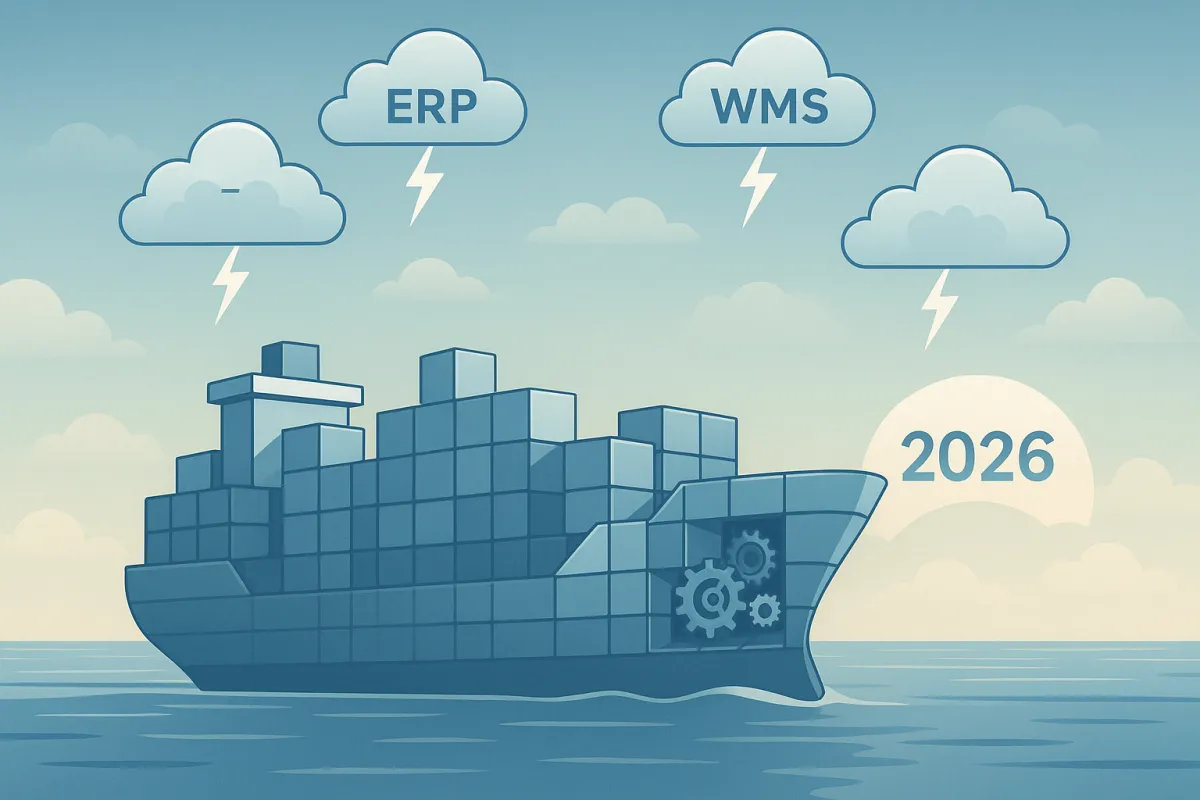
Your current TMS evaluation process is broken. Budget overruns hit 75% of European TMS implementations, yet most shippers focus only on subscription costs when evaluating systems. Implementation costs range from €30,000 to €900,000, and for shippers with freight spend exceeding $250M annually, implementation can cost 2-3 times the subscription fee. The reason? Most European shippers are still selecting transport management systems using 2018 criteria in a 2026 world where the API-first approach is becoming the standard. That means developers are designing APIs before building applications—ensuring scalability, integration readiness, and a better developer experience from the ground up.
This guide explains how European manufacturers, wholesalers, and retailers can implement API-first TMS architecture to future-proof carrier connectivity, cut integration costs by 60%, and scale operations without platform rewrites. You'll learn which vendors truly embrace API-first principles versus those that bolt APIs onto legacy architectures, plus specific strategies for avoiding the procurement mistakes that drain IT budgets.
Why API-First TMS Architecture Matters More in 2026 Than Ever
The API-fication of TMS has evolved far beyond where it was just a few years ago, with connectivity improving significantly as vendors ship more prebuilt connectors and cleaner links between TMS applications and enterprise systems. 2026 stands out as the most likely year when full TMS automation becomes mainstream. Companies that begin migrating now, blending AI, automation, and clean data workflows, will gain speed, resilience, and competitive advantage.
The difference between traditional TMS implementations and API-first approaches shows up immediately in integration complexity. Traditional systems require custom point-to-point integrations for each carrier, ERP connection, and WMS link. Each integration becomes a maintenance burden when carriers change their systems or you negotiate new partnerships.
Companies turned to APIs because they deliver real-time data sharing, standardized integration patterns, and automatic failover capabilities. Leading carriers increasingly positioned APIs as their preferred integration pathway. Early adopters reported measurable improvements in tender acceptance, tracking accuracy, and exception detection.
Modern API-first TMS platforms like Cargoson design their entire architecture around API connectivity from day one, while legacy vendors like MercuryGate and Blue Yonder often struggle with retrofitting API capabilities onto monolithic systems. The performance difference becomes obvious during peak shipping periods when API-native systems maintain consistent response times while legacy platforms experience slowdowns.
The Hidden Costs of Non-API-First TMS Selection
Carrier integration costs blindside most procurement teams because vendors present API availability as "included" functionality. While many TMS solutions offer published APIs, carriers are often unwilling or unable to create connections themselves, and even when they can, they typically charge integration costs back to the shipper.
Here's what procurement teams miss: A basic domestic shipper needs 10-15 integrations minimum, totaling 1,000-1,500 hours of labor, while most shippers today require an average of 40 integrations. Some complex implementations record over 140 integration objects. Each integration hour costs €75-150 depending on complexity and vendor, creating immediate budget overruns.
The cost differential becomes stark when comparing integration approaches. Transporeon and nShift require carriers to implement standard EDI interfaces themselves, while Cargoson builds true API/EDI connections with carriers rather than requiring standardized EDI messages that carriers must implement. This means Transporeon customers often wait months for carrier connectivity while paying additional integration fees.
Annual maintenance fees present another budget trap. Licensed TMS models include annual maintenance charges ranging from 15-20% of license costs, while traditional software maintenance fees often run around 20% of the license fee annually for support and minor upgrades. API-first platforms reduce these costs through automated updates and standardized connectivity.
Smart buyers recognize that cloud-native solutions like Cargoson focus on reducing implementation complexity through pre-built integrations and European carrier connectivity, while enterprise platforms require extensive customization work that drives up total cost of ownership.
Core Principles of API-First TMS Architecture
API-First Architecture generalizes the concept of decoupling front end from back end across all capabilities and channels, making headless one consumer among many. In TMS context, this means your rate engines, carrier connections, tracking systems, and reporting tools all expose standardized APIs that other systems can consume independently.
The microservices approach enables unprecedented flexibility. API-first architecture enables fintech platforms to scale individual services—like payments, KYC, or reporting—without affecting the entire system. This modular approach is critical in 2026, as fintech startups must handle growing transaction volumes, new markets, and multiple frontends without performance issues. European shippers benefit from the same principles: your routing service can scale independently of your tracking system when volumes spike.
API-first design differs fundamentally from "API-available" systems. API-first does not mean "we have APIs." It means APIs are designed before the UI, mobile apps, or internal dashboards. In an API-first fintech architecture, every capability—user onboarding, KYC, payments, transactions, reporting, compliance—is exposed as a well-defined, versioned interface.
The architectural benefits compound over time. When Maersk changes their API specification or UPS introduces new tracking events, API-first systems absorb these changes through standardized interfaces rather than requiring custom code updates across multiple integration points.
Overcoming DCSA Standards and Multi-Carrier Integration Challenges
DCSA and its member carriers have published track and trace (T&T) standards for the global container shipping industry. Once implemented, the standards will enable customers and supply chain participants to digitally communicate with all carriers in a unified way. Yet implementation reality proves more complex than the promise.
Data visibility is a challenge in the container shipping industry as it's not easy to exchange information digitally without standard formats. The data is not aligned and digitized amongst carriers, freight forwarders, and logistics partners. Due to this lack of visibility of data, the containers are lost from view until they arrive at a certain destination in their journeys.
Ocean carriers still rely heavily on legacy EDI infrastructures despite DCSA's API push. Today, VGM data is typically shared through emails, spreadsheets, carrier portals, or EDI messages, each using different formats and validation rules. This fragmented approach creates manual work, inconsistent visibility, and increased operational risk. European shippers need hybrid approaches that bridge API and EDI worlds until full industry adoption occurs.
The practical solution involves selecting TMS platforms that handle DCSA compliance transparently while maintaining backward compatibility with EDI-dependent carriers. Custom point-to-point integrations are giving way to shared platforms and standardized APIs. Regulation such as eFTI and industry standards like DCSA's API models and electronic bills of lading push freight data into structured, machine-readable formats.
Implementation Strategy: Microservices vs Monolithic TMS
Microservice architectures make rate limiting even more challenging. In a system composed of dozens or hundreds of services, requests might traverse multiple services before completing. Each service might have its rate limits, but you also need to consider end-to-end limits that span service boundaries. This requires coordination between services and potentially a centralized rate-limiting service with visibility across the entire request path.
The service decomposition benefits outweigh the complexity. When your tracking microservice experiences issues, your rating and booking services continue operating normally. This fault isolation prevents whole-system crashes that plague monolithic TMS platforms during carrier API outages.
Independent scaling capabilities become crucial during peak seasons. Your European operations might need 10x capacity increases for Black Friday shipping while your regular B2B freight maintains steady volumes. Microservices architectures automatically scale only the services experiencing load rather than the entire platform.
API gateway implementation becomes the coordination layer. Modern gateways like container platforms that are now the default runtime. Gateways built on Envoy or similar proxies integrate directly into Kubernetes, simplifying autoscaling and policy rollout. This infrastructure handles authentication, rate limiting, and request routing across your microservices automatically.
The vendor comparison reveals significant architectural differences. Traditional TMS vendors often claim microservices support but deliver tightly-coupled modules that fail independently. nShift and Transporeon represent hybrid approaches with some service independence, while Cargoson's cloud-native architecture provides true microservices benefits from ground-up design.
Rate Limiting and Performance Optimization for Multi-Carrier APIs
When API rate limiting and throttling issues typically emerge in three scenarios: during traffic spikes, following code changes that increase call frequency, or when scaling to new user segments, European shippers face a unique challenge. Multi-carrier environments amplify these risks because rate limits from FedEx, UPS, DHL, and regional partners don't just add up—they interact unpredictably during peak demand.
Consider this practical scenario: your manufacturing division in Germany makes 500 DHL requests for production shipments while retail operations in France need 1,200 UPS shipments for customer orders. Modern solutions like Cargoson build intelligent throttling directly into their carrier connectivity, understanding that each project has a transaction rate limit of 1,400 transactions per 10 seconds. Smart systems recognize different carriers serving different business units and prevent cross-contamination.
Each 429 error translated directly to abandoned purchases. But for European shippers, the stakes are higher because you're managing transport orders worth thousands of euros, not cart items. A bad rate limiting implementation could fail itself causing all requests to be rejected. The 429 error is a common result of such failures, indicating that too many requests have been sent in a given amount of time. When this cascades across multiple carriers simultaneously, your entire shipment pipeline stops.
Legacy systems like MercuryGate and Blue Yonder often rely on simple request counting—they work until they don't. Modern solutions like Cargoson build intelligent throttling directly into their carrier connectivity, implementing carrier-aware algorithms that understand UPS's request patterns differ from DHL's requirements.
FreightPOP and 3Gtms typically provide basic retry mechanisms with exponential backoff. Cargoson implements carrier-aware rate limiting that understands each carrier's specific patterns and adjusts automatically. This intelligence prevents the cascade failures that occur when simple retry logic overwhelms already-stressed carrier APIs.
Future-Proofing Your API-First TMS Investment
In 2026, this approach helps startups stay flexible, scale faster, and easily connect with banks, BaaS providers, and third-party platforms without rebuilding their core systems. The same principle applies to European shippers: API-first TMS architecture enables rapid adaptation when regulations change, new carriers enter your network, or acquisition activity reshapes your operations.
Vendor selection requires deeper evaluation beyond feature checklists. Some TMS providers tout that they're AI when they're probably machine learning at best. Don't be afraid to dig a little deeper during those evaluations. Ask vendors to demonstrate their API versioning strategy, explain how they handle breaking changes, and show real integration examples rather than marketing slides.
Contract negotiation should address API governance explicitly. Use semantic versioning, additive changes for minor versions, clear deprecation timelines, and migration guides. Provide test sandboxes. These requirements separate vendors with mature API programs from those offering basic connectivity.
Organizations face a clear choice: evolve API strategies now or become incompatible with tomorrow's digital infrastructure. The API landscape of 2026 demands zero-trust security, event-driven architectures, and machine-readable contracts. European shippers who invest in API-first TMS platforms position themselves for regulatory compliance, carrier connectivity, and operational efficiency.
Scalability planning should account for integration velocity rather than just volume growth. Supply chain technology is shifting from isolated tools to integrated operational intelligence. Companies that modernize their data layers, adopt AI thoughtfully, and focus on execution will gain resilience faster than those chasing hype. The year 2026 will reward organizations that can interpret signals quickly, synchronize decisions, and act decisively across their networks.
Start your API-first TMS evaluation by auditing current integration complexity and carrier connectivity requirements. Modern platforms like Cargoson, nShift, and FreightPOP each offer different approaches to API-first architecture—but only systematic evaluation reveals which approach fits your specific operational patterns and growth trajectory. The investment you make in 2026 will determine whether your logistics technology enables or constrains business growth through the next decade.