
Agentic AI vs Traditional TMS: How European Shippers Can Navigate the 2026 Hype Cycle to Avoid Joining 40% of Canceled AI Projects While Building Production-Ready Autonomous Transport Management
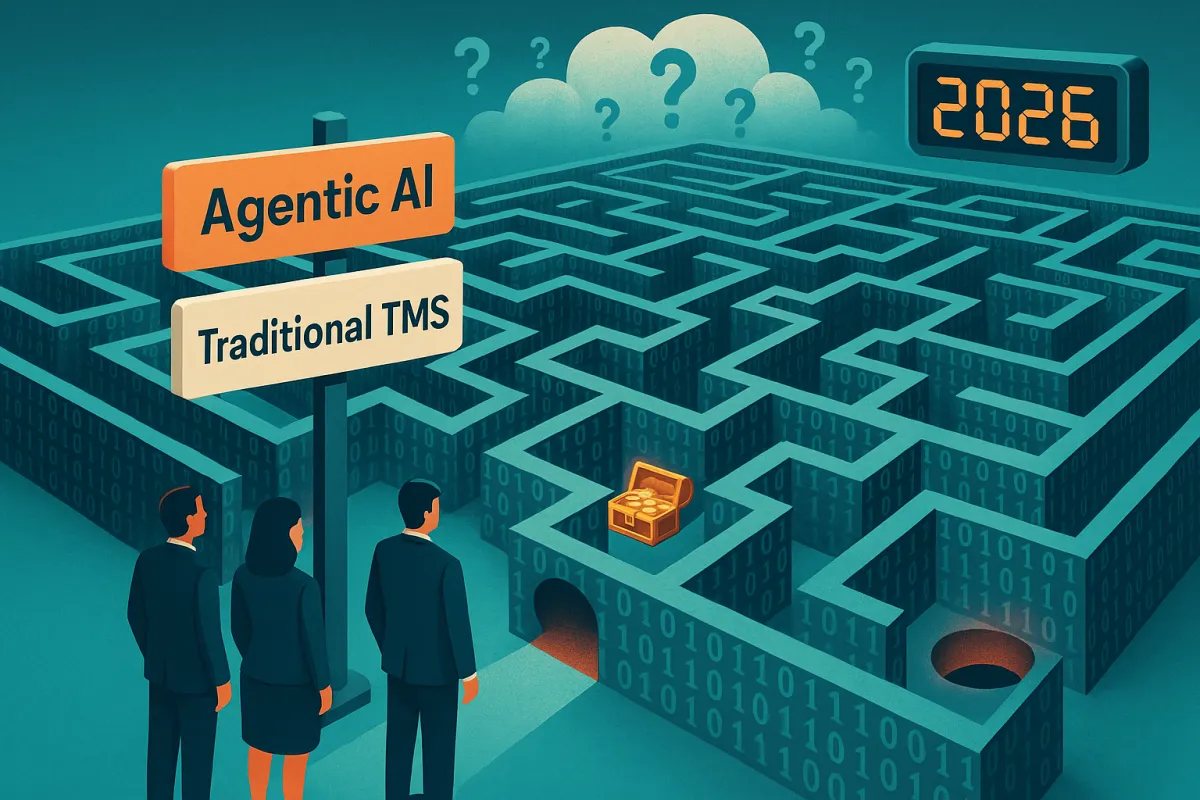
European transport procurement teams are evaluating agentic AI TMS platforms at exactly the worst possible moment. Over 40% of agentic AI projects will be canceled by the end of 2027, due to escalating costs, unclear business value or inadequate risk controls, according to Gartner. Meanwhile, WiseTech's acquisition of E2open in 2025, Descartes' purchase of 3GTMS for $115 million in March 2025, and Körber's transformation of MercuryGate into Infios following their 2024 acquisition represent just the beginning of a fundamental market restructuring that's eliminating your vendor choices faster than most teams realize.
You're being asked to make critical TMS decisions precisely when the most significant shift in 2026 is the move from "AI-assisted" to "agentic" TMS meets unprecedented vendor consolidation. Here's how to navigate this procurement minefield without joining the mounting pile of failed AI projects or vendor lock-in disasters.
The Agentic AI Reality Check: Why 40% of TMS AI Projects Will Fail by 2027
"Most agentic AI projects right now are early stage experiments or proof of concepts that are mostly driven by hype and are often misapplied," said Anushree Verma, Senior Director Analyst, Gartner. This brutal assessment hits transportation management particularly hard because according to a January 2025 Gartner poll of 3,412 webinar attendees, 19% said their organization had made significant investments in agentic AI, 42% had made conservative investments, 8% no investments, with the remaining 31% taking a wait and see approach.
The failure patterns emerging in European implementations are predictable. German and French manufacturers are discovering that integrating agents into legacy systems can be technically complex, often disrupting workflows and requiring costly modifications. A major automotive parts manufacturer faced €800,000 in additional costs when their "AI-enabled" TMS couldn't handle cross-border exception management during vendor acquisition transitions.
European buyers face additional complexity because most agentic AI marketing is designed for US domestic operations. Many vendors are contributing to the hype by engaging in "agent washing" – the rebranding of existing products, such as AI assistants, robotic process automation (RPA) and chatbots, without substantial agentic capabilities. Gartner estimates only about 130 of the thousands of agentic AI vendors are real.
Yet the numbers also reveal genuine opportunity. Gartner predicts at least 15% of day-to-day work decisions will be made autonomously through agentic AI by 2028, up from 0% in 2024. In addition, 33% of enterprise software applications will include agentic AI by 2028, up from less than 1% in 2024.
Understanding the Agentic AI Spectrum: From Marketing Buzzwords to Production-Ready Automation
Agentic AI doesn't just recommend — it acts. It detects an exception, evaluates options, selects the optimal one, executes it through downstream systems, and notifies the affected stakeholders. This differs fundamentally from traditional TMS automation that requires human approval for every decision.
For CXOs, Heads of Logistics, and Directors evaluating the category, four capabilities separate genuine AI-powered TMS platforms from rebranded legacy systems: Native AI architecture, not bolted-on dashboards. AI must be embedded in the planning, execution, and decision layers — not an analytics module on top of a transactional core. Agentic decision capability. The platform should be able to detect, decide, and execute — not just recommend.
Modern platforms like Cargoson, project44, and Manhattan Active demonstrate native AI integration where intelligence is built into the core platform, not added as a separate tool. AI TMS uses live data and predictive models to automate decisions that once depended on manual effort and experience. When intelligence is embedded across planning, execution, and visibility, transportation teams gain proactive insights that improve every stage of the shipment lifecycle — replacing guesswork with clarity.
Legacy vendors like SAP TM and Oracle are retrofitting AI modules onto existing architectures. Legacy TMS platforms often add small automation tools or dashboards and rebrand them as artificial intelligence. The result is a patchwork of features that still requires heavy manual oversight. A true AI TMS works differently. Instead of adding on modules, it embeds intelligence into the core of the system.
The European Regulatory Compliance Paradox: Why AI Hype Conflicts with eFTI and G2V2 Requirements
European transport faces converging regulatory deadlines that expose the gap between AI marketing and operational reality. As of January 2026: eFTI platforms and service providers can start preparing for operations. Member States authorities may start accepting data stored on certified eFTI platforms for inspection. As of 9 July 2027: The eFTI Regulation will apply in full.
Simultaneously, starting August 19, 2025, all heavy-duty vehicles registered in the EU and operating in Member States other than their registration must be fitted with G2V2 devices, while eFTI Regulation applies in full as of July 9, 2027. From July 1, 2026, vans weighing 2.5-3.5 tons performing international transport will be subject to second-generation smart tachographs, while the Carbon Border Adjustment Mechanism definitively applies from 2026.
These compliance requirements create a paradox: agentic tools are starting to show up in traditional supply chain systems. "Many ERP, TMS and WMS platforms now come with native AI and even agentic capabilities," says Ram. These features still need configuration and time to learn, he adds, but are increasingly available right out of the box. But experimental AI agents conflict with regulatory deadlines that demand proven, auditable processes.
European TMS providers building compliant AI features—like Cargoson, nShift, and FreightPOP—understand that platforms demonstrating native eFTI integration and automated tachograph data processing show commitment to European market requirements beyond basic transport management. The successful vendors are those treating compliance as a foundation for AI, not an afterthought.
The Vendor Consolidation Crisis: How WiseTech and Descartes Acquisitions Change Your AI Strategy
The TMS market is experiencing its most aggressive consolidation wave ever. WiseTech Global's completed $2.1 billion acquisition of E2open and Descartes' $115 million purchase of 3GTMS, marking the Canadian company's 32nd acquisition since 2016, signal a fundamental shift in how European shippers need to approach TMS procurement.
Companies undergoing integration often experience 12-18 months of reduced innovation while they harmonize platforms and teams. Post-acquisition integration timelines typically span 12-18 months, during which platform development stagnates and support quality deteriorates. This creates immediate risk for buyers evaluating experimental agentic AI features that require ongoing development and refinement.
The consolidation reveals three distinct market categories: global mega-vendors (Oracle TM, SAP TM, E2open/WiseTech, Descartes), European specialists (Alpega, nShift, Transporeon), and emerging European-native solutions like Cargoson that maintain development focus specifically on European regulatory requirements.
Each category presents different AI risks. Mega-vendors can continue R&D spending but face integration complexity. Blue Yonder and Manhattan Active have maintained independent development, while companies undergoing integration often experience 12-18 months of reduced innovation while they harmonize platforms and teams. Consider the benefits: Cargoson, Alpega, and other European specialists maintain development resources focused exclusively on European market needs, while global vendors like Descartes or WiseTech spread development efforts across multiple geographic priorities.
Practical Agentic AI Assessment Framework: Separating Production-Ready from Experimental
European buyers need concrete evaluation criteria that distinguish genuine AI capabilities from marketing theater. Smarter planning: AI uses predictive analytics to anticipate capacity needs, demand surges, and potential disruptions before they occur. Dynamic routing and optimization: AI continuously recalculates the most efficient routes by analyzing traffic, weather, fuel costs, and carrier performance in real time. Carrier selection: Machine learning models recommend the best carriers based on cost, performance history, and service level agreements.
Proven AI features that work today include live data integration for predictive capacity planning, dynamic routing that analyzes real-time conditions, and exception management that resolves disruptions automatically. Platforms like Cargoson, Shipwell, and FreightPOP demonstrate these capabilities in production European environments.
Red flags include customer-facing chatbots marketed as "agentic," fully autonomous claims without human oversight options, and experimental features that lack regulatory compliance validation. The research giant estimates only about 130 of the thousands of agentic AI vendors out there are real. "Most agentic AI propositions lack significant value or return on investment (ROI), as current models don't have the maturity and agency to autonomously achieve complex business goals or follow nuanced instructions over time," Verma noted.
Practical evaluation requires testing AI decisions under European complexity: cross-border exception handling, multi-modal optimization, and compliance reporting automation. Ask vendors for specific examples of agentic decisions made in similar European operations, not theoretical capabilities.
Implementation Strategy: Building AI-Ready TMS Architecture Without the Hype Trap
In this early stage, Gartner recommends agentic AI only be pursued where it delivers clear value or ROI. Integrating agents into legacy systems can be technically complex, often disrupting workflows and requiring costly modifications. In many cases, rethinking workflows with agentic AI from the ground up is the ideal path to successful implementation.
European implementation strategy should phase AI introduction carefully. Expect to see more traction in this area in 2026 as workflow-focused platforms add more agentic AI features that can sit on top of core systems like ERP. Once in place, these advanced systems can help supply chain and logistics managers orchestrate complex processes. "These capabilities are getting better and better with each new release," Ram says.
Start with controlled environments where AI agents handle routine tasks like carrier selection or appointment scheduling. Modern platforms like Cargoson, MercuryGate, and Descartes offer phased AI activation that begins with recommendations before progressing to autonomous decisions. Avoid vendors promising "fully autonomous" operations from day one.
Risk mitigation requires maintaining human oversight capabilities during AI learning phases. AI empowers TMS to move from reactive planning to proactive, intelligent transportation management. Where traditional TMS solutions relied on fixed rules and historical data, AI-driven systems continuously learn from patterns, analyze real-time conditions, and automate decision-making. But European regulatory requirements demand audit trails and human accountability that pure automation can't provide.
Cost-Benefit Analysis: When Agentic AI Investment Makes Business Sense vs Marketing Theater
Real ROI indicators come from operational efficiency gains that translate directly to cost reduction. Companies leveraging AI-driven logistics are cutting empty miles by up to 41%, improving asset utilization by 30%, and resolving supply chain disruptions nearly twice as fast.
Practical benefits include route optimization that reduces fuel costs by 15-25%, automated exception handling that cuts manual intervention by 60%, and predictive capacity planning that improves asset utilization. Platforms like Cargoson, Blue Yonder, and SAP TM demonstrate measurable improvements in these areas for European operations.
Hidden costs include integration complexity, change management, and ongoing AI model maintenance. A basic domestic shipper requires 10-15 integrations minimum, potentially totaling 1,000-1,500 hours of labor. For shippers with freight spend exceeding $250M annually, implementation can cost 2-3 times the subscription fee.
European market considerations include GDPR compliance costs, data residency requirements, and regulatory audit preparation. European-native solutions like Cargoson and Alpega understand GDPR and data residency requirements inherently rather than treating them as compliance burdens. GDPR and data residency requirements favor EU private clouds over global platforms, creating natural advantages for vendors with European-focused architectures.
The investment makes business sense when AI addresses specific operational pain points rather than general "efficiency improvements." Focus on vendors demonstrating quantifiable results in European environments similar to yours. Avoid experimental AI that promises transformation without proven operational benefits.
The 60% of projects that succeed will recognize agentic AI as an architecture problem. They will build systems that genuinely reason, learn, and coordinate. The distinction between automation and agency will determine which side of Gartner's prediction you land on. Choose platforms that treat AI as operational capability, not marketing differentiation, and you'll avoid joining the 40% that built automation and called it intelligence.